How to Trade Index Futures With ICT Session Setups
TL;DR
ICT index trade setups use index SMT divergence across the S&P, Dow, and NASDAQ combined with time of day. Compare the same lows or highs across all three indices; when one fails to make a new extreme, that divergence signals the trade. Hold positions toward the close to capture maximum daily range rather than taking a few early handles.
Transcript
foreign folks welcome back this is our final discussion this month June 2017 content regarding Commodities and futures but I have to remind you one more time to take a look at the disclaimer here it's very important and as a reminder I'm not a CTN my licensed commodity trade advisor everything that we discuss here should be viewed in light of a pap... Read More
Key Insights
- Index SMT divergence is the core signal: the S&P, Dow, and NASDAQ are compared at identical price points, and when one index fails to make a new low or high, that divergence supports a reversal in the e-mini S&P.
- Time of day drives the hold: the AM session typically expands into 10:30 to 11:00 New York time, described as the London close, and traders should hold for that window rather than exiting early.
- Simplicity is the goal of these setups. Overcomplicating index trading leads to a million questions and no usable conclusion, so setups are kept highly specific with no ambiguity in which lows or highs to compare.
- The daily range expands toward the closing hour, so holding long positions from the AM or PM session captures more paper profit rather than taking only a couple of handles early at two o'clock.
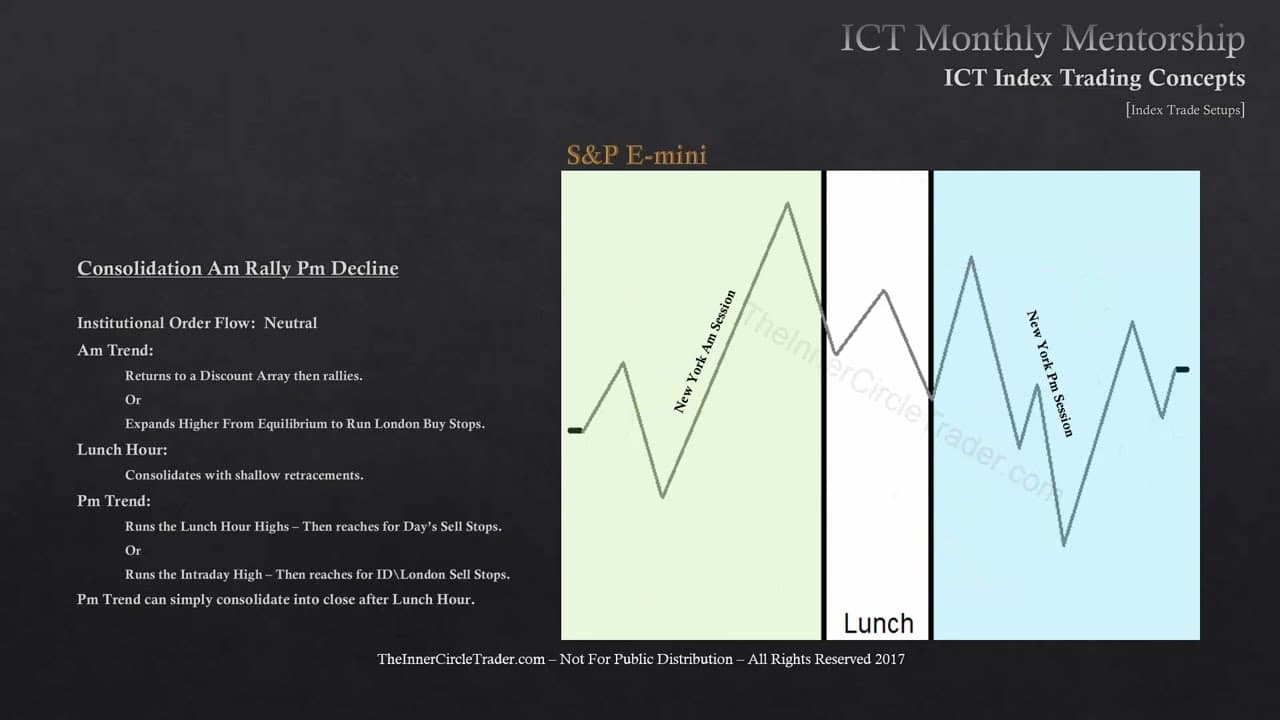
- The lunch hour often brings consolidation. Price can retrace below lunch lows or return to a fair value gap or order block formed inside the lunch hour before continuing the projected daily direction.
- AM and PM session highs or lows typically align with a 15-minute or 60-minute PD array; two-session up closes target premium arrays, while down closes target discount arrays.
- PM reversals require higher time frame confluence: a 15 or 60 minute premium or discount array must be nested with a daily or four-hour array to act as the catalyst for the afternoon reversal.
- Post-lunch price action is actively stalked from one o'clock New York time, hunting the e-mini S&P short-term high or low for a fair value or order block entry in the projected direction.
Install to Summarize YouTube Videos and Get Transcripts
Explore YouTube Video Summarizer or Get YouTube Transcript Extractor
Questions & Answers
Q: What is index SMT divergence and how is it used in ICT index trading?
Index SMT divergence compares the same price points across the three averages: the e-mini S&P, the Dow, and the NASDAQ. Traders compare the lows or highs formed from the London session into the 9:30 AM equities open. When one of the three indices fails to make a new low or new high while the others do, that divergence signals the trade. For example, if the NASDAQ fails to go lower, that supports the idea that the S&P should rally higher.
Q: Why should traders hold positions toward the close instead of taking early profits?
The daily range expands as price gets closer to the closing hour, so holding captures the maximum potential range that can fulfill in the daily candle. If you are long the e-mini S&P and see some handles of paper profit at two o'clock in the afternoon, the presenter advises against being aggressive about taking profit. Allowing time of day to deliver price to a higher level lends to a higher profit. Traders are told to hold at least until the 3 PM bond close, ideally into four o'clock.
Q: How does time of day factor into ICT index trade setups?
Time of day is central. The AM session usually expands and reaches into an expansion move, with traders holding for 10:30 to 11:00 in the morning, described as the London close in Forex. After 11 o'clock, consolidation or a retracement into the lunch hour is anticipated. In the PM session, traders rely on time again, aiming to hold until the 3 PM bond close and ideally into four o'clock to capture the maximum daily range.
Q: What happens during the lunch hour in these index setups?
During the lunch hour, price can move into consolidation. Traders look for a retracement back below the lows formed in lunch, or a return to a fair value gap or bullish order block seen inside the lunch hour at the lows. On the bearish side, price can return to a fair value gap, bearish order block, or closing of a liquidity void, or run the lunch high for buy stops and then reject. A short-term high or low always forms immediately after one o'clock New York time.
Q: What is a two-session up close profile in ICT index trading?
In a two-session up close, traders look for the AM trend to return down to a discount array and form index SMT divergence on the lows, comparing London session lows into the 9:30 AM open. Both the AM session and PM session PD arrays are premium arrays, either a 15-minute or 60-minute premium array. The PM session into the close can unfold in two stages, potentially falling short of the array, retracing, then ramping up in the last hour to reach the premium array.
Q: How do 15-minute and 60-minute PD arrays relate to these setups?
The AM and PM session highs and lows are most likely to line up with a 15-minute or 60-minute PD array. For a two-session up close, both sessions aim for a premium array; for a two-session down close, they aim for a discount array. In reversal setups, a 15 or 60 minute array alone is not a higher time frame, so traders look for it to be nested or overlapping with a daily or four-hour array to justify the reversal.
Q: What signals a PM session reversal in the AM rally PM reversal profile?
In the AM rally PM reversal profile, traders buy the e-mini S&P after index SMT divergence on the lows, holding until near or just past 11 o'clock. In the afternoon they look for a rally to sell into. The reversal is confirmed when the AM discount array is not a higher time frame array, prompting continuational downside. The PM high forms at a 15 to 60 minute premium array, and a higher time frame confluence with nested premium arrays acts as the catalyst for the reversal.
Q: How does the consolidation AM decline PM rally setup work?
In the consolidation AM decline PM rally profile, the market first attempts to rally into a premium array, where the indices diverge bearishly at the highs. Traders hold ideally around 10:30 to 11:00 AM New York time, then anticipate consolidation or a retracement higher into the lunch hour. They then look for SMT divergence at the lows across the NASDAQ, Dow, and e-mini futures, using time of day to support an upside expansion. If it is consolidation, an early short-term high forms rather than a move all the way into the close.
Summary & Key Takeaways
-
This lesson, the final June 2017 discussion on commodities and futures, presents ICT index trade setups as intentionally simplistic. Everything is framed as paper trading only, with the presenter reminding viewers he is not a licensed commodity trade advisor and directing attention to the disclaimer.
-
Setups rely on index SMT divergence: comparing lows or highs of the S&P, Dow, and NASDAQ from the London session into the 9:30 AM equities open. When one index fails to reach a new extreme, it signals a buy or sell in the e-mini S&P for the New York session.
-
Traders hold toward 10:30 to 11:00 AM and into the close, using time of day to maximize the daily range. Profiles covered include two-session up close, two-session down close, AM rally with PM reversal, AM decline with PM rally, and consolidation setups anchored to 15 and 60 minute PD arrays.
Read in Other Languages (beta)
Share This Summary 📚
Summarize YouTube Videos and Get Video Transcripts with 1-Click
Try YouTube Summary with ChatGPT & Claude or YouTube Transcript Generator
Explore More Summaries from The Inner Circle Trader 📚



Summarize YouTube Videos and Get Video Transcripts with 1-Click
Try YouTube Summary with ChatGPT & Claude or YouTube Transcript Generator