How to Synthesize 1-Octen-3-Ol to Attract Insects
TL;DR
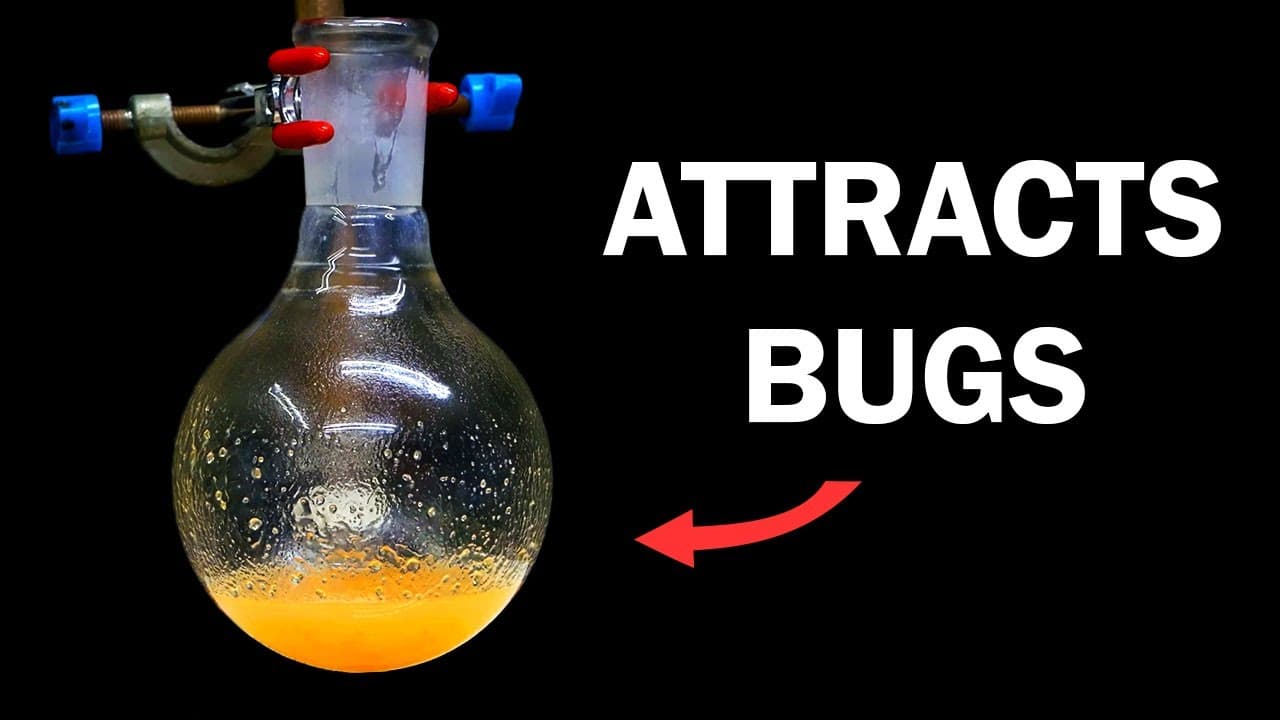
To synthesize 1-octen-3-ol, start with an aldol reaction using formaldehyde and 2-heptanone to produce 1-octen-3-one, then perform a Meerwin-Pondorff-Veerley (MPV) reduction with aluminum isopropoxide. This compound is attractive to biting insects and is naturally found in human sweat and breath. The process yields approximately 0.5 grams of product, with a crude yield of about 2%.
Transcript
Today we're finally making 1-octen-3-ol which is something I've been trying to make for a while now. It's sometimes used as an artificial mushroom flavor but what I find interesting is that it's a chemical attractive for biting insects. It's naturally present in both human sweat and breath and this is one major way for insects like mosquitoes to fi... Read More
Key Insights
- 😰 1-Octen-3-ol is a compound naturally present in human sweat and breath, and it serves as an attractant for biting insects.
- 🤣 The synthesis of 1-octen-3-ol involves an aldol reaction, which forms an intermediate compound, 1-octen-3-one, and a subsequent MPV reduction to convert it into 1-octen-3-ol.
- 🤩 Formaldehyde and 2-heptanone are key chemicals used in the aldol reaction, while aluminum isopropoxide serves as the catalyst in the MPV reduction.
- 😘 The yield of the synthesis process was low, resulting in only around 0.5 grams of product with a crude yield of approximately 2%.
- 🤣 It is possible to purchase 1-octen-3-ol from a perfume site rather than synthesizing it, making the synthesis process somewhat redundant.
Install to Summarize YouTube Videos and Get Transcripts
Explore YouTube Video Summarizer or Get YouTube Transcript Extractor
Questions & Answers
Q: What is 1-octen-3-ol used for?
1-octen-3-ol is commonly used as an artificial mushroom flavor and is naturally present in human sweat and breath. It acts as an attractant for biting insects, such as mosquitoes.
Q: Why did the initial method of synthesis fail?
The initial method using the acrolein-bromopentane route failed due to the polymerization of acrolein before it could be used. The video then introduces an alternate route involving an aldol reaction and MPV reduction.
Q: What are the chemicals used in the aldol reaction?
The chemicals used in the aldol reaction are formaldehyde and 2-heptanone, both purchased online. Formaldehyde is relatively inexpensive, while 2-heptanone is more expensive, costing $70.
Q: What is the purpose of the MPV reduction?
The MPV reduction is used to convert the intermediate compound, 1-octen-3-one, obtained from the aldol reaction, into the desired product, 1-octen-3-ol. The reduction involves the use of aluminum isopropoxide as a catalyst.
Summary & Key Takeaways
-
The video showcases the synthesis of 1-octen-3-ol, a compound found in human sweat and breath and attractive to biting insects.
-
The synthesis involves an aldol reaction and condensation, followed by a Meerwin-Pondorff-Veerley reduction.
-
Chemicals used include formaldehyde, 2-heptanone, sodium hydroxide, and aluminum isopropoxide.
Read in Other Languages (beta)
Share This Summary 📚
Summarize YouTube Videos and Get Video Transcripts with 1-Click
Try YouTube Summary with ChatGPT & Claude or YouTube Transcript Generator
Explore More Summaries from NileRed 📚
Summarize YouTube Videos and Get Video Transcripts with 1-Click
Try YouTube Summary with ChatGPT & Claude or YouTube Transcript Generator