How Can You Turn Paper into Plastic Using Cellulose?
TL;DR
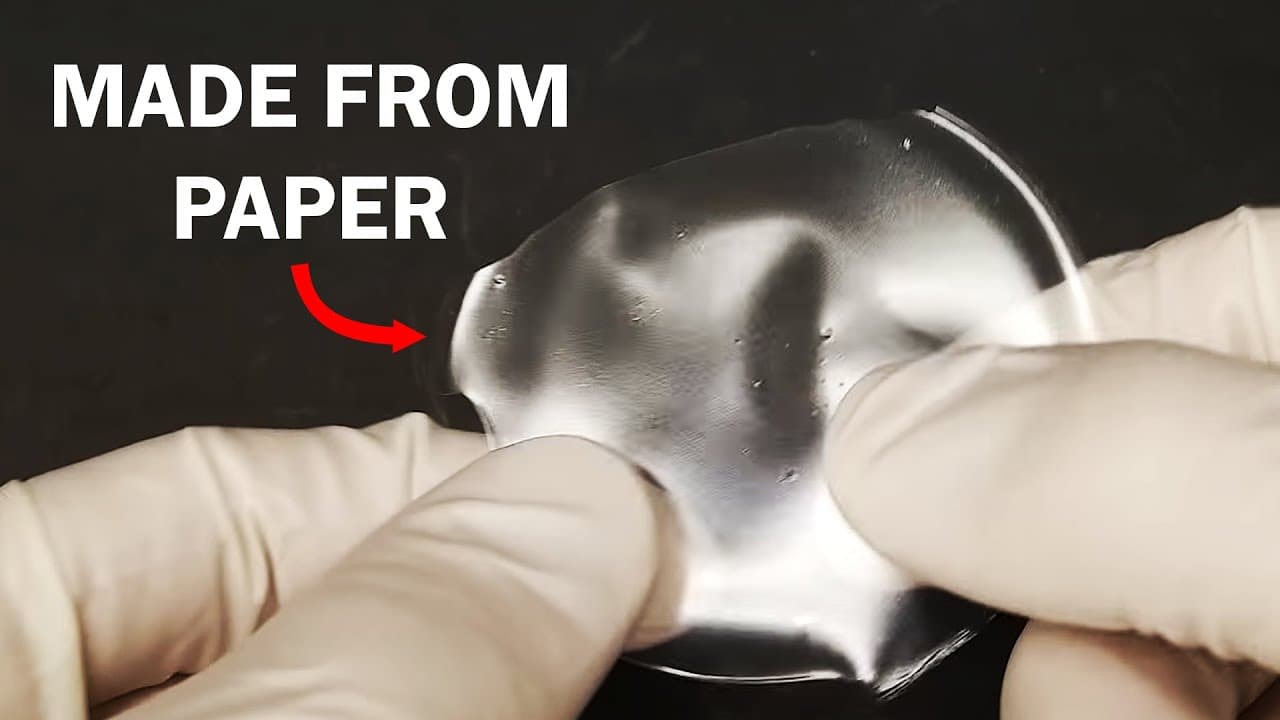
You can turn paper into plastic by chemically modifying cellulose to create cellulose acetate. This modified cellulose can be dissolved in organic solvents and used to make various plastic products, such as films and molded items. While cellulose acetate is less commonly used now, it still has niche applications in packaging and some consumer products.
Transcript
Paper's made of cellulose which is insoluble in water and most organic solvents. However, by chemically modifying it, It's possible to change its properties. A very common way of doing this is by acetylating the glucose subunits that make up cellulose. It's sometimes done completely to form cellulose triacetate, But it's more common to do it partia... Read More
Key Insights
- ❓ Cellulose can be modified to create cellulose acetate, which has different properties than unmodified cellulose.
- 💄 Cellulose acetate can be dissolved in organic solvents, making it versatile for various applications.
- 😒 Cellulose triacetate and cellulose diacetate are two forms of cellulose acetate, each with different uses.
- ❓ The quality and purity of cellulose acetate can be affected by impurities and the effectiveness of the acetylation process.
- 🫠 The process of melting and molding cellulose acetate can be challenging and requires precise temperature control.
- 🪜 Adding plasticizers, such as triacetin, can improve the flexibility and durability of cellulose acetate plastic.
- 😒 The use of cellulose acetate has been largely replaced by other polymers, but it still has limited applications in specific industries.
Install to Summarize YouTube Videos and Get Transcripts
Explore YouTube Video Summarizer or Get YouTube Transcript Extractor
Questions & Answers
Q: What is cellulose acetate, and how is it made?
Cellulose acetate is a synthetic cellulose derivative that can be dissolved in organic solvents. It is made by chemically modifying cellulose through acetylation, which involves adding acetyl groups to glucose subunits.
Q: What are some applications of cellulose triacetate?
Cellulose triacetate is commonly used for packaging, membrane filters, and photographic film due to its properties and solubility in acid mixtures.
Q: How is cellulose acetate dissolved and used to make plastic films?
Cellulose acetate can be dissolved in organic solvents, such as acetone. Once dissolved, it can be poured onto a surface and allowed to evaporate, leaving behind a plastic film.
Q: How can the brittleness of cellulose acetate be reduced?
The brittleness of cellulose acetate can be reduced by adding plasticizers, such as triacetin, which improve the flexibility and strength of the plastic.
Summary & Key Takeaways
-
Cellulose can be modified by acetylating glucose subunits to create cellulose acetate.
-
Cellulose acetate can be dissolved in organic solvents and used to make plastic films and other products.
-
Cellulose triacetate is used for packaging, membrane filters, and photographic film, while cellulose diacetate is used for toothbrushes, eyeglass frames, and cigarette filters.
Read in Other Languages (beta)
Share This Summary 📚
Summarize YouTube Videos and Get Video Transcripts with 1-Click
Try YouTube Summary with ChatGPT & Claude or YouTube Transcript Generator
Explore More Summaries from NileRed 📚
Summarize YouTube Videos and Get Video Transcripts with 1-Click
Try YouTube Summary with ChatGPT & Claude or YouTube Transcript Generator