How Are OpenAI Models Advancing Math and Coding?
TL;DR
OpenAI’s experimental models reportedly reached second place in the 2025 AtCoder World Tour Finals heuristic contest and gold-medal-level performance on the 2025 International Mathematical Olympiad problems. The results suggest that general-purpose reinforcement learning and increased test-time computation can support stronger coding, sustained reasoning, and natural-language proof generation, although the coding model’s identity was not confirmed.
Transcript
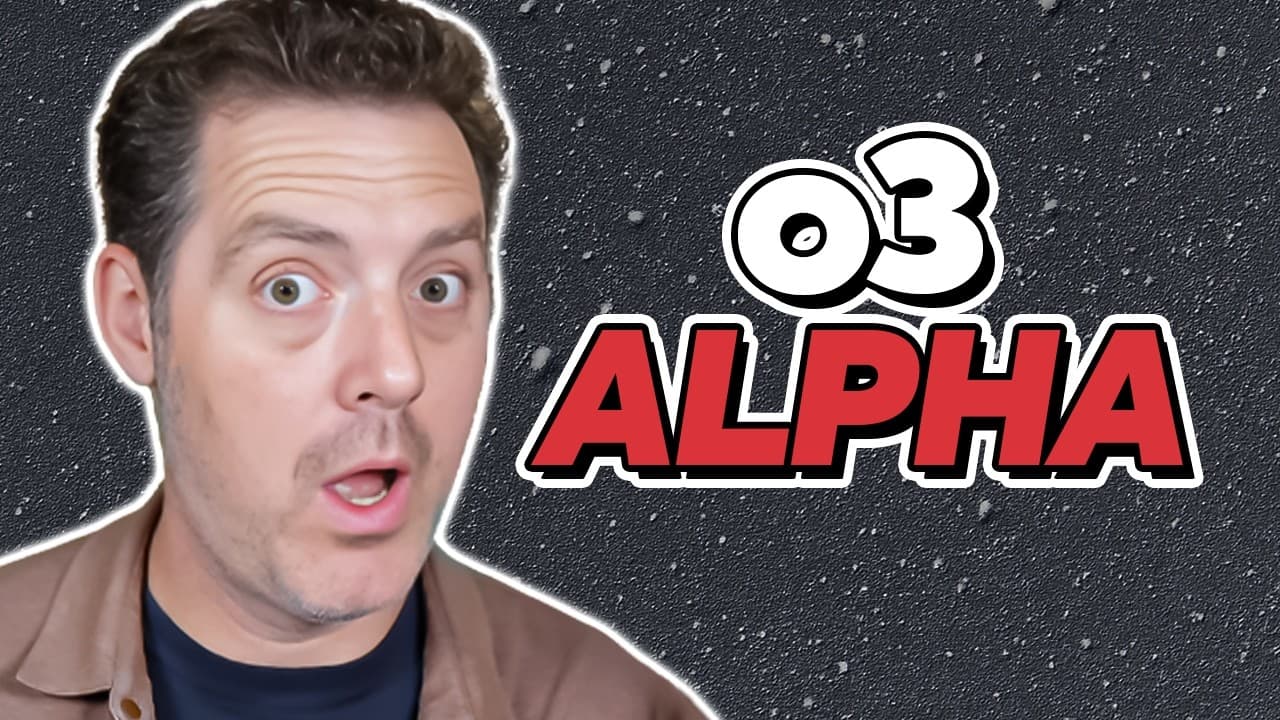
There is a new mystery model by OpenAI on LM Arena and apparently it is a new variant of 03 called 03 alpha and it might have just gotten second place in one of the hardest coding competitions in the world. Not only that, we have another experimental reasoning model from OpenAI that just got gold on the International Math Olympiads. This feels like... Read More
Key Insights
- The identity of o3 Alpha remains uncertain because the transcript only identifies an LM Arena entry named o3 Alpha Responses 2025 717 and attributes it to OpenAI. The suggestion that it powered OpenAI’s AtCoder entry is presented as speculation, not confirmation.
- The o3 Alpha demonstrations showed stronger visual polish than regular o3 in the presented comparison. Examples included Space Invaders with controls and settings, a space basketball game, a 3D Pokédex with a shiny-sprite option, and a dark Doom-like game with some clipping.
- OpenAI’s system finished second at the 2025 AtCoder World Tour Finals heuristic contest in Tokyo. FakePsyho, a Polish programmer and former OpenAI employee, won after a 10-hour coding marathon, while human competitors occupied first place and third place onward.
- The experimental mathematics model achieved gold-medal-level performance by solving five of six 2025 IMO problems. It worked during two 4.5-hour examination sessions without tools or internet, read the official problem statements, and produced natural-language proofs under the same stated rules as human contestants.
- IMO problems require sustained creative reasoning and multi-page proofs rather than answers that can be checked automatically. The transcript contrasts their roughly 100-minute human reasoning horizon with shorter benchmarks spanning approximately 0.1 minute, 1 minute, and 10 minutes for top human solvers.
- The mathematical proofs were evaluated by three former IMO medalists who independently graded each submission. Final scores were established only after unanimous consensus, providing a human review process for outputs that could not be verified as straightforwardly as program execution or numerical answers.
- OpenAI attributed the mathematics result to general-purpose reinforcement learning and increased test-time computation rather than a narrow, competition-specific method. The transcript connects this approach to the broader idea that scalable learning can outperform systems built primarily from human-authored rules and heuristics.
- The IMO gold model was described as an experimental research system distinct from GPT-5. OpenAI reportedly planned GPT-5 for release soon, while stating that it did not expect to release a system with the experimental model’s level of mathematical capability for several months.
Install to Summarize YouTube Videos and Get Transcripts
Explore YouTube Video Summarizer or Get YouTube Transcript Extractor
Questions & Answers
Q: What is OpenAI’s o3 Alpha mystery model?
o3 Alpha is presented as an unidentified OpenAI model available for testing through LM Arena, with the model entry listed as o3 Alpha Responses 2025 717. AI Battle reportedly characterized it as a new checkpoint of o3. The transcript does not confirm its exact architecture, release status, or relationship to OpenAI’s competition system, so claims connecting it to the AtCoder result remain speculative.
Q: How does o3 Alpha compare with the regular o3 model?
The presented side-by-side example suggests that o3 Alpha produced a more polished Space Invaders game than regular o3. Its generated interface included controls, scoring, a high score, levels, lives, pause functionality, sound options, and other settings. Additional demonstrations included space basketball, a 3D Pokédex, and a Doom-like game, although the Doom example showed some clipping and was visually dark.
Q: How did OpenAI perform at the 2025 AtCoder World Tour Finals?
An OpenAI model placed second in the 2025 AtCoder World Tour Finals heuristic contest in Tokyo. Greg Brockman’s updates indicated that OpenAI held first place during much of the event and temporarily regained the lead with one hour and 20 minutes remaining. FakePsyho ultimately moved well ahead and won, leaving the AI second and human competitors in first place and third place onward.
Q: Who defeated the OpenAI model in the coding competition?
FakePsyho, described as a Polish programmer and former OpenAI employee, defeated the OpenAI system during the AtCoder World Tour Finals heuristic contest. The competition involved a 10-hour coding marathon. According to the transcript, FakePsyho finished comfortably ahead of the AI and every other participant, while the OpenAI entry still achieved second place in the overall standings.
Q: How did OpenAI’s experimental model perform on the 2025 IMO?
OpenAI’s experimental reasoning model solved five of the six problems from the 2025 International Mathematical Olympiad and reached gold-medal-level performance. The evaluation used two 4.5-hour sessions, with no tools or internet access. The model received official problem statements and wrote natural-language proofs, following the same stated conditions used for a human contestant during the examination.
Q: How were the AI model’s IMO proofs evaluated?
Three former International Mathematical Olympiad medalists independently graded the model’s submitted proofs. The final scores were established after the graders reached unanimous consensus. This review process mattered because IMO submissions consist of detailed, multi-page mathematical arguments rather than outputs that can always be checked automatically through code execution or a single clearly verifiable numerical result.
Q: Why is gold-medal-level IMO performance significant for AI reasoning?
IMO problems demand sustained creative thinking over a much longer reasoning horizon than the earlier benchmarks described in the transcript. The comparison progresses from approximately 0.1 minute for GSM8K, to 1 minute for a math benchmark, 10 minutes for AIME, and 100 minutes for IMO problems. Success therefore indicates an ability to develop intricate natural-language arguments across extended reasoning tasks.
Q: What methods reportedly produced OpenAI’s IMO result?
OpenAI attributed the result to advances in general-purpose reinforcement learning and test-time compute scaling, not to a narrow method designed specifically for the competition. The transcript relates this strategy to the bitter lesson: scalable learning and computation can surpass systems that depend heavily on human-authored rules, as illustrated through its discussions of chess self-play and end-to-end neural networks for self-driving.
Summary & Key Takeaways
-
An unidentified OpenAI model listed on LM Arena as o3 Alpha Responses 2025 717 appeared substantially better than regular o3 in several zero-shot coding demonstrations. Its outputs included a polished Space Invaders game, a space basketball game, a 3D Pokédex, and a Doom-like game, although some visual clipping remained visible.
-
An OpenAI system placed second in the 2025 AtCoder World Tour Finals heuristic contest in Tokyo. Polish programmer FakePsyho won after a 10-hour coding marathon, while the AI finished ahead of the remaining human competitors. The transcript suggests, but does not establish, that the competing system may have been o3 Alpha.
-
A separate experimental OpenAI reasoning model solved five of six 2025 International Mathematical Olympiad problems under human-style examination rules. OpenAI attributed the performance to general-purpose reinforcement learning and test-time compute scaling. Three former IMO medalists independently graded its natural-language proofs and finalized the scores through unanimous consensus after reviewing the submitted solutions.
Read in Other Languages (beta)
Share This Summary 📚
Summarize YouTube Videos and Get Video Transcripts with 1-Click
Try YouTube Summary with ChatGPT & Claude or YouTube Transcript Generator
Explore More Summaries from Matthew Berman 📚





Summarize YouTube Videos and Get Video Transcripts with 1-Click
Try YouTube Summary with ChatGPT & Claude or YouTube Transcript Generator