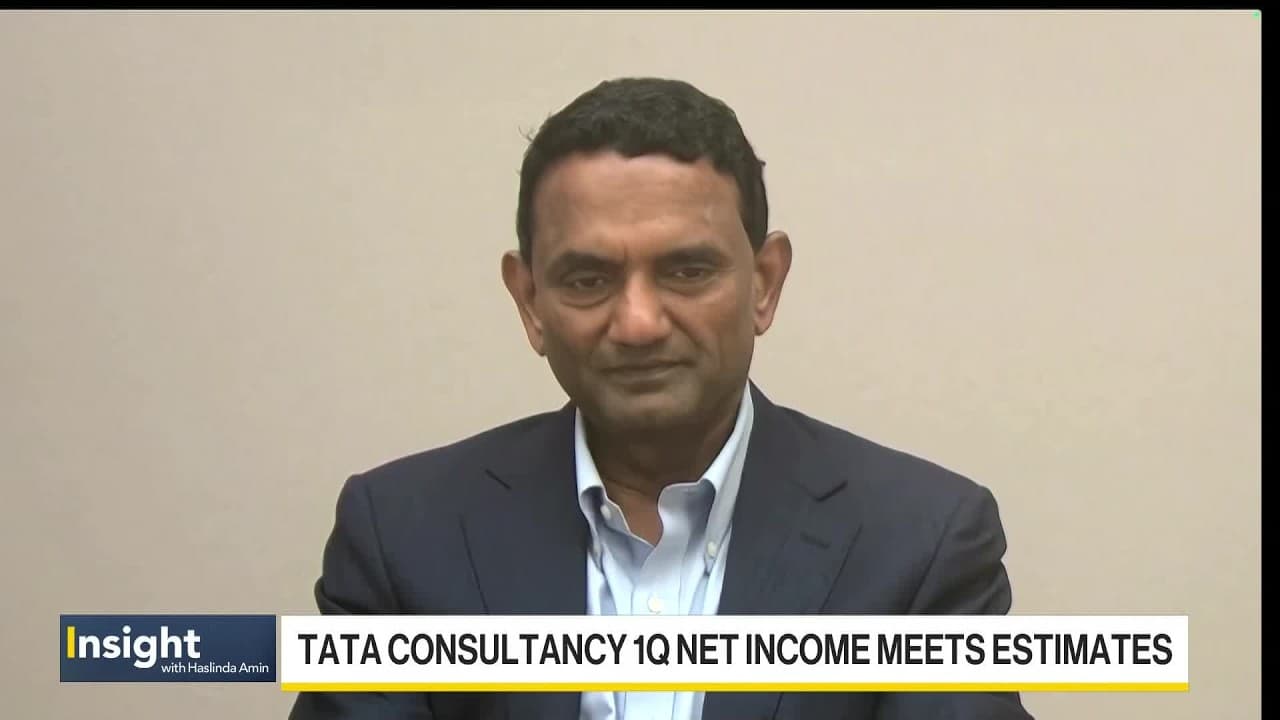
How will AI reach 20 percent of TCS revenue?
TL;DR
AI revenue at TCS is expected to rise significantly, with projections to reach around 20 percent of total revenue within four to six quarters. The company cites strong customer interest, an expanding AI portfolio across data, models, agents, and applications, and ongoing deflation managed through productivity gains and proactive pricing. The path relies on rapid contract wins and scalable solutions.
Transcript
When you take a look at the quarter numbers, it does seem like customers are still spending despite the challenging macro backdrop. What changed do you think in the last three months? Like, one, we found the banking and financial services industry really going ahead, and there were no no major headwinds in the banking industry, and that was quite h... Read More
Key Insights
- AI revenue is growing from 2.3 billion to 2.6 billion annually, indicating strong adoption by customers.
- The company expects AI to become a material part of revenue, potentially reaching 20 percent in a short time frame.
- TCS integrates data infrastructure, models, agents, applications, and physical automation to deliver end-to-end AI capabilities.
- The approach includes partnerships with frontier model providers and development of in-house small language models.
- AI adoption is tied to delivering real business value and reimagining the customer value chain, not just cost savings.
- Margins are being protected through productivity gains and potential pricing strategies despite AI investments.
- There is a clear emphasis on not relying on a single AI vendor but building multi-provider ecosystems.
- Workforce impact is seen as job reallocation rather than straightforward headcount reduction, with new roles in model life cycle and governance.
- More videos from this channel:
- More from this channel: Bloomberg Television
Install to Summarize YouTube Videos and Get Transcripts
Explore YouTube Video Summarizer or Get YouTube Transcript Extractor
Questions & Answers
Q: What is the projected AI revenue share of TCS, and by when could it reach that level?
The company says AI revenue is growing and could reach around 20 percent of total revenue within four to six quarters. This projection reflects the accelerating adoption by customers and the rapid expansion of AI-led initiatives across multiple layers of the business. The timeline frames a fast buildup rather than a slow, incremental increase.
Q: How does TCS describe the nature of its AI revenue—recurring or one-off?
TCS states that the AI revenue is not annuity revenue but rather revenue that can be realized over a few quarters and needs constant refreshing through new contracts. This means the growth relies on ongoing wins and renewals, ensuring that AI-generated revenue remains a dynamic part of the annual topline rather than a fixed, long-term contract.
Q: What five layers are included in TCS’s AI strategy, and why are they important?
TCS outlines five layers: data infrastructure, models, agents, applications, and the experience layer. This end-to-end framework ensures that from data preparation to user experience, every step leverages AI. By addressing each layer, TCS can offer comprehensive solutions that integrate secure data, capable models, autonomous agents, useful applications, and a polished user experience.
Q: What role do partnerships with frontier model providers play in TCS’s AI plan?
Partnerships with frontier model providers are central to TCS’s model layer strategy. These collaborations enable access to advanced models, while TCS also develops its own small language models. The goal is to offer flexible solutions that can combine external frontier models with in-house capabilities, ensuring broad compatibility and scalability for clients.
Q: How does TCS view the impact of AI on jobs and headcount?
Kriti Krithivasan and Menaka Doshi discuss that AI will both replace some tasks and create new roles in model life cycle governance, fine tuning, and deployment. They estimate that agents will proliferate but emphasize that headcount may not rise linearly, as productivity gains and new AI-enabled workflows can reduce the need for incremental hires while increasing output.
Q: What does internal productivity and deflation mean for TCS’s AI pricing and margins?
TCS reports productivity-led top-line deflation of about 10 to 15 percent, which it offsets through productivity gains and proactive pricing strategies. They have managed to hold margins despite wage hikes, and ongoing AI-driven efficiencies are expected to help protect profitability while expanding AI-related revenue.
Q: What is the status of Hyperwall and hyperscaler partnerships in TCS’s AI roadmap?
TCS is in advanced talks with a couple of hyperscalers, with a definitive announcement expected in the second quarter and groundwork starting in the same period. These partnerships are intended to strengthen data and compute capabilities for AI delivery, enabling scalable, enterprise-grade solutions across many clients.
Q: Why does TCS prefer not to rely on a single small language model provider?
TCS argues for a multi-provider ecosystem, building its own small language models while remaining open to external options. The rationale is that customers will use many models across different tasks and industries, so a diverse set of tools and in-house capabilities offers greater flexibility, control, and resilience in delivering AI solutions.
Summary & Key Takeaways
-
TCS projects AI contributing about 20 percent of revenue within four to six quarters, driven by rapid contract wins and scalable AI offerings.
-
The AI strategy covers five layers from data infrastructure to physical automation, with partnerships and internal models supporting rapid deployment.
-
Deflation and margin protection are addressed through productivity gains and proactive customer engagement to offset AI investment costs.
Read in Other Languages (beta)
Share This Summary 📚
Summarize YouTube Videos and Get Video Transcripts with 1-Click
Try YouTube Summary with ChatGPT & Claude or YouTube Transcript Generator
Explore More Summaries from Bloomberg Television 📚






Summarize YouTube Videos and Get Video Transcripts with 1-Click
Try YouTube Summary with ChatGPT & Claude or YouTube Transcript Generator