How Does Chemical Strengthening Make Glass Tougher?
TL;DR
Chemical strengthening enhances glass toughness by replacing sodium atoms with larger potassium atoms, creating internal compression. This compression mitigates tension caused by microscopic defects, which are the primary cause of glass breakage. The process involves heating glass in potassium salt at about 425-450°C to induce this strength improvement.
Transcript
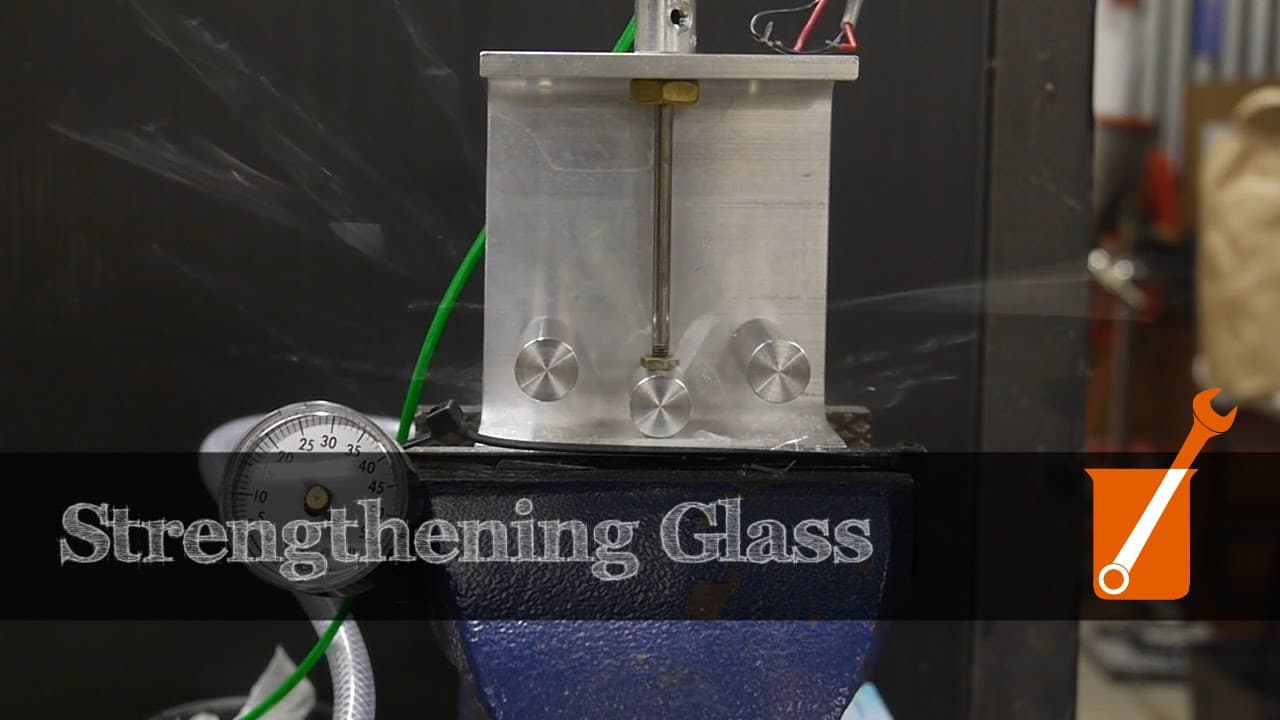
today on Applied Science I want to talk about glass why it breaks and how we can strengthen it with a chemical process so to get started let me show you this rig that I built to test the strength of these glass samples here we have a rigid aluminum frame with two fixed aluminum bars on the bottom and a pneumatic cylinder on the top and the cylinder... Read More
Key Insights
- 😎 Glass breaks due to tension caused by microscopic defects, not compression.
- 😎 Chemical process involving potassium strengthens glass by inducing compression in the material.
- 😎 Strength of glass depends on the size and number of defects present throughout the material.
- 😎 Potassium replaces sodium atoms in glass to create compression and increase its strength.
- ❓ Gorilla Glass includes a unique blend of ingredients for chemical strengthening, not just potassium replacement.
- 😎 Compression added to the edges of glass helps offset tension during bending scenarios.
- 🥵 Chemical strengthening process involves submerging glass in potassium salt and heating it to around 425-450 degrees Celsius.
Install to Summarize YouTube Videos and Get Transcripts
Explore YouTube Video Summarizer or Get YouTube Transcript Extractor
Questions & Answers
Q: How does tension in glass lead to its breakage?
Tension in glass causes microscopic defects to propagate into fractures when the material is bent, as the defects are being pulled apart by the tension forces.
Q: How does the chemical process involving potassium strengthen glass?
By replacing sodium atoms with larger potassium atoms, the glass is put under compression, reducing tension forces and making the material stronger and less prone to breakage.
Q: Why can't glass be made defect-free to enhance its strength?
Glass inherently contains microscopic defects that cannot be entirely eliminated, determining its strength, as any added defect can propagate into fractures due to tension forces during bending.
Q: What is the significance of compression in strengthening glass?
Compression in glass helps to close cracks and defects, preventing them from propagating under tension, thereby increasing the material's resilience to breakage.
Summary & Key Takeaways
-
Testing the strength of glass samples through a rig designed to apply pressure until the glass breaks.
-
Glass breaks due to microscopic defects causing tension, which leads to fractures.
-
Chemical process involving potassium atoms replaces sodium atoms in glass, putting it under compression to strengthen it.
Read in Other Languages (beta)
Share This Summary 📚
Summarize YouTube Videos and Get Video Transcripts with 1-Click
Try YouTube Summary with ChatGPT & Claude or YouTube Transcript Generator
Explore More Summaries from Applied Science 📚






Summarize YouTube Videos and Get Video Transcripts with 1-Click
Try YouTube Summary with ChatGPT & Claude or YouTube Transcript Generator