How Did a Forbidden Elevation Trick Kill Panther Tanks?
TL;DR
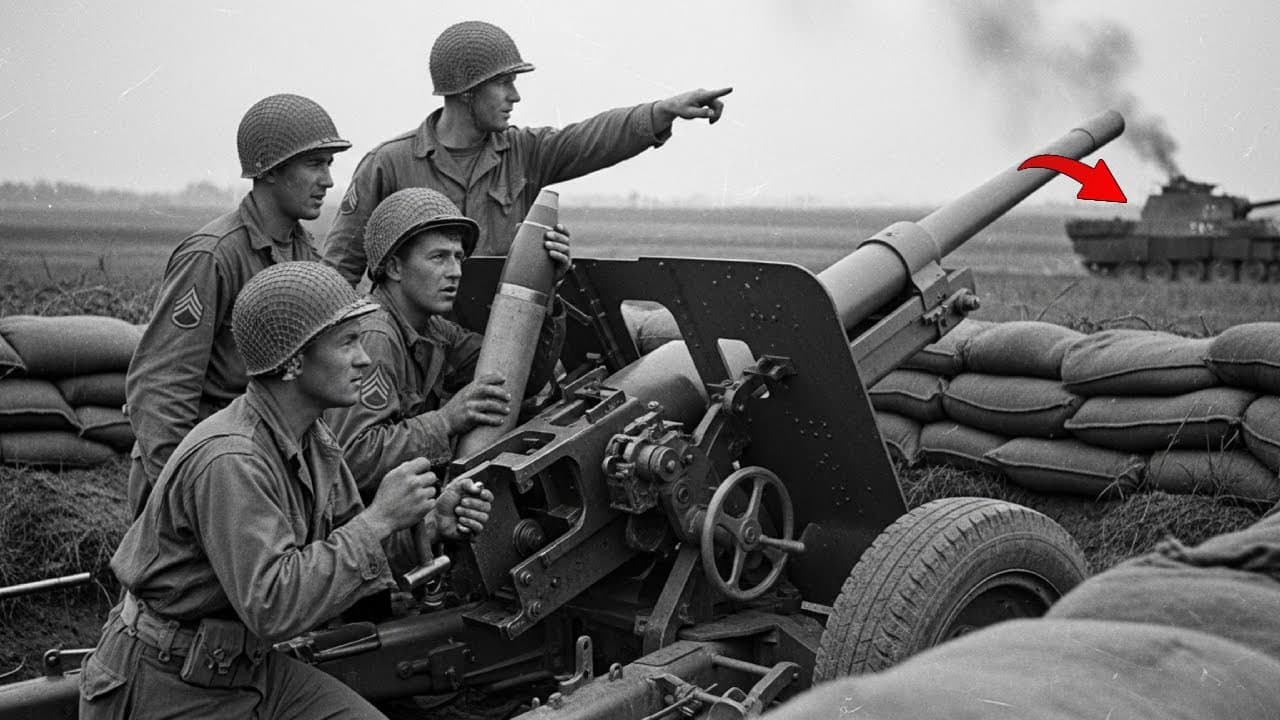
Elevating a 3-inch M5 anti-tank gun to 32 degrees, more than double the approved 15-degree maximum, let Corporal Thomas Bennett drop armor-piercing shells onto a Panther's thin 40mm top armor instead of bouncing off its 80mm sloped frontal plate. Near Saint-Lo on September 19, 1944, this let crews kill Panthers from a distance without taking return fire.
Transcript
At 1423 on September 19th, 1944, Corporal Thomas Bennett crouched behind his M5 3-in anti-tank gun in a hedro near St. Low, France, watching five German Panther tanks advance across an open field at 800 yd. His hands were shaking. The gun crew had been in position for 6 hours. They'd watched the panzers maneuver all morning, waited for them to get ... Read More
Key Insights
- The German Panther's frontal armor was 80mm sloped at 55 degrees, nearly twice a Sherman's thickness. The slope deflected shells and absorbed impact, making it nearly impenetrable from the front except at close range under 500 yards.
- The M5 3-inch anti-tank gun could penetrate 3 inches of armor at 1,000 yards, but only within its designed firing envelope: a depression angle of -5 degrees or an elevation of no more than 15 degrees per the gunnery manuals.
- The tactical math against Panthers was brutal: to penetrate frontal armor a crew had to let the tank close to killing range, where the Panther's 75mm gun and excellent optics would usually destroy the American position with one shot within about 8 seconds of seeing a muzzle flash.
- Bennett's solution was to elevate the gun to 32 degrees and fire a high trajectory so the shell dropped onto the Panther's top armor, which was only 40mm thick, letting a 3-inch armor-piercing shell punch through easily.
- The risk of the 32-degree elevation was enormous recoil forces that could snap recoil springs, crack the mount, or damage the traverse mechanism, potentially turning a functional gun into scrap after only a few shots.
- Bennett's terrain made standard doctrine impossible: his gun sat 12 feet above the field while the Panthers moved through a depression another 8 feet below field level, a 20-foot vertical difference the manual's 15-degree limit never addressed.
- The approved 'shoot and scoot' doctrine failed in practice because moving a 3,000-pound gun took 2 to 3 minutes, during which Panthers could close 300 yards and fire 6 to 8 rounds. Bennett's tight hedgerow position offered no escape route.
- By late September, after three other crews copied the technique, American kill ratios against Panthers reversed from two-to-one losses toward nearly even, saving an estimated 40 to 60 crew lives before the Army acknowledged it in a December bulletin.
Install to Summarize YouTube Videos and Get Transcripts
Explore YouTube Video Summarizer or Get YouTube Transcript Extractor
Questions & Answers
Q: What was the forbidden elevation trick used against Panther tanks?
The trick was elevating the M5 3-inch anti-tank gun to 32 degrees, more than double its approved maximum elevation of 15 degrees. Instead of firing a flat trajectory at the Panther's thick frontal armor, this high angle sent the armor-piercing shell up and dropped it onto the tank's top armor, which was only 40mm thick. A 3-inch shell coming down at a steep angle could punch through this thin top plate easily, letting crews destroy Panthers without exposing themselves to close-range return fire.
Q: Why was the Panther tank so hard for American anti-tank crews to destroy?
The Panther's frontal armor was 80mm thick and sloped at 55 degrees, nearly twice as thick as a Sherman's. The slope caused shells to hit at an angle and deflect, and even when penetrated it absorbed much of the impact. American 3-inch guns could defeat it only at close range, usually under 500 yards, but at that distance the Panther's accurate 75mm gun and excellent optics could destroy the American position with one shot, giving crews perhaps 8 seconds after their muzzle flash was seen.
Q: What were the approved firing angles for the M5 anti-tank gun?
The M5 was designed to fire at a depression angle of -5 degrees or an elevation angle of no more than 15 degrees, the parameters specified in every gunnery manual. Firing outside those angles risked damaging the recoil mechanism, possibly destroying the gun, and voided any maintenance warranty. The 15-degree maximum was designed for shooting targets on level ground, hills, or slightly elevated positions, covering most combat situations but not Bennett's terrain.
Q: What risks came with elevating the gun to 32 degrees?
At 32 degrees, more than double the approved maximum, the recoil forces were enormous. The gun might survive one shot or three, but eventually something would break: the recoil springs could snap, the mount could crack, or the traverse mechanism could fail. If that happened, the crew would be left defenseless with five Panther tanks bearing down on them, since their tight hedgerow position had no escape route and would take 15 minutes to extract from.
Q: Why did the standard 'shoot and scoot' doctrine fail against Panthers?
Shoot and scoot called for firing one or two rounds then relocating before the enemy returned fire. In practice, moving a 3,000-pound anti-tank gun under fire was nearly impossible. The gun had to be hitched to a vehicle, loaded, and driven away, taking 2 to 3 minutes. In that time Panthers could close 300 yards and fire 6 to 8 rounds. The tactic only worked with space to maneuver and time to escape, which Bennett's tight hedgerow position near Saint-Lo did not have.
Q: How did the terrain create Bennett's firing problem?
Bennett's gun was dug into a hedgerow elevated 12 feet above the field, while the Panthers advanced through a shallow depression another 8 feet below field level. This 20-foot vertical difference created a firing problem the manual did not address. To hit the tanks using approved angles, Bennett would have to wait until they climbed out of the depression to within about 300 yards, where they could spot his muzzle flash and destroy his gun before he could fire effectively.
Q: How many losses had Panthers inflicted on Bennett's unit before this engagement?
Bennett's battalion started the Normandy campaign with 18 anti-tank guns and was down to 11 by mid-September, having lost 7 guns destroyed, 23 crewmen killed, and 16 wounded. In North Africa his battalion had lost 14 anti-tank guns in 3 weeks fighting Panthers and Tigers, most destroyed after firing their first or second shot. He had personally watched crews following textbook doctrine die, including his friend Corporal Mike Stevens and a crew near Mortain.
Q: What impact did the elevation technique have on the war?
The technique spread unofficially through anti-tank battalions gunner to gunner. By the end of September, when three other gun crews had copied it, American kill ratios against Panthers reversed from two-to-one losses to nearly even, and crews survived. It saved an estimated 40 to 60 crew lives and accounted for 60 to 80 Panther losses before the Army quietly acknowledged the method in a December bulletin. The principles discovered at Saint-Lo changed how American crews engaged German armor.
Summary & Key Takeaways
-
On September 19, 1944, near Saint-Lo, Corporal Thomas Bennett faced five German Panther tanks advancing at 800 yards. His M5 gun sat 12 feet above a field, while the Panthers moved through a depression, creating a firing problem the standard 15-degree elevation limit could not solve without waiting until the enemy was too close.
-
The Panther's 80mm frontal armor sloped at 55 degrees was nearly impenetrable except under 500 yards, where its accurate 75mm gun would usually destroy the American position first. Bennett had watched crews die following textbook doctrine; his battalion fell from 18 anti-tank guns to 11 by mid-September, losing 7 guns and 23 crewmen killed.
-
Bennett elevated the gun to 32 degrees, double the approved maximum, to drop shells onto the Panther's 40mm top armor. Despite Lieutenant Walsh insisting they follow procedure, the technique spread gunner to gunner, accounting for 60 to 80 Panther losses and saving dozens of lives before the Army quietly acknowledged it in December.
Read in Other Languages (beta)
Share This Summary 📚
Summarize YouTube Videos and Get Video Transcripts with 1-Click
Try YouTube Summary with ChatGPT & Claude or YouTube Transcript Generator
Explore More Summaries from WW2 Records 📚
Summarize YouTube Videos and Get Video Transcripts with 1-Click
Try YouTube Summary with ChatGPT & Claude or YouTube Transcript Generator