How to Create AI That Writes Shakespearean Text
TL;DR
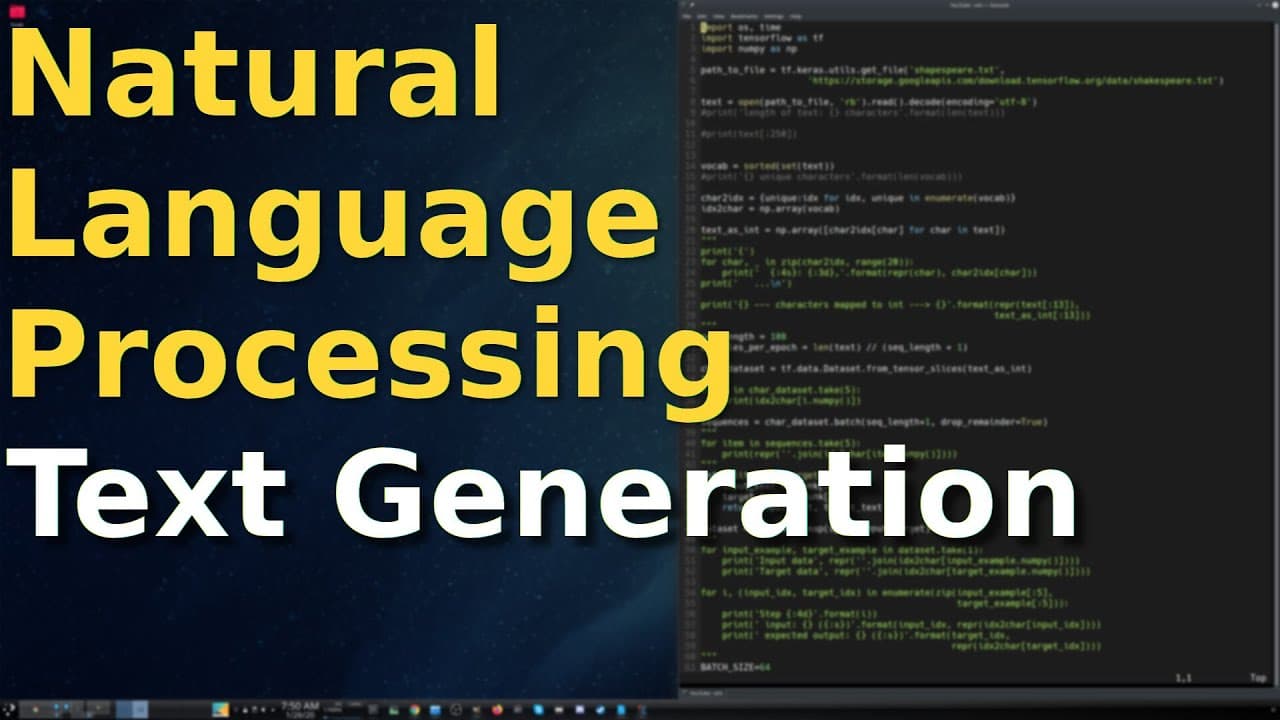
To create an AI that writes Shakespearean text, use TensorFlow to build a model that processes character data by converting it to integer representations. After training the model with sequences of text, it can generate new sentences that mimic Shakespearean prose, showcasing its ability to understand and approximate the language style.
Transcript
where he sees your head my lovely we sleep her with my hate or for me think that we give his cruel he cries said your honor's ear I shall grow moss no I haven't just had a stroke don't call 9-1-1 I've just written a basic artificial intelligence to generate Shakespearean text now we get to finally address the question which is better writing Shakes... Read More
Key Insights
- 🔠 Converting characters to their integer representation is necessary for input to the model.
- 😒 The model uses a gated recurrent unit (GRU) to process the text data.
- 🚂 Training the model over multiple epochs improves its ability to predict the next characters in a sequence.
- 🛀 The generated text shows the model's ability to approximate Shakespearean language, although some outputs may be nonsensical.
Install to Summarize YouTube Videos and Get Transcripts
Explore YouTube Video Summarizer or Get YouTube Transcript Extractor
Questions & Answers
Q: What is the purpose of converting characters to their integer representation?
Converting characters to integers allows the model to process the text data more efficiently, as neural networks work better with numerical data.
Q: How does the model handle predicting the next characters in the sequence?
The model is trained to take a sequence of characters as input and predict the most likely next characters in the sequence based on the patterns it has learned from the Shakespearean text.
Q: What is the significance of the temperature parameter in generating text?
The temperature parameter controls the randomness of the generated text. A lower temperature value results in more predictable and coherent text, while a higher temperature value produces more random and varied text.
Q: Can this model generate text from any Shakespearean play?
The model can generate text based on the training data it was provided, which is a text file containing a Shakespearean sonnet. So, it can only generate text similar to the style and content of that particular sonnet.
Summary & Key Takeaways
-
The tutorial starts by importing necessary libraries and downloading a text file containing Shakespearean sonnets.
-
The text is then processed by converting characters to their integer representation for input into the model.
-
The data is split into sequences, and a model is built using a gated recurrent unit (GRU).
-
The model is trained using the text data, and the loss decreases over 25 epochs.
-
Finally, a function is created to generate Shakespearean text using the trained model.
Read in Other Languages (beta)
Share This Summary 📚
Summarize YouTube Videos and Get Video Transcripts with 1-Click
Try YouTube Summary with ChatGPT & Claude or YouTube Transcript Generator
Explore More Summaries from Machine Learning with Phil 📚


Summarize YouTube Videos and Get Video Transcripts with 1-Click
Try YouTube Summary with ChatGPT & Claude or YouTube Transcript Generator