How to reduce anxiety with mindful attention training
TL;DR
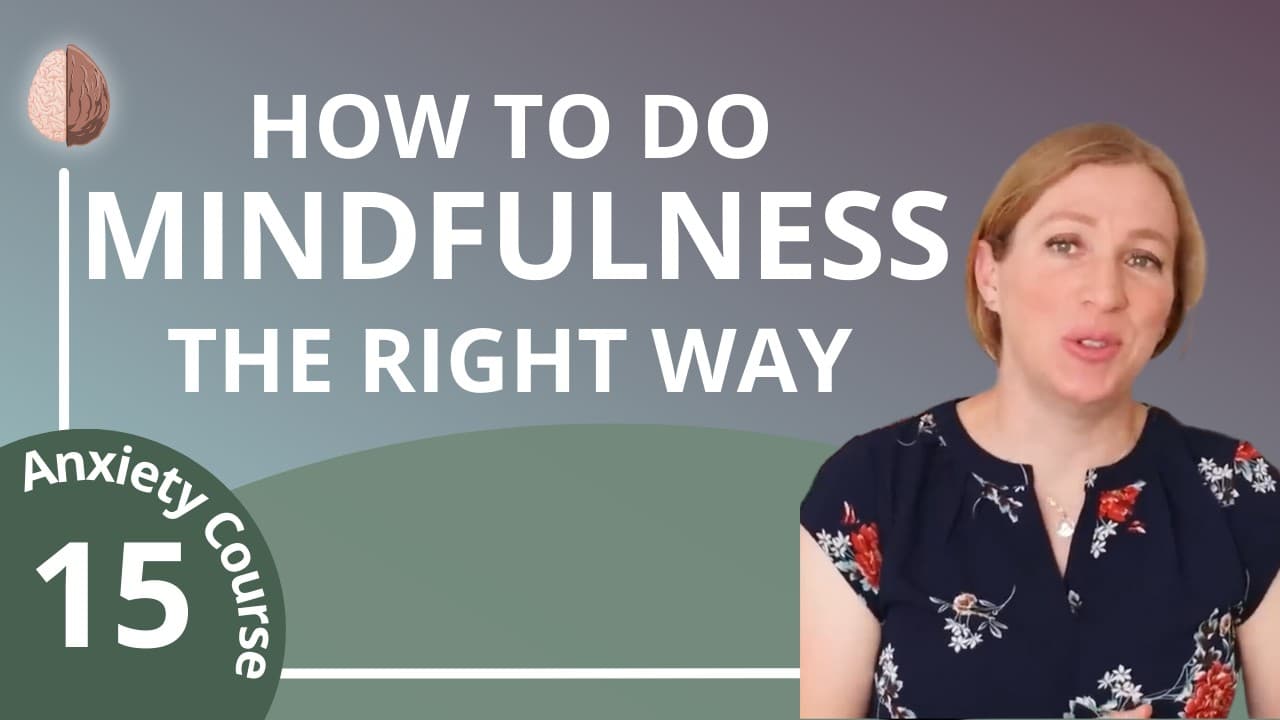
Mindfulness is an exercise for attention control, not a quick coping fix. Resisting worrisome thoughts often makes them stronger, so the practice shifts focus rather than eliminates thoughts. By training attention through mindful exercises, you gradually reduce anxiety and stay connected to what matters in the present moment.
Transcript
Okay. So you want to stop overthinking, or you want to stop worrying so much. You really want to stop being anxious all the time, but when someone tells you, "Stop worrying," it's super annoying because if you could just turn it off, you would. It's just not that easy. Now, in the last four videos we've talked about four cognitive skills that c... Read More
Key Insights
- Worry tends to persist when people try to suppress or avoid it, because the more you resist a thought, the more your brain flags it as important and keeps attention on it.
- Attention control is the practical target for anxiety reduction, because you can choose where to focus despite not being able to veto every thought.
- Mindfulness should be framed as an ongoing exercise, not a coping quick fix, to build long term resilience against worry and anxiety.
- Thoughts are not easily controlled, but attention can be redirected, making it possible to interrupt rumination and reduce the frequency of anxious cycles.
- The White Bear Experiment illustrates that effortful avoidance of a thought increases its prominence, teaching the importance of letting thoughts come and go without elaboration.
- Regular mindfulness practice leads to brain changes associated with attention regulation, supporting its use as a long term tool for anxiety management.
- The speaker differentiates between using mindfulness to feel less anxious in the moment and using it to strengthen the system so anxiety is less likely to arise in daily life.
- A practical mindfulness approach involves simple, non judgmental breath focus and deliberate redirection of attention when worries arise, reinforcing the habit of choosing where to concentrate.
Install to Summarize YouTube Videos and Get Transcripts
Explore YouTube Video Summarizer or Get YouTube Transcript Extractor
Questions & Answers
Q: What is the main reason resisting worry makes it worse
Resisting worry signals danger to the brain, increasing alertness and attention to the worry. This counterintuitive effect makes thoughts you are trying to avoid more prominent, perpetuating a loop of rumination. By recognizing this, you can shift to attention training to reduce the urgency and frequency of worrying thoughts over time.
Q: What is the key difference between thought control and attention control
Thought control aims to block or suppress thoughts, which often backfires by increasing focus on the thought. Attention control, by contrast, means choosing where to place your focus. You may still have a worry present in your mind, but you deliberately redirect your attention toward more constructive or neutral tasks.
Q: How should mindfulness be viewed according to the video
Mindfulness should be viewed as an exercise, not a quick coping strategy. Its purpose is to strengthen attention and build resilience so that when worry arises you are better able to respond calmly. This reframing helps prevent reliance on mindfulness as a Band Aid for short term relief.
Q: What does the White Bear Experiment illustrate about thinking
The White Bear Experiment shows that people who try not to think about a white bear tend to experience more intrusive thoughts about it. This demonstrates that avoidance increases cognitive load and the frequency of unwanted thoughts, highlighting why mindful attention training focuses on changing where you direct focus rather than suppressing thoughts.
Q: How can someone begin a basic mindfulness practice
Start with a simple, nonjudgmental practice focusing on breath and the present moment. When a worry arises, acknowledge it without elaboration and gently redirect attention to a neutral task or sensation. Regular repetition strengthens attentional control and reduces automatic reliance on worry during daily life.
Q: What role does attention play in changing brain function
Attention acts as a controllable focus that can be trained like a muscle. Regularly directing attention away from worry allows neural networks related to executive control to strengthen, which can alter brain function and improve the ability to manage anxious thoughts over time.
Q: Why is mindfulness not just for when you are anxious
Mindfulness is more effective as an ongoing exercise than a reaction to anxiety. By practicing in calm moments, you build the capacity to handle future stress without spiraling, making anxiety less likely to escalate when difficult situations occur.
Q: What practical tip helps with shifting attention during worry
Treat attention as a spotlight you can move. When a worry appears, acknowledge it briefly, decide not to engage with it, and deliberately shift your focus to something productive or neutral. This repeated shift strengthens attentional control and reduces the power of the worry over time.
Summary & Key Takeaways
-
Mindfulness is presented as a regular training exercise that strengthens attention control rather than a Band-Aid for anxious feelings. It emphasizes that resisting thoughts can backfire and that shifting attention is the core skill to reduce anxiety.
-
The discussion contrasts thought control with attention control, explaining that you cannot directly stop thoughts but can guide where you place your focus to prevent rumination and escalation of worry.
-
The interview frames the White Bear Experiment as a demonstration of how avoidance increases cognitive load and how mindful practice can retrain the brain to respond more adaptively to worry and anxious thoughts.
Read in Other Languages (beta)
Share This Summary 📚
Summarize YouTube Videos and Get Video Transcripts with 1-Click
Try YouTube Summary with ChatGPT & Claude or YouTube Transcript Generator
Explore More Summaries from Therapy in a Nutshell 📚



Summarize YouTube Videos and Get Video Transcripts with 1-Click
Try YouTube Summary with ChatGPT & Claude or YouTube Transcript Generator