What Are the 6 Hook Formats for Viral Content?
TL;DR
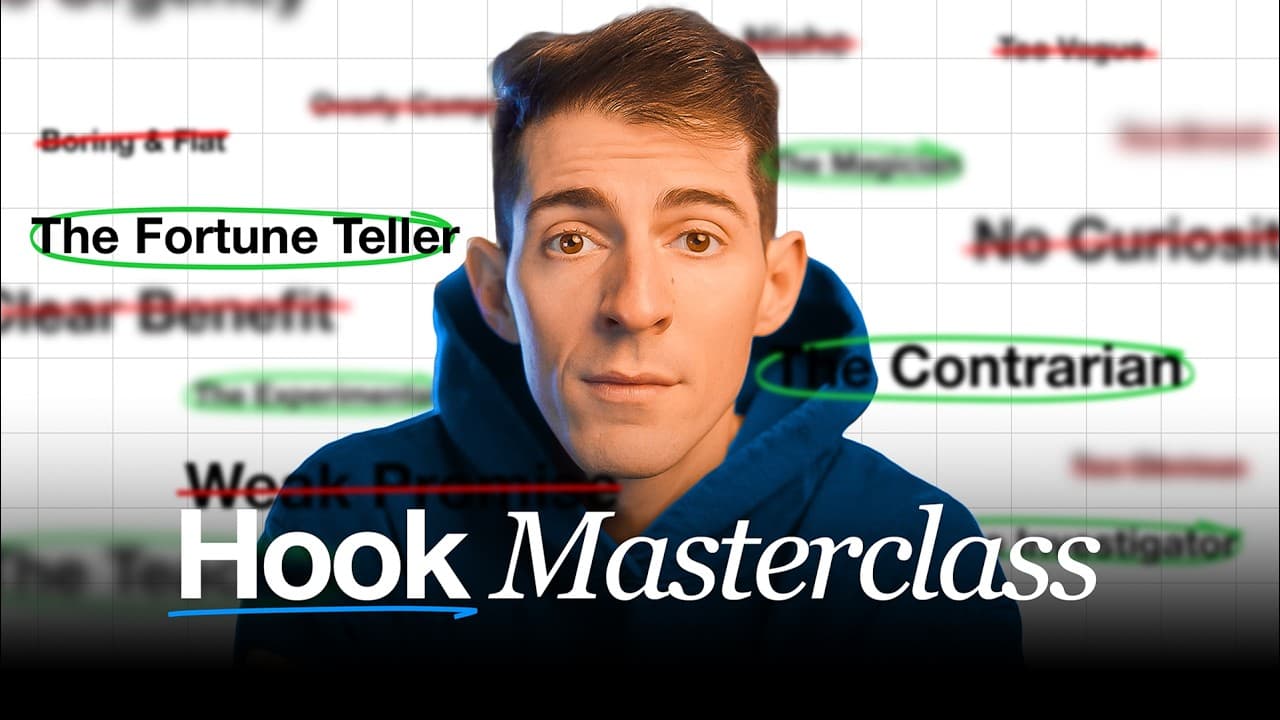
The six hook formats for creating viral content are Fortune Teller, Experimenter, Teacher, Magician, Investigator, and Contrarian. Each format is designed to generate curiosity and engage viewers by establishing contrast and compelling narratives within the first few seconds. Mastering these hooks and their alignment with visual and audio elements is key to maximizing viewer engagement.
Transcript
the biggest difference between winning and losing on social media is the hook this is the 8020 of video if you want your videos to perform better you need to focus on leveling up your hooks now I've studied thousands of videos and it turns out all of the best performers only use six different hook formats if you know these six you're set so in this... Read More
Key Insights
- The key to social media success is mastering the 'hook,' which captures viewers' attention in the first few seconds.
- Six hook formats are crucial: Fortune Teller, Experimenter, Teacher, Magician, Investigator, and Contrarian.
- The Fortune Teller hook contrasts the present with a future scenario, leveraging human curiosity about future changes.
- The Experimenter hook uses demonstrations or experiments to showcase a new method or tool, often in a peer-to-peer format.
- The Teacher hook involves explaining a new method or lesson, positioning the creator as an authority on the topic.
- The Magician hook uses visual or auditory elements to capture attention, often acting as a precursor to other hooks.
- The Investigator hook reveals unknown secrets or findings, creating contrast by sharing new information with the audience.
- The Contrarian hook directly challenges conventional wisdom, offering a unique perspective that stands out.
Install to Summarize YouTube Videos and Get Transcripts
Explore YouTube Video Summarizer or Get YouTube Transcript Extractor
Questions & Answers
Q: What is the main purpose of a hook in a video?
The main purpose of a hook in a video is to capture the viewer's attention within the first few seconds, creating a 'curiosity loop' that compels them to continue watching. Hooks are designed to create contrast and intrigue, making the content irresistible to viewers.
Q: How does the Fortune Teller hook format work?
The Fortune Teller hook format contrasts the present with a future scenario, playing on viewers' natural curiosity about future changes. By presenting a scenario where the future is different from the current reality, it creates intrigue and encourages the viewer to continue watching to learn more about the potential change.
Q: What differentiates the Experimenter hook from the Teacher hook?
The Experimenter hook involves demonstrating a new method or tool through a peer-to-peer format, showing how something works through a practical example. In contrast, the Teacher hook involves explaining a new method or lesson, positioning the creator as an authority and focusing on teaching the audience how to achieve a particular result.
Q: What role does the Magician hook play in video content?
The Magician hook acts as a visual or auditory 'stun gun' to capture the viewer's attention immediately. It uses striking visuals or sounds to stop the viewer's scroll and can be combined with other hook formats to enhance their effectiveness. Its primary role is to ensure the viewer's focus is directed at the content.
Q: How does the Investigator hook create interest?
The Investigator hook creates interest by revealing unknown secrets or findings, presenting information that the audience is not aware of. This format leverages the contrast between the viewer's current knowledge and the new information being shared, generating curiosity and encouraging the viewer to continue watching to learn more.
Q: What makes the Contrarian hook format unique?
The Contrarian hook format is unique because it directly challenges conventional wisdom, offering a perspective that is different from what most people believe. By explicitly stating a belief that goes against the norm, it creates immediate contrast and intrigue, compelling the viewer to explore the reasoning behind the contrarian viewpoint.
Q: Why is alignment between the four components of a hook important?
Alignment between the spoken, visual, text, and audio components of a hook is crucial for maximizing viewer comprehension and engagement. When these elements are perfectly aligned, they reinforce each other, ensuring that the viewer fully understands and is interested in the content. Misalignment can lead to confusion and loss of viewer interest.
Q: What is the process for creating a successful hook?
Creating a successful hook involves several steps: identifying a strong visual element, choosing the appropriate hook format based on the visual and content contrast, writing a concise and engaging spoken hook, overlaying supportive text, and ensuring alignment between all components to maximize viewer comprehension. This process helps ensure the hook effectively captures and retains viewer attention.
Summary & Key Takeaways
-
The video emphasizes the importance of hooks in creating viral content, identifying six key formats: Fortune Teller, Experimenter, Teacher, Magician, Investigator, and Contrarian. Each format serves to generate curiosity and engagement.
-
Hooks are composed of four components: spoken, visual, text, and audio. Alignment between these elements is crucial for maximizing viewer comprehension and engagement.
-
The video provides a detailed breakdown of successful and unsuccessful hooks, illustrating how visual alignment and format choice impact a video's performance.
Read in Other Languages (beta)
Share This Summary 📚
Summarize YouTube Videos and Get Video Transcripts with 1-Click
Try YouTube Summary with ChatGPT & Claude or YouTube Transcript Generator
Explore More Summaries from Kallaway 📚



Summarize YouTube Videos and Get Video Transcripts with 1-Click
Try YouTube Summary with ChatGPT & Claude or YouTube Transcript Generator