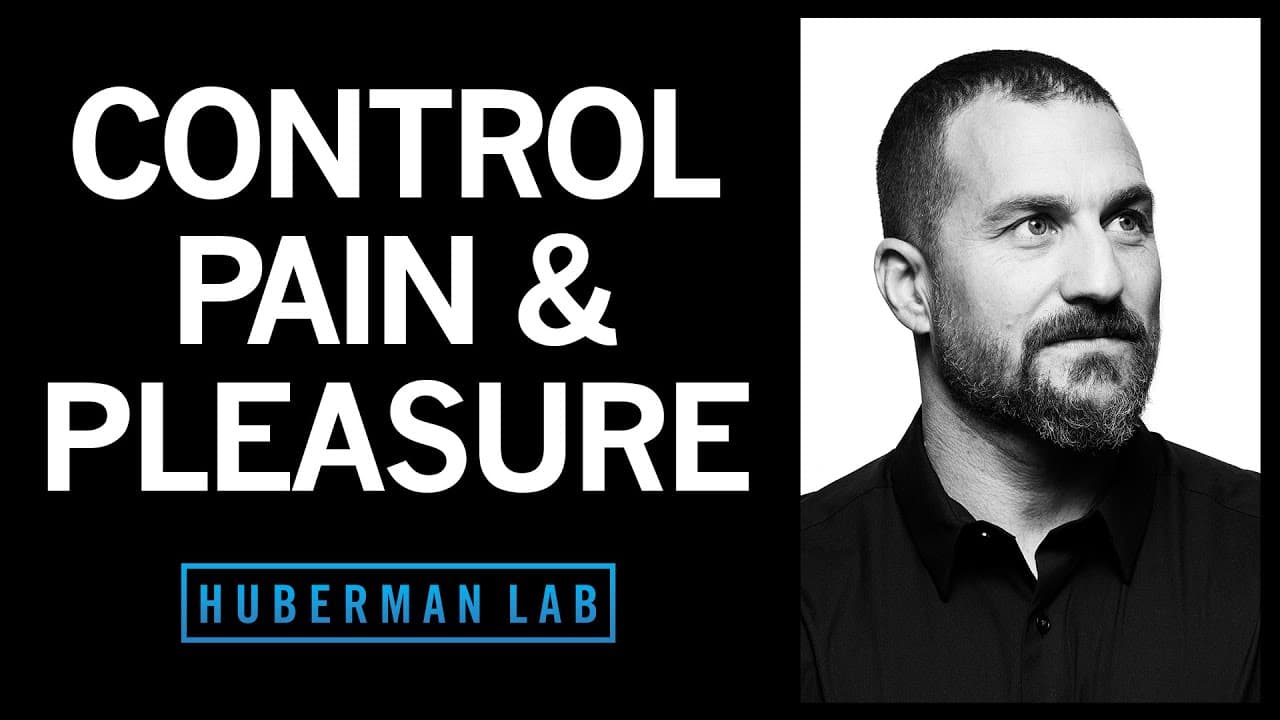
How to Control Your Sense of Pain & Pleasure | Huberman Lab Podcast #32
TL;DR
Pain and pleasure are complex subjective experiences that involve sensory receptors in the skin and interpretation by the brain. Expectation and anxiety play a role in pain perception, while heat and cold sensations are processed differently by the body. The subjective nature of pain and pleasure can vary greatly among individuals.
Transcript
- [Andrew Huberman] Welcome to the Huberman Lab Podcast, where we discuss science and science-based tools for everyday life. [bright upbeat music] - I'm Andrew Huberman, and I'm a Professor of Neurobiology and Ophthalmology at Stanford School of Medicine. Today, we continue our discussion of the senses. And the senses we are going to discuss are pa... Read More
Key Insights
- 🧠 Pain and pleasure involve a complex interplay between sensory receptors in the skin and interpretation by the brain.
- 👨🎨 Expectation and anxiety can influence our perception of pain.
- 🥵 Heat and cold sensations are processed differently in the brain.
- 🥳 The brain's homunculus map can produce unusual sensations and merge perceptions between adjacent body parts.
Install to Summarize YouTube Videos and Get Transcripts
Explore YouTube Video Summarizer or Get YouTube Transcript Extractor
Questions & Answers
Q: How does dopamine work in relation to pleasure and motivation?
Dopamine is released in response to anticipation of a reward and provides a feeling of motivation and energy. When the reward is obtained, dopamine levels return to baseline. Intermittent reward schedules, rather than consistent rewards, can increase dopamine release, leading to increased motivation and focus.
Q: Can expectations influence our experience of pain?
Yes, expectations can modulate our experience of pain. Being warned about impending pain can reduce subjective pain perception when given about 20-40 seconds in advance. However, being warned too early or too late can worsen the pain experience.
Q: How does the brain interpret heat and cold sensations?
Heat and cold sensations are processed differently in the brain. Cold receptors respond to relative temperature drops, while heat receptors respond to absolute temperature changes. Gradually moving into heat and experiencing relative temperature drops can help reduce pain perception.
Q: How does the mirror box therapy for phantom limb pain work?
Mirror box therapy uses a visual illusion created by mirrors to alleviate phantom limb pain. When patients place their intact limb into one side of the box, they see a reflection that appears as their phantom limb. By moving the intact limb, the brain perceives movement in the missing limb, leading to reduced pain perception.
Summary & Key Takeaways
-
Pain and pleasure are opposite ends of a continuum and involve the detection of stimuli by sensory receptors in the skin and interpretation by the brain.
-
The skin is an important organ that serves various functions and allows us to experience pain and pleasure.
-
Dopamine, a neuromodulator, plays a role in motivation and anticipation rather than pleasure itself.
Read in Other Languages (beta)
Share This Summary 📚
Summarize YouTube Videos and Get Video Transcripts with 1-Click
Try YouTube Summary with ChatGPT & Claude or YouTube Transcript Generator
Explore More Summaries from Andrew Huberman 📚

Summarize YouTube Videos and Get Video Transcripts with 1-Click
Try YouTube Summary with ChatGPT & Claude or YouTube Transcript Generator