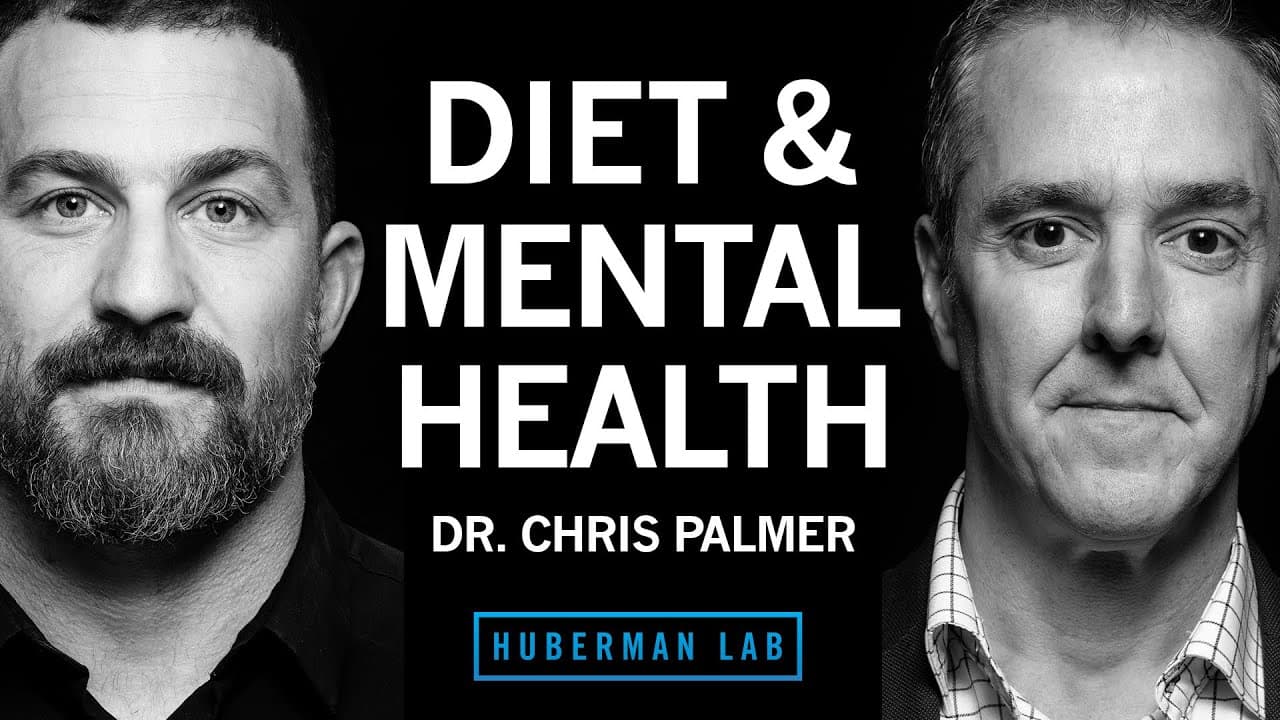
Dr. Chris Palmer: Diet & Nutrition for Mental Health | Huberman Lab Podcast #99
TL;DR
Nutrition, particularly a ketogenic diet, has been found to have significant effects on mental health, including improving symptoms of depression, bipolar disorder, and schizophrenia.
Transcript
ANDREW HUBERMAN: Welcome to the Huberman Lab podcast, where we discuss science and science-based tools for everyday life. [MUSIC PLAYING] I'm Andrew Huberman, and I'm a professor of neurobiology and ophthalmology at Stanford School of Medicine. Today, my guest is Dr. Chris Palmer. Dr. Chris Palmer is a medical doctor specializing in psychiatry at H... Read More
Key Insights
- 🧑⚕️ The ketogenic diet was originally developed to treat epilepsy and has since been found to have positive effects on mental health.
- 😑 Ketogenic diets can lead to improvements in neurotransmitter levels, gene expression, brain inflammation, and insulin resistance.
- 🧑✈️ Case studies and pilot trials have shown positive outcomes in patients with depression, bipolar disorder, schizophrenia, PTSD, and Alzheimer's disease.
- 🖐️ The ketogenic diet stimulates processes that improve mitochondrial function, which plays a crucial role in mental health.
Install to Summarize YouTube Videos and Get Transcripts
Explore YouTube Video Summarizer or Get YouTube Transcript Extractor
Questions & Answers
Q: How is the ketogenic diet different from other diets?
The ketogenic diet is high in healthy fats, moderate in protein, and extremely low in carbohydrates. This leads to a state of ketosis, where the body relies on fat for fuel instead of glucose.
Q: Does the ketogenic diet work for everyone with mental health disorders?
The response to the ketogenic diet varies among individuals. While some experience complete remission of symptoms, others may see improvements but not achieve full remission. It's important to work with a healthcare professional to determine the best approach.
Q: Are there any risks or side effects associated with the ketogenic diet?
The ketogenic diet can cause initial side effects such as "keto flu," which includes symptoms like fatigue, headache, and nausea. It may also require careful monitoring of electrolyte levels. It's crucial to work with a healthcare professional to ensure nutritional needs are met.
Q: Is medication still necessary while on a ketogenic diet?
Most patients continue taking medication alongside the ketogenic diet. The goal is to work with healthcare professionals to potentially reduce medication dosages, but it should not be attempted without supervision.
Summary & Key Takeaways
-
The ketogenic diet was originally developed in 1921 to treat epilepsy and has a long history of success in reducing seizures in patients.
-
Multiple studies have shown the efficacy of a ketogenic diet in improving mental health, including reducing symptoms of depression, bipolar disorder, and schizophrenia.
-
The diet stimulates processes that improve mitochondrial function and repair, such as mitophagy and mitochondrial biogenesis.
-
Adherence to a ketogenic diet can be challenging but is possible with support from healthcare professionals and regular monitoring of ketone levels.
Read in Other Languages (beta)
Share This Summary 📚
Summarize YouTube Videos and Get Video Transcripts with 1-Click
Try YouTube Summary with ChatGPT & Claude or YouTube Transcript Generator
Explore More Summaries from Andrew Huberman 📚



Summarize YouTube Videos and Get Video Transcripts with 1-Click
Try YouTube Summary with ChatGPT & Claude or YouTube Transcript Generator