How to Finish a Full Workday by Noon Using Flow
TL;DR
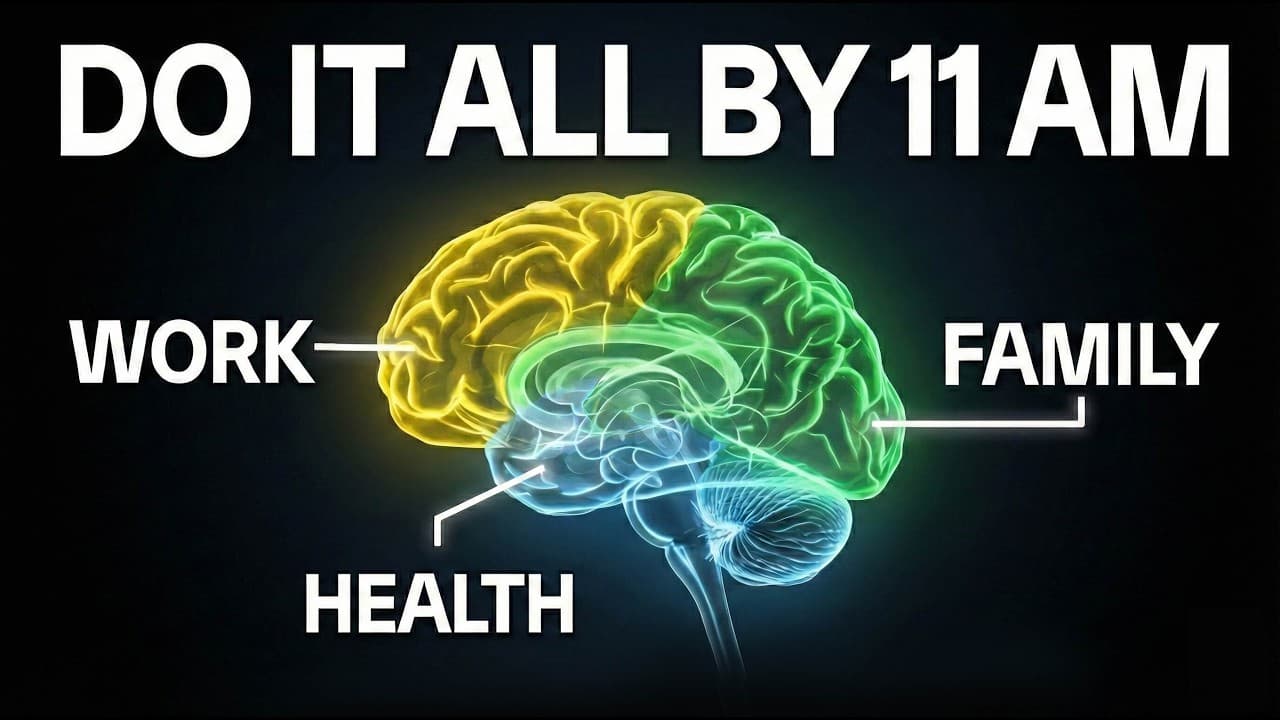
Compress all your real work into a single uninterrupted flow block of three to six hours, then stop completely for the rest of the day. Most people have a work efficiency of only 20 to 30 percent, doing about three hours of real work across a long day. Raising efficiency to 90 percent or more frees the excess time for life.
Transcript
I'm going to show you how to achieve so much in four hours that it feels unfair and how to build a work routine that allows you to be completely finished by noon every day because there's more to life than work. In case you don't want to watch the whole video, I'm going to give you the quick gist. Now, basic idea is that people have a low work effi... Read More
Key Insights
- Work efficiency is the percentage of a workday spent actually working in a fully focused manner, and most people sit at just 20 to 30 percent, meaning a long day contains only about three hours of real work.
- The one moment workday compresses all real work into a single uninterrupted flow block lasting between three and six hours, after which you stop working completely and stay fully unplugged for the rest of the day.
- The upper limit for sustained high-intensity focus is around five to six hours for most people, so a calendar audit of true critical work time determines a flow block that should feel stretched but stay under six hours.
- Cognitive load is lowest right after waking, and brain waves transitioning out of delta and theta are close neighbors to the alpha-theta borderline of flow, which is why the wake up and flow protocol starts work within 90 seconds of opening your eyes.
- Artificially inducing time scarcity triggers a mechanism researcher Eldar Shafir called tunneling, where the brain aggressively reallocates mental bandwidth and inhibits peripheral distractions because time becomes the scarce resource.
- Meetings create calendar choke points that block deep focus, so collapsing them (in-person to Zoom to phone to email) and batching them at the boundaries of the flow block protects the block's continuity.
- Keeping to a single flow block rather than two or three dramatically raises behavioral adherence, because hitting one target consistently is far easier and forces the brain to prefilter every task through whether it is worth the one block.
- A consistent flow dojo with the same desk and chair removes the friction and cognitive load of deciding where to work each day, since environment determines behavior when willpower is low.
Install to Summarize YouTube Videos and Get Transcripts
Explore YouTube Video Summarizer or Get YouTube Transcript Extractor
Questions & Answers
Q: What is work efficiency and why does it matter?
Work efficiency is the percentage of time across your whole workday that is spent actually working in a fully focused manner. It parallels sleep efficiency, which measures the percentage of time in bed spent asleep. Most people's work efficiency is only 20 to 30 percent, meaning a long workday contains just three or so hours of real work. The higher your work efficiency, the more time you have off to live and the higher quality your work output generally is.
Q: What is the one moment workday?
The one moment workday is a work protocol where you compress all your real work that occurs across a whole workday into a single uninterrupted flow block lasting between three and six hours, then stop working completely, fully unplugged and fully present for the rest of the day. It rejects the modern obsession with being always on yet only partially engaged, replacing it with extreme intensity from flow state. You measure productivity by output produced, not hours logged or tasks checked off.
Q: How long should my flow block be?
Start with a calendar audit tracking the exact amount of high-quality critical work time, excluding meetings, email, and Slack. Most people find they do between one and six hours of real productive work per day. Compress that into a single block under six hours, since the upper limit for sustained high-intensity focus sits around five to six hours. If your audit shows four to five hours of real work, start with a three-hour block; if five to six hours, start with a four-hour block so you feel stretched.
Q: Why should I start working right after waking up?
The wake up and flow protocol has you start work within about 90 seconds of opening your eyes, going straight into your highest priority task. This leverages your biology because cognitive load, the amount of information held in working memory, is lowest as soon as you wake. Low cognitive load funnels attention into a single channel, which is critical to trigger flow. Additionally, your brain waves upon waking transition out of delta and theta and are close neighbors to the alpha-theta borderline seen in flow state.
Q: Why does forcing a shorter work window make you more focused?
Researcher Eldar Shafir found that when any resource is scarce, whether food, money, or time, the brain is hijacked by a mechanism called tunneling, an aggressive reallocation of mental bandwidth that makes distractions go away. Giving yourself 12 hours creates destructive time abundance, but artificially inducing scarcity by forcing the window down triggers tunneling. Your brain realizes time is the scarce resource and involuntarily inhibits processing of peripheral stimuli, otherwise known as distraction.
Q: How should I handle meetings around my flow block?
Each meeting creates a calendar choke point, a constraint that chokes off your ability to enter deeply focused work. Pull everything that isn't focused work out of the block and batch it. Collapse meetings wherever possible by asking whether an in-person meeting can become a Zoom call, the Zoom call a phone call, and the phone call an email. Set remaining meetings at the boundaries of your flow block, stacked after your deep focused work is complete, protecting the block's continuity.
Q: Why keep to just one flow block instead of two or three?
When set up as one block, behavioral adherence goes through the roof. With only one flow block per day you cannot waste time on gray zone work because your brain prefilters everything through whether the task is worth your one flow block, and most tasks fail that test so you cut, delegate, or ignore them. From a behavioral change standpoint it is infinitely easier to hit one target than two. People attempting two or three blocks a day commonly end up doing none.
Q: What is the power down ritual and how do I do it?
The power down ritual runs the night before and takes about 60 seconds. Write down tomorrow's single highest priority task, then break it into clear goals so your brain knows exactly what to lock onto as soon as you begin your flow block. Write down anything still nagging at you so your brain knows it's captured, and schedule any unfinished tasks into your calendar. Then close your laptop to create a clear mental boundary between work mode and recovery mode.
Summary & Key Takeaways
-
Rian Doris, founder and CEO of flowstate.com, describes how a low work efficiency of 20 to 30 percent means people spread roughly three hours of real work across a long 14-hour on-mode day, wasting large swaths of life in a half-working gray zone.
-
A forced early time zone in Hawaii compressed his work into a dense five-hour block finishing by 10 a.m. with 96.7 percent work efficiency, versus 28 percent in Zurich, proving that higher efficiency yields both more free time and higher-quality output.
-
The execution steps are: compress work into one flow block under six hours, set fixed start and stop times, rearrange the day by batching meetings at the boundaries, keep it to one block, run a 60-second power down ritual the night before, and set up a consistent flow dojo.
Read in Other Languages (beta)
Share This Summary 📚
Summarize YouTube Videos and Get Video Transcripts with 1-Click
Try YouTube Summary with ChatGPT & Claude or YouTube Transcript Generator
Explore More Summaries from Rian Doris 📚


Summarize YouTube Videos and Get Video Transcripts with 1-Click
Try YouTube Summary with ChatGPT & Claude or YouTube Transcript Generator