How to boost website conversions with clarity
TL;DR
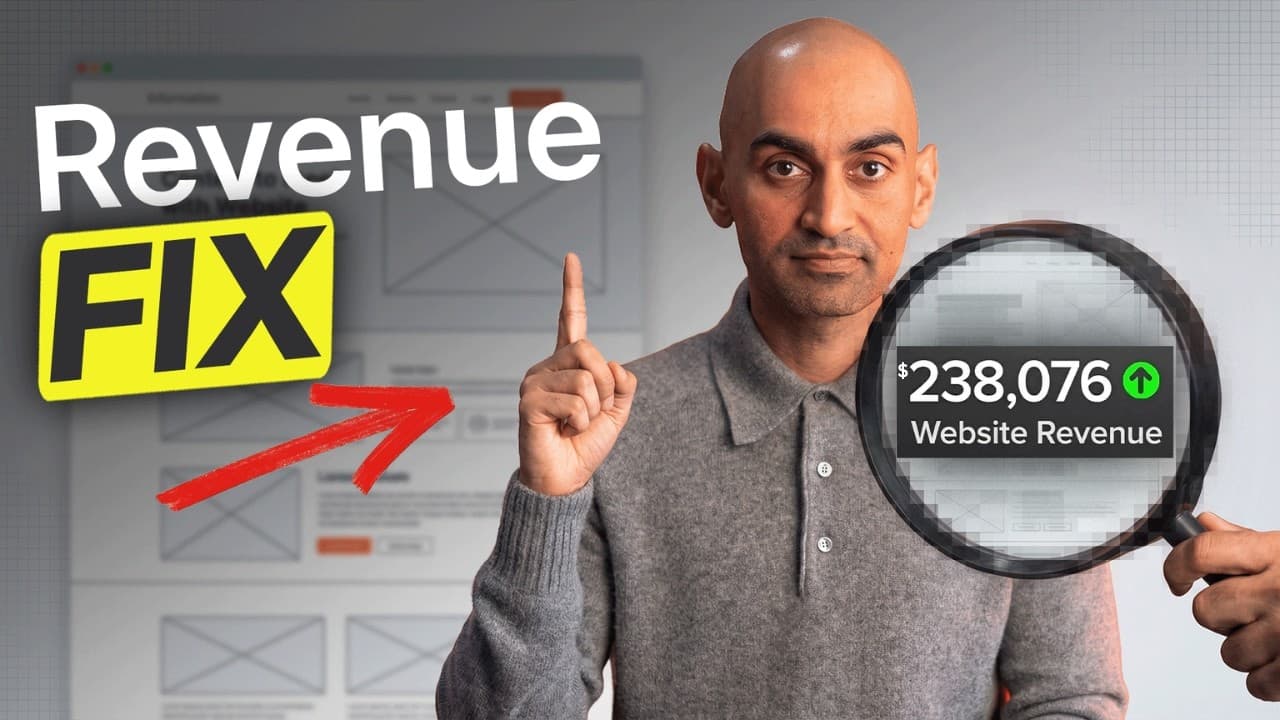
A clarity focused page that answers the three questions at first glance improves engagement. Show who it is for, what it does, and why it matters on the first screen, then move the best proof up front. Use intent matching and address hesitation at the moment it occurs for best results.
Transcript
Most businesses don't have a traffic problem. They have a clarity problem. And here's what's wild. The average website visitor decides whether to stay or leave within 10 seconds. Not because your product isn't good, not because your price is wrong, because they landed on your page and couldn't immediately answer one question. Is this for me? That's... Read More
Key Insights
- Page clarity trumps persuasion because visitors decide within seconds whether to stay on a page.
- The three questions framework ensures immediate clarity: What is this, Is this for me, Can I trust this.
- Moving the best content to the top increases perceived value and reduces drop off in the first scroll.
- Intent matching tailors pages to traffic source so paid and organic users see relevant messaging.
- Trust signals belong near the claim they support, not buried down the page.
- A single top traffic page should be restructured first if it scores poorly on clarity and relevance.
- Peak hesitation is the moment to answer objections on the page itself, not after the visit.
- Tools like heat maps can reveal where content should be moved for better orientation and retention.
Install to Summarize YouTube Videos and Get Transcripts
Explore YouTube Video Summarizer or Get YouTube Transcript Extractor
Questions & Answers
Q: What is the core reason most websites fail to convert despite traffic
The core reason is a clarity problem, not a traffic problem. Visitors decide within about 10 seconds whether a page is for them and if they can trust it. If the page does not answer the three immediate questions at first glance, users leave, and no amount of traffic fixes the underlying misalignment.
Q: How do you apply the three questions framework on a homepage
Apply the three questions by rewriting the top visible content so it clearly states what the product is, who it is for, and why it matters. Avoid internal jargon, name the specific user, and place a trust signal or proof immediately beneath the claim to reinforce credibility without requiring scrolling.
Q: What does intent matching look like in practice
Intent matching means creating separate pages or variants tailored to different audience intents from the same traffic, such as brand search versus a paid ad. Start with the largest traffic source, align the headline and tone to the platform, and measure performance to see improvements in conversions.
Q: Why should you move your best content to the top of the page
Moving the best content to the top ensures visitors immediately see the strongest benefit statement or proof, which reduces early drop off. Most people do not scroll far, so if the value proposition is buried, potential customers never encounter it, leading to lost conversions regardless of traffic quality.
Q: What is peak hesitation and how can you address it
Peak hesitation is the moment when a visitor almost converts but stops due to an unanswered question or risk. Address it on the page by providing the missing information, a clear answer to objections, and immediate proof or reassurance to move the user forward without leaving the page.
Q: How can AI and real time personalization impact conversions
AI enables adaptive pages that learn which version performs best for which audience and can serve it automatically. Real time personalization and chat can answer objections instantly, improving the moment of hesitation and increasing the likelihood of a conversion rather than chasing visitors later.
Q: What steps should you take before testing or redesigning a page
Before testing, audit the page to locate where your value actually lives and move it higher. Score the top three high traffic pages on clarity and the three questions framework, and restructure any page scoring below seven. This aligns content with user intent before spending on traffic campaigns.
Q: What practical tool recommendations are given for optimization
Use heat maps and scroll tracking to understand how far visitors scroll and where they drop off. Tools like Crazy Egg can help you identify the exact location to reposition content for better orientation and increased conversions without requiring developer resources.
Summary & Key Takeaways
-
Summary point 1: The video argues that most conversions fail because pages are built for the company, not the buyer, causing confusion within the first scroll.
-
Summary point 2: It emphasizes three questions on every page—What is this, Is this for me, Can I trust this—answered immediately to retain visitors.
-
Summary point 3: It advocates matching pages to visitor intent, moving key content up, and addressing moment of hesitation with real time clarity and signals.
Read in Other Languages (beta)
Share This Summary 📚
Summarize YouTube Videos and Get Video Transcripts with 1-Click
Try YouTube Summary with ChatGPT & Claude or YouTube Transcript Generator
Explore More Summaries from Neil Patel 📚

Summarize YouTube Videos and Get Video Transcripts with 1-Click
Try YouTube Summary with ChatGPT & Claude or YouTube Transcript Generator