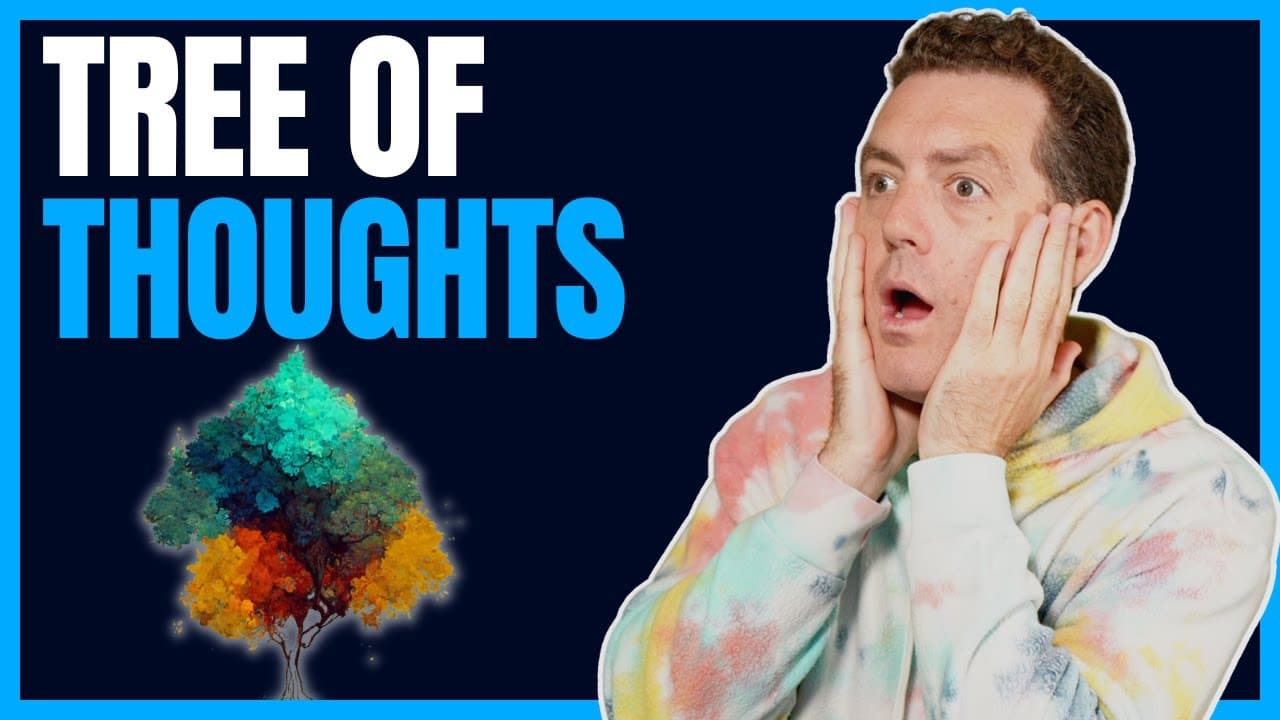
How Does the Tree of Thoughts Improve AI Reasoning?
TL;DR
The Tree of Thoughts approach enhances large language models' reasoning by enabling them to break down problems into intermediate steps, evaluate potential solutions, and strategically select the best path to an answer. This method significantly improves success rates across various tasks, outperforming traditional methods by allowing models to think ahead and backtrack as needed.
Transcript
hey welcome back a new research paper out of Google deepmind in Princeton aims to completely append the way that people think about prompt engineering and make large language models do logic problem solving and reasoning much more aligned with how the human brain does those things it's really interesting and the results are incredible I'm going to ... Read More
Key Insights
- 🗯️ Large language models have limitations in tasks requiring exploration, strategic planning, and reasoning due to their left-to-right decision-making processes.
- 👋 The "Tree of Thoughts" approach breaks down problems into intermediate steps, generates potential solutions, evaluates their feasibility, and selects the best path to the solution.
- 🤔 With "Tree of Thoughts," large language models can think ahead, backtrack when necessary, and make more informed and strategic decisions, resulting in improved problem-solving performance.
- ☠️ "Tree of Thoughts" outperforms traditional prompt methods and significantly improves success rates in tasks like logical reasoning, creative writing, and crossword puzzles.
- 🤳 The approach leverages self-reflection and value-based feedback to evaluate the viability of predictions and explore different solution paths.
- 👻 Despite the resource-intensive nature of the approach, the modular flexibility of "Tree of Thoughts" allows users to customize performance and cost trade-offs.
Install to Summarize YouTube Videos and Get Transcripts
Explore YouTube Video Summarizer or Get YouTube Transcript Extractor
Questions & Answers
Q: What is the main goal of the "Tree of Thoughts" approach?
The main goal of the "Tree of Thoughts" approach is to enhance large language models' problem-solving abilities by enabling them to think through problems in multiple steps and select the best path to the solution.
Q: How does the "Tree of Thoughts" approach differ from traditional left-to-right decision-making?
Unlike traditional left-to-right decision-making, the "Tree of Thoughts" approach allows large language models to explore different reasoning paths, backtrack when necessary, and make global choices based on self-evaluation and value-based feedback.
Q: What are the challenges that the paper tests the "Tree of Thoughts" approach on?
The paper tests the "Tree of Thoughts" approach on game of 24, creative writing tasks, and crossword puzzles to evaluate its effectiveness in different problem-solving scenarios.
Q: What are the advantages of using the "Tree of Thoughts" approach in problem-solving tasks?
The "Tree of Thoughts" approach outperforms traditional input-output prompt methods and chain of thought prompting methods, significantly improving success rates in diverse problem-solving tasks. It allows for more flexible and strategic decision-making by considering multiple potential solutions and exploring different problem paths.
Summary & Key Takeaways
-
The paper introduces the "Tree of Thoughts" approach, which enhances large language models' problem-solving abilities by enabling them to think through problems in multiple steps.
-
Large language models are typically limited to left-to-right decision-making processes, which can hinder their performance in tasks requiring exploration, strategic planning, and reasoning.
-
"Tree of Thoughts" breaks down problems into intermediate steps, generates potential solutions, evaluates their feasibility, and selects the best path to the solution, resulting in improved success rates across various problem-solving tasks.
Read in Other Languages (beta)
Share This Summary 📚
Summarize YouTube Videos and Get Video Transcripts with 1-Click
Try YouTube Summary with ChatGPT & Claude or YouTube Transcript Generator
Explore More Summaries from Matthew Berman 📚




Summarize YouTube Videos and Get Video Transcripts with 1-Click
Try YouTube Summary with ChatGPT & Claude or YouTube Transcript Generator