How to never hit Claude token limits again every time
TL;DR
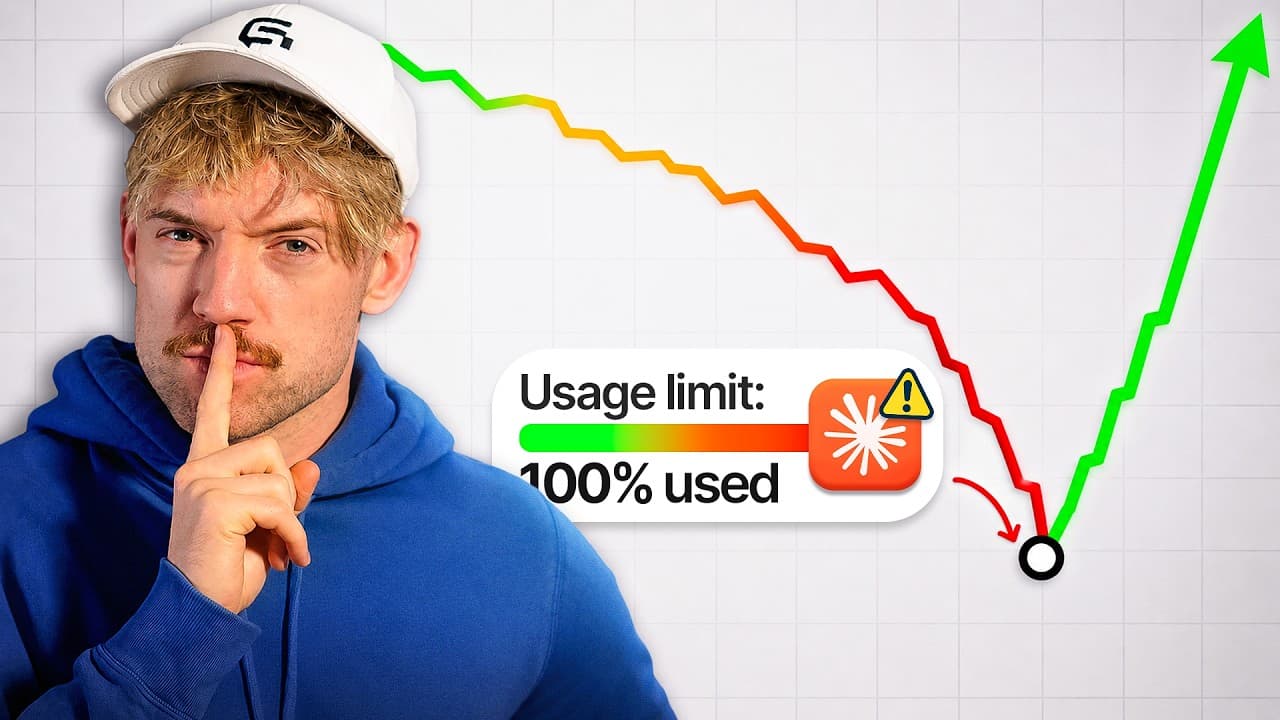
The video shows a five level system to cut Claude token usage. It starts with a master prompt that audits and reduces waste, revealing user sessions with high token drain. It then covers habits like clearing between jobs, using one model per session, batching questions, editing messages, and preferring text to PDFs to save tokens overall.
Transcript
Imagine if you never ran out of Clawude tokens. I found a new system in Claude and it more than tripled my available usage. [music] And in this video, I'm going to show you exactly how to never hit a rate limit in Claude again so you can build way more, spend less, and get light [music] years ahead of everybody else. So, if you haven't already, gra... Read More
Key Insights
- Systematically auditing a Claude setup can reveal large token waste, sometimes over 90 percent in some sessions.
- A master prompt in level one identifies what to preload, including tools, logs, and session context, to minimize unused content.
- Level two promotes practical habits such as clearing context between jobs and using one model per session to avoid reprocessing history.
- Batching questions reduces the token cost by avoiding repeated context loading with each message.
- Editing messages instead of correcting them helps preserve context and lowers token usage.
- Favor text over PDFs or images when possible to reduce ongoing processing costs.
- Level three introduces a D-100 communication style to make Claude responses clearer and shorter, reducing follow up clarifications.
- Levels four and five optimize routing to different models and saving design styles as skills for reusability and efficiency.
Install to Summarize YouTube Videos and Get Transcripts
Explore YouTube Video Summarizer or Get YouTube Transcript Extractor
Questions & Answers
Q: How does the master prompt audit help save tokens in Claude usage?
The master prompt audit in level one preloads and reviews all relevant session data, tools, and logs, then flags wasteful content and large files. By identifying what is unnecessary or redundant, it reduces the amount of context Claude must process in every new message, leading to substantial token savings over time.
Q: Why is using one model per session recommended in the video?
Using one model per session prevents Claude from reprocessing the entire conversation history when the model changes. This consistency avoids extra token expenditure caused by reloading and reanalyzing the same data with a different model, enabling more efficient use of tokens for the actual tasks at hand.
Q: What is the benefit of batching questions as suggested in level two?
Batching questions allows you to send a block of thoughts or questions at once, reducing the number of times Claude has to reread the conversation history. This minimizes token consumption due to repeated context loading and makes the interaction more cost effective without sacrificing clarity.
Q: How does editing a message instead of correcting it help token usage?
Editing a message avoids polluting the conversation history with both the incorrect and corrected versions. By updating a single message, Claude can proceed with the intended query without having to reprocess and reconcile multiple messages, saving tokens that would have been spent on reprocessing the drifted context.
Q: Why is text preferred over PDFs or images in this system?
Text is preferred because it is quicker for Claude to parse and does not require additional processing or extraction steps that consume extra tokens. When possible, converting references to plain text reduces ongoing token costs associated with handling heavy documents or media.
Q: What does the D-100 communication skill aim to fix, and how does it help?
The D-100 communication skill aims to break down complex information into simple, readable steps, making Claude responses easier to understand and reducing clarifying questions. Clear, concise prompts lower token use by minimizing back-and-forth needed to reach the correct conclusion.
Q: What role do level four model routing and level five skills play in token efficiency?
Level four routes work to the most appropriate model for the task, maximizing efficiency by matching the model to the job type. Level five saves design styles as reusable skills and uses Graphify to map codebases, enabling faster, more consistent results with less repetitive prompting.
Q: How could one apply these techniques to real-world Claude usage?
A real-world application would start with auditing the setup to identify waste, then implement the habit changes such as clearing context between tasks, using a single model per session, batching queries, and editing messages. By adding the D-100 style and saving useful configurations as skills, token usage becomes more predictable and cost-effective over time.
Summary & Key Takeaways
-
The video presents a five level framework that builds on each other to reduce token waste in Claude. It starts with a master prompt that audits a user setup and finds enormous waste, then lays out practical habits to maintain low usage. The approach is practical and actionable for daily Claude use.
-
Level two focuses on behavioral changes such as clearing context between jobs, using a single model per session, batching questions, and editing rather than rewriting, all aimed at conserving tokens.
-
Level three introduces a D-100 communication style to improve readability and reduce clarifications, while level four routes tasks to the most appropriate model and level five saves design styles as skills and uses Graphify to map codebases.
Read in Other Languages (beta)
Share This Summary 📚
Summarize YouTube Videos and Get Video Transcripts with 1-Click
Try YouTube Summary with ChatGPT & Claude or YouTube Transcript Generator
Explore More Summaries from Jack Roberts 📚






Summarize YouTube Videos and Get Video Transcripts with 1-Click
Try YouTube Summary with ChatGPT & Claude or YouTube Transcript Generator