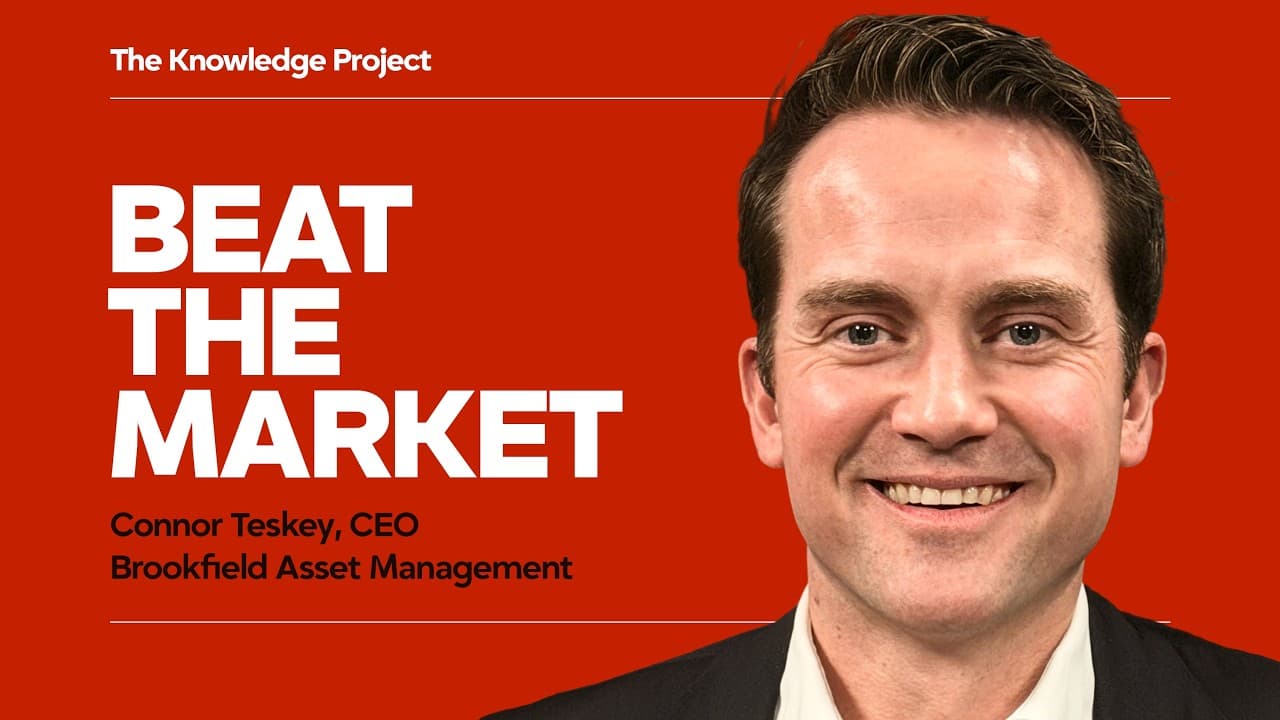
How Does Brookfield CEO Connor Teskey Manage $1 Trillion, De-Risk Deals, Deploy Capital and Build Wealth?
TL;DR
Brookfield manages about $1 trillion by raising capital from major pools of money worldwide and deploying it into high-quality assets and services that support the global economy. Connor Teskey explains how the firm combines downside-focused investing, global reach, evolving asset classes, product expansion and a culture that empowers others. Read on for the specific principles behind its capital deployment and long-term growth.
Transcript
Why don't we start with the state of the union for Brookfield? You guys manage about a trillion dollars. Where is it allocated? Uh and how is it allocated? So, our business today is really built around raising capital from the largest pools of money around the world and then turning around and deploying that capital into the largest and most attrac... Read More
Key Insights
- Global deployment defines scale: Managing about $1 trillion depends on linking capital raised worldwide with investment themes found across 60 major countries and markets. Brookfield is not presented as a firm whose capital base or opportunity set belongs to one region. Its scale comes from operating both sides of the model globally.
- Major markets anchor expansion: The United States and Western Europe continue to be Brookfield’s largest markets, even as the firm operates across Asia, India, the Middle East and South America. This creates a structure with established geographic anchors and a much wider operating footprint, allowing capital deployment to extend beyond its biggest existing markets.
- Capital returns remain foundational: Teskey calls deploying capital at exceptional returns the bedrock of Brookfield’s business. Team building, communication and client relationships matter because they help the organization perform that core activity at greater scale and over longer periods. The wider capabilities support investment execution rather than replace it as the firm’s defining responsibility.
- Measured responses reduce reaction risk: Brookfield’s senior leaders respond to large market moves in a balanced and measured way. Teskey presents this temperament as a distinctive part of how they process changing dynamics. The emphasis is on thinking through changes carefully, which complements the downside-focused investment approach described later in the conversation.
- Forward thinking shapes decisions: Brookfield learns from the past but avoids spending excessive time dwelling on it. That distinction allows the firm to use prior experience while remaining focused on investment themes expected to persist. Teskey says some themes have already been developing for three, four or five years and could continue for one or two decades.
- Others’ success strengthens culture: A central cultural principle is to focus on putting other people in positions to succeed. Teskey says Flatt and other senior leaders embody this behavior, even though it can leave their accomplishments underappreciated. The culture is therefore tied to empowering colleagues and preserving the platform’s ability to keep building beyond individual leaders.
- Leadership requires broader competence: Running a large investment organization demands more than selecting assets. Teskey identifies building teams, explaining strategy, communicating with clients and limited partners, and interacting with counterparties as essential capabilities. These responsibilities become increasingly important when the organization wants to deploy more capital over a sustained period.
- The asset definition evolves: Brookfield’s focus on the backbone of the global economy is stable, but the assets fitting that description continually change. The firm still invests in established categories such as hydro dams, ports and railroads. It has also expanded into solar, nuclear, batteries, data centers, fiber and telecom towers.
- New categories drive allocation: Teskey estimates that perhaps two-thirds, or even 70 percent, of Brookfield’s current investments were not investable asset classes 15 or 20 years ago. This illustrates why consistency does not mean holding an unchanged asset list. Brookfield preserves its economic-backbone test while applying it to newly investable infrastructure and services.
- Downside focus guides selection: Brookfield pairs its search for essential assets and services with a downside-focused investment approach. Existing page material explains that de-risking can involve securing contracts and financing upfront, including construction costs, revenue agreements and long-term financing. These measures are intended to reduce exposure to interest-rate changes and market fluctuations.
- Product variety expanded sharply: Brookfield moved from four products 10 years ago to 60 products today. The expansion did not require abandoning its principal verticals of infrastructure, real estate and private equity. Instead, it packaged its established approach in different forms to address the needs of a larger and increasingly diverse client base.
- Multiple strategies serve clients: A vertical that once offered only a flagship strategy can now include flagship, mezzanine debt and super core strategies, along with a strategy for the retail wealth channel. This shows how Brookfield separates its consistent investment focus from product design. Distribution and packaging can change even when the underlying investment discipline remains stable.
Install to Summarize YouTube Videos and Get Transcripts
Explore YouTube Video Summarizer or Get YouTube Transcript Extractor
Questions & Answers
Q: How does Brookfield manage its $1 trillion portfolio?
Brookfield raises capital from major pools of money worldwide and deploys it into large, attractive investment themes. It invests across 60 major countries and markets, with the United States and Western Europe remaining its largest markets. The firm concentrates on high-quality assets and services that support economic growth and productivity. This structure gives Brookfield global sources of both capital and investment opportunities.
Q: What does Brookfield invest in?
Brookfield invests in assets and services it considers part of the global economy’s backbone. Examples include hydro dams, solar, nuclear, batteries, ports, railroads, data centers, fiber and telecom towers. The categories change as economies and investable markets evolve. The consistent test is whether an asset or service is critical to the productivity and growth of its community or country.
Q: How has Brookfield’s investment approach changed?
The central approach has remained focused on high-quality, economically important assets and downside protection. What has changed is the set of assets that qualifies under that approach. Teskey estimates that perhaps two-thirds, or even 70 percent, of current investments were not investable asset classes 15 or 20 years ago. Brookfield therefore maintains a consistent principle while adapting its opportunity set.
Q: How does Brookfield de-risk investment deals?
Brookfield uses a downside-focused approach and seeks to address important variables before they can undermine returns. Existing page material identifies securing contracts and financing upfront, including construction costs, revenue agreements and long-term financing. Locking in those elements reduces exposure to market fluctuations and changing interest rates. The purpose is to make projected investment outcomes less dependent on unresolved external conditions.
Q: What did Connor Teskey learn from Bruce Flatt?
Teskey highlights Flatt’s balanced response to major market changes and his forward-looking perspective. Flatt learns from the past without dwelling on it and combines investment judgment with team building and communication. Teskey also emphasizes Flatt’s habit of putting others in positions to succeed. More than 12 years of working together gave Teskey the opportunity to observe and absorb these leadership practices.
Q: Why is culture important at Brookfield?
Teskey believes culture helps Brookfield continue growing beyond what its current senior leaders have built. The culture values measured judgment, forward thinking and creating opportunities for other people to succeed. These behaviors support teams working across a large global investment platform. They also shift attention from individual recognition toward the organization’s long-term capacity to perform.
Q: How has Brookfield expanded its investment products?
Brookfield had four products 10 years ago and has 60 today. It retained its focus on infrastructure, real estate and private equity while adding more strategies within those verticals. A vertical can now include flagship, mezzanine debt, super core and retail wealth strategies. This expansion allows the firm to package a consistent investment approach for a broader range of clients and limited partners.
Q: How does Brookfield use AI in its operations?
Existing page material says Brookfield uses AI to improve efficiency across its operations. Applications include preventative maintenance and health and safety, where the technology can support operational improvements and risk management. Portfolio companies are encouraged to experiment with AI applications. Successful uses can then be shared across the organization so that useful practices extend beyond one company.
Summary & Key Takeaways
-
Brookfield’s global capital model: Brookfield raises capital from the largest pools of money around the world, then deploys it into major and attractive investment themes. Its investments span 60 large countries and markets. The United States and Western Europe remain its biggest markets, while its operations also extend across Asia, India, the Middle East and South America. This global structure connects worldwide fundraising with opportunities found by teams operating across numerous regional markets.
-
Leadership through culture and balance: Connor Teskey credits Bruce Flatt and Brookfield’s senior management with building both an investment platform and a culture capable of supporting continued growth. Their response to major market movements is measured rather than reactive. They learn from previous events without dwelling on them and remain forward-looking. Another defining principle is putting other people in positions to succeed, even when that means the leaders who built the firm receive less recognition.
-
Scaling beyond investment selection: Deploying capital at exceptional returns remains the foundation of Brookfield’s investment organization, but increasing its scale requires broader capabilities. Teskey says leaders must build effective teams, communicate strategy and work successfully with clients, limited partners and counterparties. He describes his relationship with Flatt as complementary and points to more than 12 years of working together. During that time, he has observed how Flatt combines investment judgment with these wider organizational and communication responsibilities.
-
Consistent focus, evolving assets: Brookfield continues to target high-quality assets that form the backbone of the global economy, meaning critical assets and services that support the productivity and growth of communities and countries. The principle has stayed consistent, although the investable universe has changed significantly. Teskey estimates that perhaps two-thirds, or even 70 percent, of what Brookfield invests in today was not an investable asset class 15 or 20 years ago.
-
More products for more clients: Brookfield has adapted its established investment approach to serve an increasingly varied group of limited partners and clients. Ten years ago, it had four products, compared with 60 today. Its central verticals still include infrastructure, real estate and private equity, but each can now support several strategies. Beyond a flagship offering, those strategies may include mezzanine debt, super core investments and products designed for the retail wealth channel.
Read in Other Languages (beta)
Share This Summary 📚
Summarize YouTube Videos and Get Video Transcripts with 1-Click
Try YouTube Summary with ChatGPT & Claude or YouTube Transcript Generator
Explore More Summaries from The Knowledge Project Podcast 📚



Summarize YouTube Videos and Get Video Transcripts with 1-Click
Try YouTube Summary with ChatGPT & Claude or YouTube Transcript Generator