Why AI Models Stop Learning and How to Restart
TL;DR
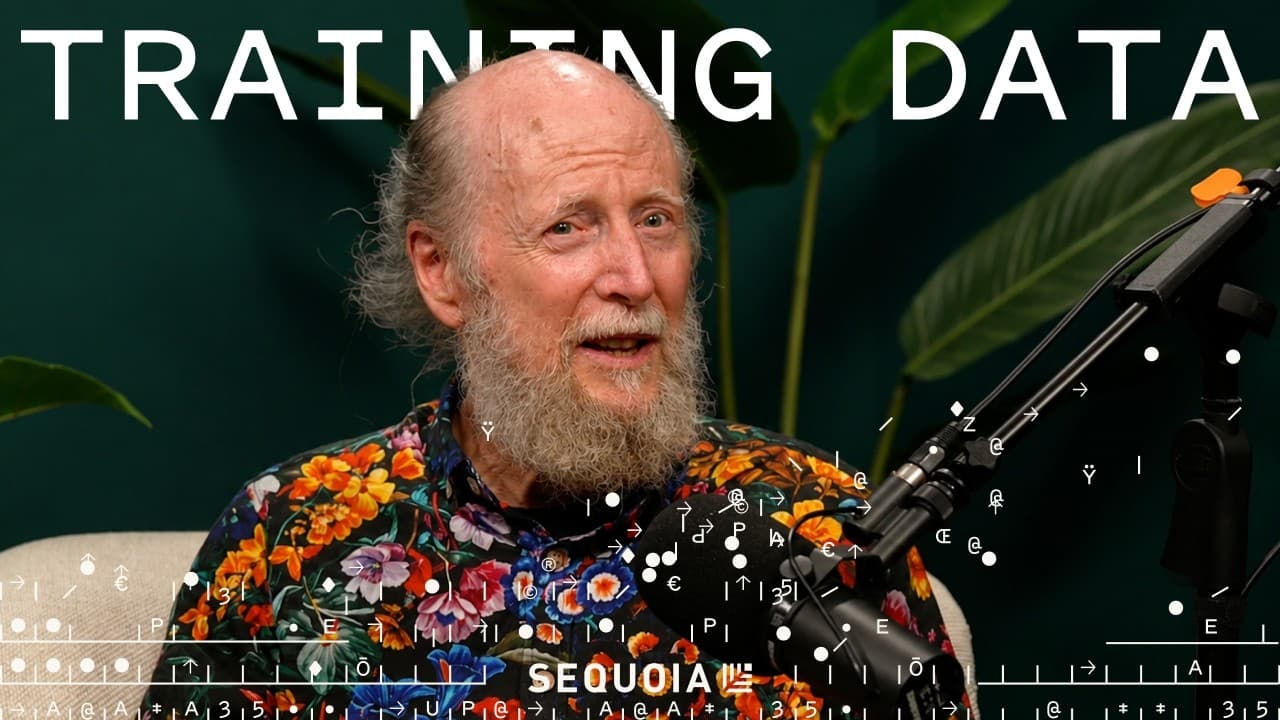
AI models can keep learning if their approximations are continually updated through direct experience instead of being frozen after training. Sutton and Javed argue that catastrophic forgetting is curable, synthetic data cannot capture the full complexity of the world, and scalable learning methods should rely less on fixed human knowledge and more on computation, action, and continual adaptation.
Transcript
People think I'm have a radical point of view. Sometimes they they they start questions saying how what I'm thinking is so different from everyone else. But I don't see it that way at all. I see it as like I'm thinking the ordinary way. It's just everyone else that's thinking a bit weird. And [laughter] and I mean that like you know it's just the r... Read More
Key Insights
- Continual learning is simply learning under Sutton's view, because an intelligent system should constantly act, perceive information, pursue goals, and adapt. Dividing learning into a temporary training stage and a fixed deployment stage departs from this ordinary model of intelligence.
- The Bitter Lesson is a warning against relying too heavily on human knowledge when designing AI. Sutton argues that progress comes from sophisticated algorithms, especially search and learning methods, whose capabilities can continue increasing as more computation becomes available.
- Large language models are both positive and negative examples of the Bitter Lesson. They achieved major capability gains by scaling computation and absorbing internet data, but their future improvement is constrained because the internet and the human-produced information stored there are finite.
- Synthetic data is described by Sutton as a major mistake when treated as the path beyond finite internet data. The Big World Hypothesis holds that the actual world is massively more complex than any agent or simulator used to generate approximations.
- A model of the world must be updated continuously because every agent and simulator can capture only an approximation of a much larger reality. Freezing that approximation at deployment prevents the system from incorporating the continuing stream of experience available through interaction.
- Catastrophic forgetting is considered totally curable by Sutton and Javed. Their continual backprop work provides the relevant ideas for preserving a model's ability to learn, supporting their broader objective of creating agents that remain adaptive rather than becoming fixed after initial training.
- Frontier AI laboratories occupy a local minimum according to Javed, because moving toward a different learning paradigm may initially produce worse results before yielding improvements. This short-term decline makes it difficult for organizations invested in the current approach to change direction.
- Oak Lab's long-term target is a coherent trillion-parameter mind that continually learns while operating on 20 watts. The stated horizon is five to ten years, and the central research direction is learning from ongoing experience instead of depending primarily on human-generated training material.
Install to Summarize YouTube Videos and Get Transcripts
Explore YouTube Video Summarizer or Get YouTube Transcript Extractor
Questions & Answers
Q: What does continual learning mean for AI agents?
Continual learning means that an AI agent keeps updating its knowledge while it acts, perceives information, and pursues goals. Sutton argues that this is simply what learning normally means, not a special category. An agent should learn throughout its existence rather than completing a separate training phase and then remaining frozen when it is deployed.
Q: What is the central lesson of the Bitter Lesson?
The Bitter Lesson says AI researchers should avoid becoming distracted by attempts to insert human knowledge directly into intelligent systems. Instead, they should develop sophisticated learning and search algorithms that can improve as computation increases. Sutton emphasizes that the lesson does not reject advanced algorithms. It favors algorithms whose benefits scale with computation rather than continued human input.
Q: How do large language models support the Bitter Lesson?
Large language models support the Bitter Lesson because they gained substantial capabilities through methods that could absorb far more computation and internet data. This demonstrated the power of scalable learning approaches. Sutton nevertheless views them as a negative example too, because their dependence on finite, human-produced information eventually limits how far the same approach can continue scaling.
Q: Why does Rich Sutton criticize synthetic data?
Sutton calls synthetic data a major mistake in the context of overcoming the limits of internet training data. His reasoning is connected to the Big World Hypothesis: the real world contains vastly more complexity than any agent or simulator. Data generated from an approximation cannot remove the need to interact with reality and continually update that approximation.
Q: What is the Big World Hypothesis in AI?
The Big World Hypothesis states that the world is massively larger and more complex than any individual agent or simulator. Consequently, every internal model is necessarily an approximation. Sutton and Javed argue that such approximations cannot be treated as complete or frozen at deployment. They must be revised continuously as an agent receives new experience from the world.
Q: Can catastrophic forgetting in AI be cured?
Sutton describes catastrophic forgetting as totally curable and connects that claim to the ideas behind continual backprop. The broader objective is to let a model keep acquiring new knowledge without losing its capacity to learn. This supports agents that remain coherent and adaptive across ongoing experience instead of stopping their learning once initial training has ended.
Q: Why might frontier AI labs resist continual learning?
Javed argues that frontier laboratories are caught in a local minimum created by the current AI paradigm. A transition to a genuinely different approach may make performance worse before it becomes better. Organizations succeeding with existing methods therefore face difficulty accepting the initial decline required to explore agents that learn continually from their own experience.
Q: What is Oak Lab trying to build?
Oak Lab aims to build agents that continually learn from their own experience rather than relying primarily on information supplied by humans. Its stated five-to-ten-year target is a trillion-parameter mind that remains coherent, continues learning, and runs on 20 watts. The research agenda combines continual adaptation with methods intended to scale through computation.
Summary & Key Takeaways
-
Sutton presents continual learning as ordinary learning, because intelligent beings continually act, perceive, pursue goals, and update their understanding. He argues that treating learning as a separate training phase is the unusual position. Oak Lab therefore aims to develop agents that keep learning from their own experience rather than remaining fixed after deployment.
-
The Bitter Lesson advises researchers not to become distracted by inserting human knowledge into AI systems. Sutton favors sophisticated methods that improve as more computation becomes available, particularly search and learning. Large language models support this lesson through computational scaling, but challenge it because their dependence on finite human-produced internet data eventually becomes a limitation.
-
Sutton and Javed's Big World Hypothesis says the world is vastly more complex than any agent or simulator. Synthetic data therefore cannot replace ongoing interaction with reality. They argue that approximations must be updated continually, catastrophic forgetting is curable through continual backprop ideas, and long-term progress requires escaping the current paradigm's local minimum.
Read in Other Languages (beta)
Share This Summary 📚
Summarize YouTube Videos and Get Video Transcripts with 1-Click
Try YouTube Summary with ChatGPT & Claude or YouTube Transcript Generator
Explore More Summaries from Sequoia Capital 📚

Summarize YouTube Videos and Get Video Transcripts with 1-Click
Try YouTube Summary with ChatGPT & Claude or YouTube Transcript Generator