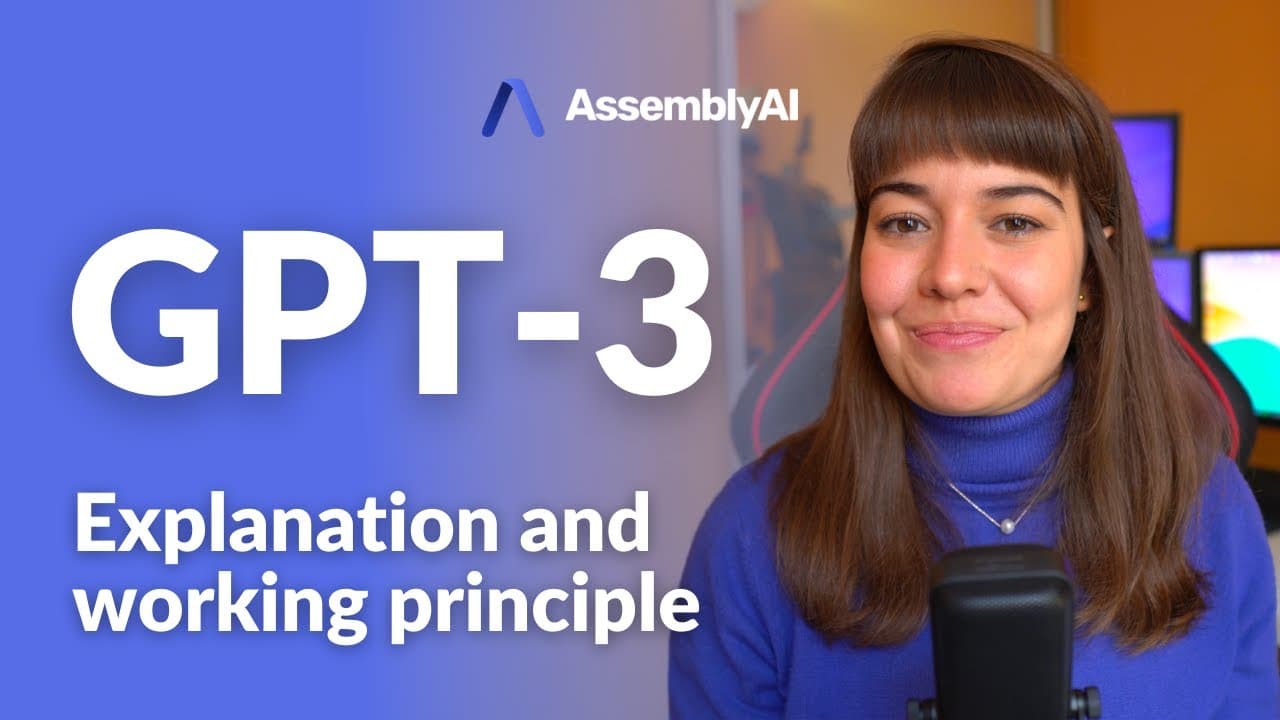
What Is GPT-3 and How Does It Work in NLP?
TL;DR
GPT-3 is a language model with 175 billion parameters that excels in natural language processing tasks without requiring fine-tuning. It operates using a unique transformer architecture made up of decoder blocks, learning from 300 billion tokens of data. Despite issues like bias and environmental impact, it is widely applied in creative writing, code generation, and customer service.
Transcript
if you're into deep learning or generally artificial intelligence it's very likely that you've heard of gpt3 and even if you haven't heard of it you might have used a tool that was built with tpd3 but what is it and how does it work let's learn that in this video gpt3 is a language model that was developed by openai what's special about it is that ... Read More
Key Insights
- ❓ GPT-3 is a powerful language model with 175 billion parameters, excelling in NLP tasks without fine-tuning.
- 😷 The architecture of GPT-3 utilizes decoder blocks with specific layers like mask self-attention for efficient learning.
- ✳️ Drawbacks of GPT-3 include potential biases in data, environmental impact, and misuse risks.
- ✍️ GPT-3 is already being used in various applications like creative writing, code generation, and customer service.
- ♿ Access to GPT-3 is made possible through OpenAI's API, with guidelines for usage and development compliance.
Install to Summarize YouTube Videos and Get Transcripts
Explore YouTube Video Summarizer or Get YouTube Transcript Extractor
Questions & Answers
Q: What makes GPT-3 unique in the realm of artificial intelligence models?
GPT-3 stands out for its massive size, 175 billion parameters, and its ability to excel in NLP tasks without the need for fine-tuning, showcasing its versatility and power.
Q: How does GPT-3 differ in architecture from traditional transformer models?
GPT-3 utilizes decoder blocks with mask self-attention layers and feed-forward neural networks, omitting encoder-decoder self-attention layers, showcasing a simplified yet effective design.
Q: What are some drawbacks associated with using a model as large as GPT-3?
Drawbacks include potential biases in the data, environmental impact of training such a large model, and the risk of misuse such as generating fake news or articles.
Q: How can developers access and utilize GPT-3 in their applications?
Microsoft holds a license for GPT-3 but developers can access it through OpenAI's API, with guidelines to follow, enabling a wide range of applications.
Summary & Key Takeaways
-
GPT-3, developed by OpenAI, is a language model with 175 billion parameters, excelling at NLP tasks and lacking fine-tuning.
-
The architecture of GPT-3 utilizes decoder blocks with mask self-attention and feed-forward neural network layers.
-
While facing drawbacks like bias and environmental impact, GPT-3 has applications in creative writing, code generation, and more.
Read in Other Languages (beta)
Share This Summary 📚
Summarize YouTube Videos and Get Video Transcripts with 1-Click
Try YouTube Summary with ChatGPT & Claude or YouTube Transcript Generator
Explore More Summaries from AssemblyAI 📚


Summarize YouTube Videos and Get Video Transcripts with 1-Click
Try YouTube Summary with ChatGPT & Claude or YouTube Transcript Generator