What Jobs Will AI Affect Most by 2027 and Why
TL;DR
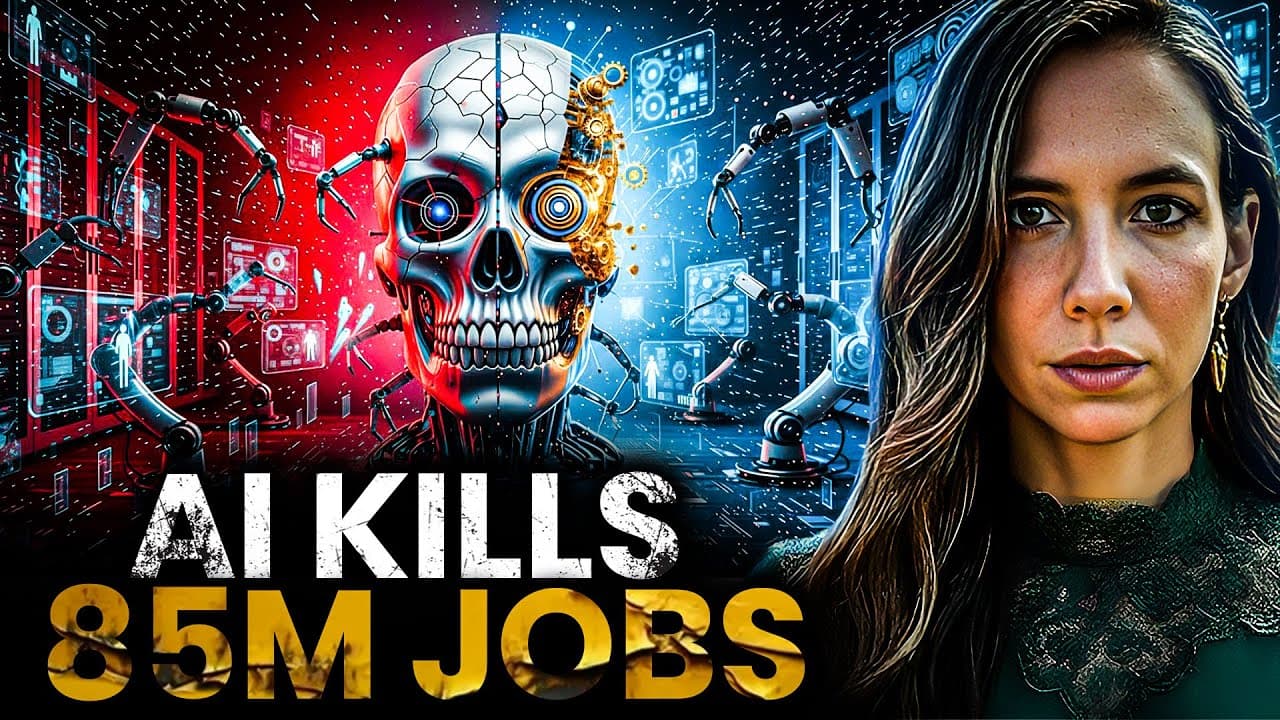
AI is already reshaping work with real usage data from 200,000 worker conversations. High AI applicability means routine tasks shift to machines, freeing humans for higher judgment work, while new roles emerge. The transition will be uneven and wage gaps will grow as skills in AI collaboration become essential.
Transcript
2026, [music] 2027, 2028. These three years won't just change the job market, they'll completely rewrite the rules of who works and who doesn't. Microsoft has released the most comprehensive research we've ever seen on AI's impact on jobs. Not predictions, not speculation, actual data from 200,000 real conversations between workers and AI throughou... Read More
Key Insights
- AI applicability highlights how often workers use AI for tasks, how well AI completes tasks, and how many tasks AI can help with in a work activity.
- High AI applicability does not guarantee job loss; it often shifts work toward tasks requiring human judgment, ethics, and creativity.
- Certain occupations show the highest AI overlap in information work like writing, analysis, and communication, indicating where disruption will be felt first.
- Stage one of disruption targets white collar tasks first, with customer service and data entry heavily affected by automation efforts.
- Stage two projects global job displacement balanced by new roles, but the local human cost can be severe due to non one-to-one transitions.
- Stage three predicts wage gaps as AI skills command premium and workers must change or adapt to new roles.
- Occupations with minimal AI applicability tend to involve hands on physical labor or direct care, where AI cannot yet replace human interaction.
- The ATM analogy illustrates that automation can expand productivity and create new tasks rather than simply eliminate jobs.
Install to Summarize YouTube Videos and Get Transcripts
Explore YouTube Video Summarizer or Get YouTube Transcript Extractor
Questions & Answers
Q: What is the AI applicability score and why does it matter for jobs?
The AI applicability score measures how often AI is used for tasks, how well it completes those tasks, and the share of a work activity AI can assist with or perform. It helps identify which occupations are most affected by current AI usage, showing where automation may shift routine tasks away from humans and where human oversight remains essential. This score clarifies that high applicability does not automatically mean job loss, but signals a shift in job design and required skills.
Q: Which occupations are most affected by AI now and what tasks are impacted?
The analysis lists interpreters and translators, historians, writers and authors, sales representatives, CNC programmers, broadcast announcers, customer service representatives, telemarketers, political scientists, mathematicians, journalists, technical writers, editors, public relations specialists, data scientists, and market research analysts as having the highest AI applicability scores. The common thread is information work involving analysis, writing, research, and communication, where AI can assist with the majority of tasks or perform them with high accuracy.
Q: Does higher AI applicability mean jobs will disappear?
No, higher AI applicability does not automatically equate to job loss. The material explains that automation can reduce the cost of performing tasks, enabling employers to expand operations and hire more people in new or transformed roles. The key is that routine tasks may be delegated to AI, freeing humans to focus on areas requiring judgment, creativity, or interpersonal skills, while new roles emerge to manage AI systems.
Q: What is the staged impact timeline for AI on jobs?
The timeline describes three stages. Stage one in 2025 targets rapid automation of customer service and data entry with significant job reductions. Stage two around 2026 introduces a replacement effect with millions of new roles, creating a net gain but not a direct one to one swap. Stage three by 2027 warns of a wage divide where AI skills yield higher pay and many workers must change careers.
Q: Which sectors face the largest automation potential according to the data?
Sectors with high automation potential include finance, health care, media and marketing, and information based roles across data analysis, coding, and writing. These areas show extensive reliance on information processing and communication tasks where AI can perform or assist a large portion of daily work, leading to substantial shifts in job design and required competencies.
Q: What does the ATM analogy illustrate about AI adoption?
The ATM analogy shows that automation does not simply replace workers but can enable new business models and growth. When ATMs reduced transaction costs, banks opened more branches, creating roles in relationship building and sales. Similarly, AI can reduce routine workload, enabling employees to focus on higher value activities and creating new roles around AI oversight and strategic use.
Q: What are the predicted wage implications of AI adoption by 2027?
By 2027, workers who master AI collaboration are predicted to earn significantly more than peers in identical roles, creating a wage divide. The data suggests that skills enabling effective AI use will become more valuable, while those unable to adapt may experience stagnant or reduced wages. This underlines the importance of retraining and upskilling for future work.
Q: What caveats should readers take away from these findings?
One major caveat is that high AI applicability does not guarantee job loss and may lead to productivity gains and new types of work. Another is that regional differences and sectoral factors will shape how transitions unfold, with some workers facing disproportionate disruption. Finally, the research emphasizes the need for retraining and policy support to help workers shift to AI augmented roles.
Summary & Key Takeaways
-
AI is reshaping the job landscape by showing where AI can assist or complete tasks based on real usage data. The impact is strongest in information heavy roles like writing, analysis, and communication, not just blue collar work. The shift enables humans to focus on higher judgment tasks while creating new roles to manage AI systems.
-
The process is not about immediate mass elimination but a staged transition where tasks move to AI and new opportunities appear. Entry level positions may disappear first, while mid to advanced roles adapt or transform. The wage divide may widen as AI skills become increasingly valuable.
-
Economic effects will vary by occupation and sector, with significant implications for planning, retraining, and policy. People who learn to collaborate with AI can command higher pay, while those in hands-on or non AI friendly roles may face greater disruption.
Read in Other Languages (beta)
Share This Summary 📚
Summarize YouTube Videos and Get Video Transcripts with 1-Click
Try YouTube Summary with ChatGPT & Claude or YouTube Transcript Generator
Explore More Summaries from Julia McCoy 📚






Summarize YouTube Videos and Get Video Transcripts with 1-Click
Try YouTube Summary with ChatGPT & Claude or YouTube Transcript Generator