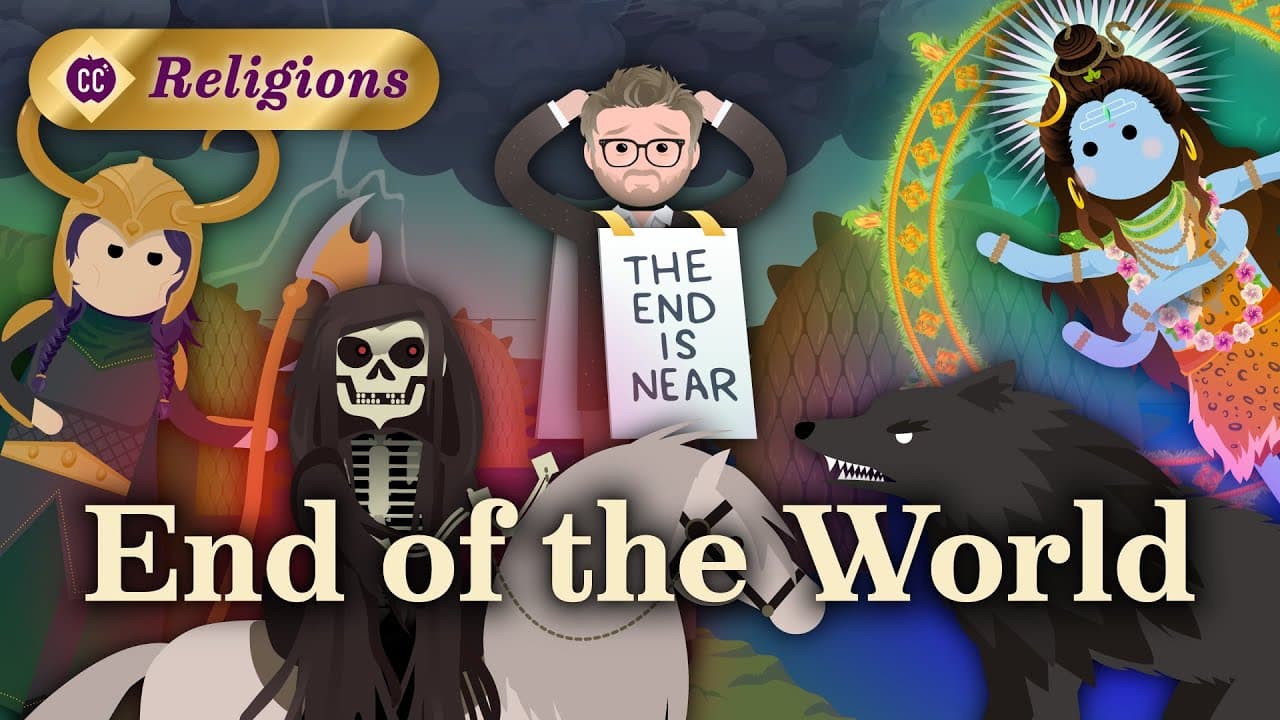
Visions of the End of the World: Crash Course Religions #22
TL;DR
Apocalyptic stories reflect current societal fears and challenges.
Transcript
Hi! I'm John Green. Welcome to Crash Course Religions. So the poet Robert Frost, when pondering the end of the world, wrote, “Some say the world will end in fire. Some say in ice. From what I’ve tasted of desire. I hold with those who favor fire.” Setting aside the irony of a man named Frost favoring fire, his now famous poem envisions the world e... Read More
Key Insights
- Apocalyptic stories across religions often reflect the societal fears and challenges faced by their believers, rather than predicting actual future events.
- The concept of apocalypse originally meant 'revelation' or 'unveiling' in Greek, often involving divine beings revealing the world's fate to prophets.
- Jewish apocalypticism emerged during oppressive periods, like under the Seleucid Empire, predicting the destruction of evil forces and God's kingdom on Earth.
- The Book of Revelation in Christianity uses metaphors like '666' to critique Roman oppression, showing how apocalyptic texts address contemporary issues.
- Norse mythology's Ragnarök depicted a shift from paganism to Christianity, paralleling Iceland's volcanic eruptions and cultural changes at the time.
- Hinduism's Kali Yuga and Shi’a Islam's Mahdi are examples of apocalyptic beliefs that adapt ancient narratives to modern societal issues.
- When apocalyptic prophecies fail, followers often reinterpret them, claiming spiritual fulfillment or blaming misinterpretations to maintain belief.
- Apocalyptic stories, like Robert Frost's poem, are flexible and open to interpretation, reflecting both historical and current fears.
Install to Summarize YouTube Videos and Get Transcripts
Explore YouTube Video Summarizer or Get YouTube Transcript Extractor
Questions & Answers
Q: What is the original meaning of the word 'apocalypse'?
The original meaning of 'apocalypse' in Greek is 'revelation' or 'unveiling.' It refers to a narrative where a divine being, such as an angel, reveals the fate of the world to a prophet. This meaning is distinct from the modern association of apocalypse with catastrophic end-of-the-world scenarios.
Q: How do apocalyptic narratives address societal fears?
Apocalyptic narratives often address societal fears by reflecting the contemporary issues and challenges faced by the people who create them. These stories are not just predictions of future events but are deeply rooted in the present concerns, such as oppression, political turmoil, and cultural shifts, offering a form of explanation or hope for change.
Q: What role did apocalyptic literature play for Jewish people under the Seleucid Empire?
For Jewish people under the Seleucid Empire, apocalyptic literature served as a means to explain their oppression and predict the end of evil forces. This literature, like the Book of Daniel, provided hope by envisioning a future where God would destroy these forces and establish His kingdom on Earth, offering a form of resistance and resilience.
Q: How does the Book of Revelation use metaphors to address contemporary issues?
The Book of Revelation uses metaphors, such as the 'number of the beast' (666), to critique and address contemporary issues like Roman oppression. By encoding messages through symbolic language, the text spoke to early Christians' fears and challenges, such as persecution, while critiquing the political powers of the time.
Q: What is Ragnarök and how does it reflect Norse societal changes?
Ragnarök in Norse mythology describes the end times with signs like battles and world destruction. It reflects societal changes, such as the shift from paganism to Christianity in Iceland, and parallels natural events like volcanic eruptions. This narrative addressed fears about cultural transitions and environmental disasters, showing how apocalyptic stories adapt to current contexts.
Q: How do Hinduism's Kali Yuga and Shi’a Islam's Mahdi relate to modern issues?
Hinduism's Kali Yuga and Shi’a Islam's Mahdi relate to modern issues by adapting ancient narratives to contemporary concerns. Kali Yuga is associated with disorder and injustice, which some link to rising cancer rates, while the Mahdi is seen as a messianic figure who will guide people toward justice, often invoked during times of political and economic inequality.
Q: What happens when apocalyptic prophecies fail?
When apocalyptic prophecies fail, followers often reinterpret them to maintain their beliefs. They might claim the prophecy was fulfilled spiritually, blame misinterpretations, or see it as a test of faith. This flexibility allows the narrative to persist, as seen with groups like Jehovah's Witnesses and QAnon, who adapt their beliefs despite unfulfilled predictions.
Q: How are apocalyptic stories similar to poetry, according to the transcript?
Apocalyptic stories are similar to poetry in their flexibility, evolution, and openness to interpretation. Just as poetry can convey multiple meanings and adapt to different contexts, apocalyptic narratives can be reinterpreted to address both historical and current fears, reflecting the concerns of the people who engage with them across time.
Summary & Key Takeaways
-
Apocalyptic narratives across various religions often reflect the societal fears and challenges of the time, rather than predicting actual future events. These stories reveal much about the concerns of the people who created them, as they often address the most pressing issues of their era.
-
The concept of apocalypse originally meant 'revelation' in Greek, involving divine beings revealing the world's fate to prophets. Throughout history, oppressed groups have developed apocalyptic literature to explain their struggles and predict the end of their oppression.
-
When apocalyptic prophecies fail, followers often reinterpret them to maintain their beliefs. This can involve claiming spiritual fulfillment, blaming others for misinterpretations, or seeing the prophecy as a test of faith. Such flexibility allows these narratives to persist across time.
Read in Other Languages (beta)
Share This Summary 📚
Summarize YouTube Videos and Get Video Transcripts with 1-Click
Try YouTube Summary with ChatGPT & Claude or YouTube Transcript Generator
Explore More Summaries from CrashCourse 📚


Summarize YouTube Videos and Get Video Transcripts with 1-Click
Try YouTube Summary with ChatGPT & Claude or YouTube Transcript Generator