What Can Dream Science Reveal About Waking Life
TL;DR
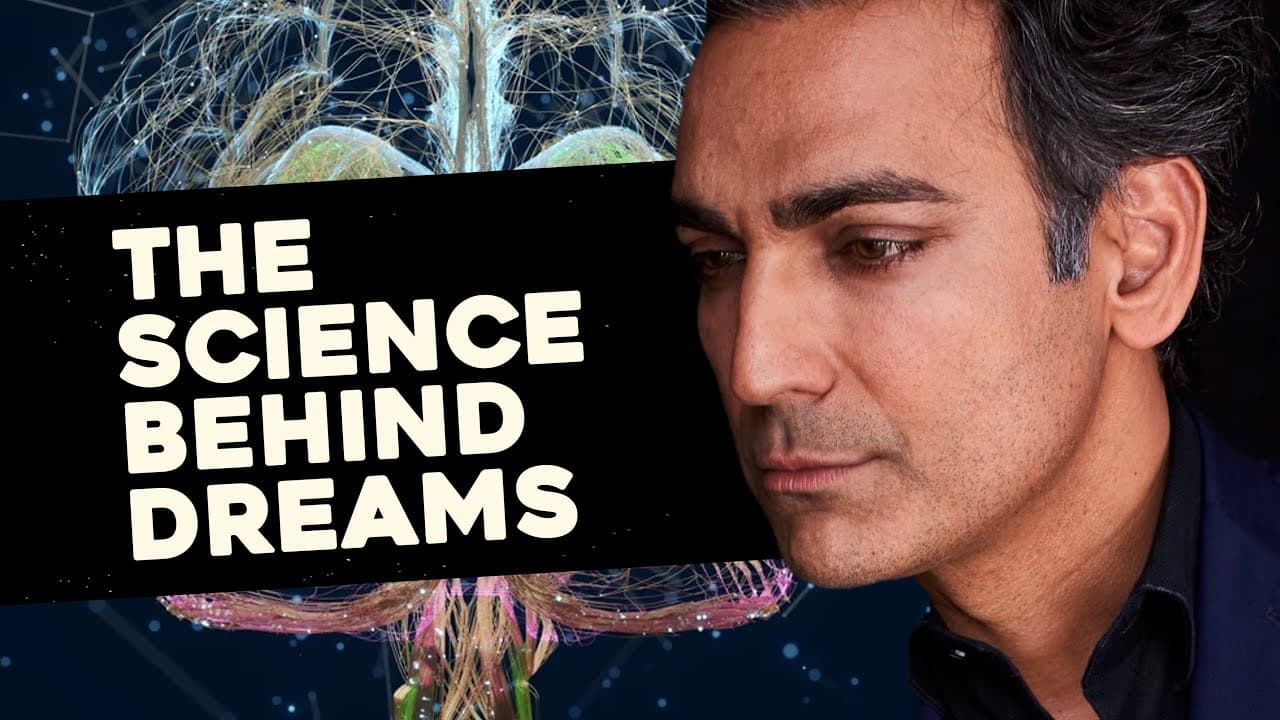
Dreams originate in the brain, shown by awake brain surgery where stimulation evokes dreamlike experiences and reports. Sleep likely evolved to support dreaming, shaping how we think and act when awake, through patterns and networks that differ from wakefulness and can be studied with imaging and EEG.
Transcript
good evening everybody um it's not every day that you get to introduce someone as being a neurosurgeon and then an and um but tonight's guest is a neurosurgeon and a neurobiologist and we couldn't be more delighted to be welcoming Dr Rahul jandel to the stage today to talk to us about what we can learn about uh being awake from the time that we spe... Read More
Key Insights
- Dreams come from the brain, demonstrated by awake brain surgery where stimulating brain tissue can evoke dream memories or nightmares.
- The waking brain and the dreaming brain are the same organ, but they recruit different networks during different states, leading to distinct patterns of activity.
- The prefrontal cortex is dampened during dreaming, reducing logic and complex calculation in favor of imaginative experiences.
- The dreaming mind often relies on the imagination network rather than the executive network, enabling fantastical and nonlogical dream content.
- Dream reports and brain imaging show consistent patterns that link reported dream content with specific brain activity.
- Electrical measurements from scalp electrodes reveal the brain’s electrical phenomenon underlying thoughts, emotions, and dreams.
- Dreaming provides a framework to understand waking cognition, emotions, and behavior by mapping dream patterns to brain activity.
- Historically, dream ideas moved from external explanations to brain-based proofs through technologies like awake brain surgery and EEG imaging, aligning ancient curiosity with modern neuroscience.
- Dream science aims to connect thousands of dream reports with measurable brain activity to explain why dreams occur and how they influence waking life.
Install to Summarize YouTube Videos and Get Transcripts
Explore YouTube Video Summarizer or Get YouTube Transcript Extractor
Questions & Answers
Q: What is the basic proof that dreams come from the brain?
The fundamental proof is awake brain surgery observations where the brain surface can be stimulated with electrical currents and patients report dream memories or nightmares. This demonstrates that dreaming experiences can be elicited directly by the brain, confirming that dreams originate from neural activity rather than external sources.
Q: How do the waking and dreaming brains differ in their networks?
During wakefulness the brain engages the executive network for planning and control, while dreaming more strongly involves the imagination network. This shift explains why dreams often feel spontaneous, illogical, and highly visual, as the brain reorganizes activity across networks to generate vivid imagery.
Q: What role does the prefrontal cortex play in dreams?
In dreaming, the prefrontal cortex is dampened, reducing logical processing and calculation. This lower activity level helps explain the surreal, non-linear, and sometimes absurd nature of dreams, as critical reasoning is not the primary driver of dream content.
Q: Why does dreaming feel so vivid if logic is dampened?
Dream vividness is supported by the imagination network and other sensory-rich brain regions that remain active, plus global brain states during sleep that amplify emotional and perceptual experiences. The combination allows for intense, cinematic dream scenes even without logical constraints.
Q: Can brain recordings predict dream content or themes?
Brain recordings and dream reports show correlations between certain brain activation patterns and common dream themes, such as flying or falling. While not predicting exact content, researchers can link reported dreams to specific activity in networks responsible for imagination and emotion.
Q: What is the historical significance of dream research developments?
Historically, dream ideas shifted from external explanations to brain-based proofs through technologies like EEG and awake brain stimulation. This progression moved the understanding of dreams from mystery to a measurable phenomenon rooted in neural activity, aligning scientific methods with long-standing questions about dreaming.
Q: How might sleep and dreaming influence waking life, according to this talk?
If dreaming reflects the brain’s integrative processes, the patterns observed during sleep could shape emotions, creativity, and cognition when awake. Understanding dreaming could illuminate how experiences, memories, and emotions are organized, potentially guiding practices to improve waking life and mental health.
Q: What is the speaker’s main claim about why we sleep?
The speaker argues that we sleep because we must dream, suggesting that dreaming serves a functional role in processing emotions, memories, and cognitive patterns. This perspective frames sleep as a necessary state for maintaining brain function and adaptive behavior when awake.
Summary & Key Takeaways
-
Dreams originate in the brain and can be triggered by direct brain stimulation, proving a brain-based source for dreaming. The waking and dreaming brain share an organ but engage different networks, which explains the odd vividness and variability of dream content.
-
The prefrontal cortex shows dampened activity during dreaming, reducing logical reasoning and math use, which allows for vivid imagination and unusual dream sequences that do not rely on everyday logic.
-
Electrical activity and metabolic signals reveal that dreaming involves the imagination network, not always the executive network, and that large-scale brain patterns underlie common dream themes and transitions between sleep stages.
Read in Other Languages (beta)
Share This Summary 📚
Summarize YouTube Videos and Get Video Transcripts with 1-Click
Try YouTube Summary with ChatGPT & Claude or YouTube Transcript Generator
Explore More Summaries from How To Academy 📚


Summarize YouTube Videos and Get Video Transcripts with 1-Click
Try YouTube Summary with ChatGPT & Claude or YouTube Transcript Generator