Why Are Grocery Prices Rising So Quickly?
TL;DR
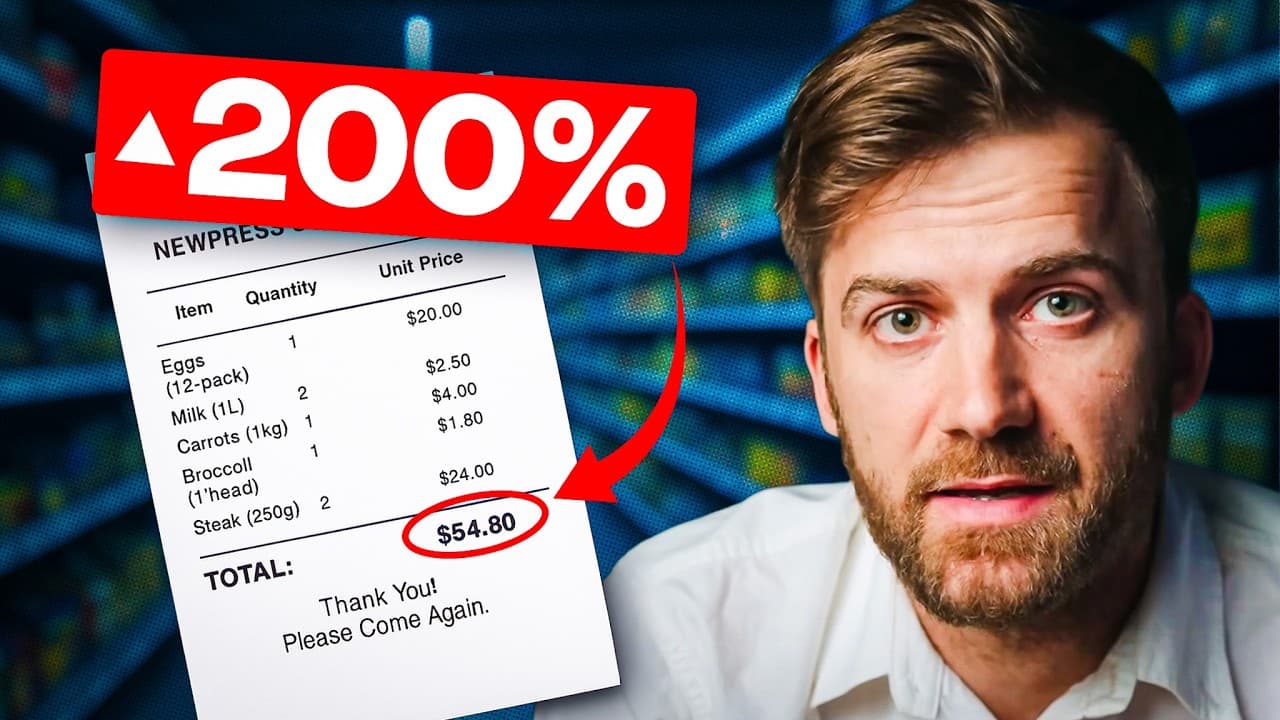
Grocery prices rose from their usual 1% or 2% annual increases to roughly 13%, with COVID, broader inflation, and the structure of the food system presented as contributing factors. Modern supply chains make imported food remarkably affordable, but their many farms, refrigerated trucks, borders, transfer stations, and distribution centers also reveal how complicated the journey to a grocery shelf has become.
Transcript
(paper thuds) - Eggs, milk, bread, ground beef, butter. Prices at the grocery store are going up. Especially for people who spend a large amount of their income on food. So a little price shock can have huge effects. Grocery prices that usually go up 1% or 2% a year have started jumping to more like 13% a year. - Prices are going up yet again. - [N... Read More
Key Insights
- Grocery price inflation is described as accelerating from a typical 1% or 2% per year to roughly 13% per year, creating especially serious consequences for households that spend a large share of their income on food.
- Food affordability improved dramatically over time as trade, technology, and logistics became more efficient. British households spent about 75% of their income on food in the late 1700s, while the reported share fell to 42% by 1900 and 34% during the 1930s.
- The postwar global economic system increased efficiency by connecting economies through shared rules, international agreements, and the United States dollar. Its architects believed economic interdependence could make countries benefit too much from cooperation to fight one another.
- Standardization is a foundation of modern trade because common container, railroad, pallet, paper, barcode, shoe, and screw specifications allow goods and components to move between countries and transportation systems with less friction, loading time, and cost.
- Fresh-food supply chains work by carefully controlling timing and temperature. Mexican tomatoes can be picked green, exposed to the naturally occurring hormone ethylene for coordinated ripening, sorted, chilled, palletized, transported in refrigerated trucks, cleared through customs, and repackaged before sale.
- Imported tomatoes can complete a nine-day journey of about 1,000 kilometers and still sell for about $2 per pound. The comparison with a locally grown $6 tomato demonstrates how industrial scale and coordinated logistics can outweigh geographic proximity in determining retail prices.
- Foreign suppliers provide much of the produce sold in the United States. The transcript states that Mexico sends four billion pounds of tomatoes into the country each year and that about 60% of United States vegetables come from other countries.
- Record corporate profits, rising chief executive compensation, and large shareholder payouts are presented as reasons to examine corporate incentives and power. The provided transcript raises their possible relationship to rising grocery prices, but it does not establish a complete causal conclusion before ending.
Install to Summarize YouTube Videos and Get Transcripts
Explore YouTube Video Summarizer or Get YouTube Transcript Extractor
Questions & Answers
Q: Why are grocery prices rising so quickly?
Grocery prices are described as rising because of COVID, broader inflation, and larger forces within the food system. The transcript reports that annual increases shifted from a usual 1% or 2% to roughly 13%. It also points to record food-company profits, rising chief executive compensation, and large shareholder payouts as issues requiring scrutiny, although the provided excerpt does not complete the causal analysis.
Q: How does the global food supply chain affect grocery prices?
The global food supply chain can lower prices by combining specialized production, industrial scale, standardized transportation, refrigeration, and coordinated distribution. A product may cross borders and pass through many facilities while remaining cheaper than a nearby alternative. At the same time, the journey requires farms, trucks, customs processing, transfer stations, inventory systems, repackaging, and temperature control, making the system highly complex.
Q: How do tomatoes travel from Mexico to United States grocery stores?
Tomatoes are often picked by hand while still green, loaded onto trucks, and exposed to ethylene so they ripen at a coordinated time. They are sorted, chilled, placed on pallets, and transported north in refrigerated trucks. After customs and a possible trailer transfer to an American driver, they travel to a distribution center for scanning and repackaging before reaching grocery shelves.
Q: Why can imported tomatoes cost less than local tomatoes?
Imported tomatoes can cost less because the global system uses large-scale production and highly coordinated logistics. The example compares a local tomato costing $6 with imported tomatoes selling for about $2 per pound after a nine-day, 1,000-kilometer journey. The transcript uses this contrast to show that distance alone does not determine price when standardized transportation, refrigeration, sorting, and distribution operate efficiently.
Q: How did food become more affordable over time?
Food became more affordable as societies expanded trade, invented better technology, and built systems that moved goods more efficiently. After World War II, shared standards for containers, pallets, railroads, barcodes, and other components further reduced costs and loading time. The change appears in household spending: Britain moved from about 75% of income spent on food in the late 1700s to 42% by 1900.
Q: Why is standardization important to modern food trade?
Standardization allows goods to move smoothly among farms, factories, ships, trains, trucks, warehouses, and stores. Common container, pallet, railroad, barcode, paper, shoe, and screw specifications reduce incompatibility and unnecessary handling. The transcript describes this infrastructure as largely invisible but transformative because every participant can use the same system, making trade faster, more connected, and less costly.
Q: What role does refrigeration play in transporting fresh food?
Refrigeration helps prevent fresh produce from becoming too hot, too cold, spoiled, or damaged during long journeys. Mexican tomatoes are chilled after sorting and then carried in refrigerated trucks toward the border and through the United States. Temperature control works alongside early picking and coordinated ripening, allowing perishable food to survive multiple transfers and arrive at grocery stores ready for sale.
Q: Are food corporations responsible for higher grocery prices?
The transcript identifies record food-company profits, increased chief executive compensation, and large shareholder payouts as reasons to investigate corporate power and incentives. However, the supplied excerpt ends before demonstrating exactly how corporate decisions affect individual prices or how much of the roughly 13% grocery-price increase they explain. It therefore presents corporate behavior as a major question, not a fully proven sole cause.
Summary & Key Takeaways
-
Food historically consumed most household income, but trade, technology, standardization, and global economic integration steadily reduced that burden. British households spent about 75% of their income on food in the late 1700s, compared with 42% by 1900 and 34% during the 1930s, illustrating a long decline in food costs.
-
After World War II, the United States and its allies created a more connected global economic system. Standardized containers, pallets, railroad sizes, barcodes, currencies, and trade rules reduced costs and loading time. These largely invisible systems allowed products and components to travel efficiently across borders and helped construct modern supply chains.
-
A tomato grown in Mexico can be picked green, ripened with ethylene, sorted, chilled, transported across the border, transferred between drivers, processed at a distribution center, and displayed in a United States grocery store. The described journey takes nine days and about 1,000 kilometers, yet the imported tomatoes cost substantially less than a local $6 tomato.
Read in Other Languages (beta)
Share This Summary 📚
Summarize YouTube Videos and Get Video Transcripts with 1-Click
Try YouTube Summary with ChatGPT & Claude or YouTube Transcript Generator
Explore More Summaries from Johnny Harris 📚






Summarize YouTube Videos and Get Video Transcripts with 1-Click
Try YouTube Summary with ChatGPT & Claude or YouTube Transcript Generator