Arduino power meter based on the ACS 712 and the ADS1115
TL;DR
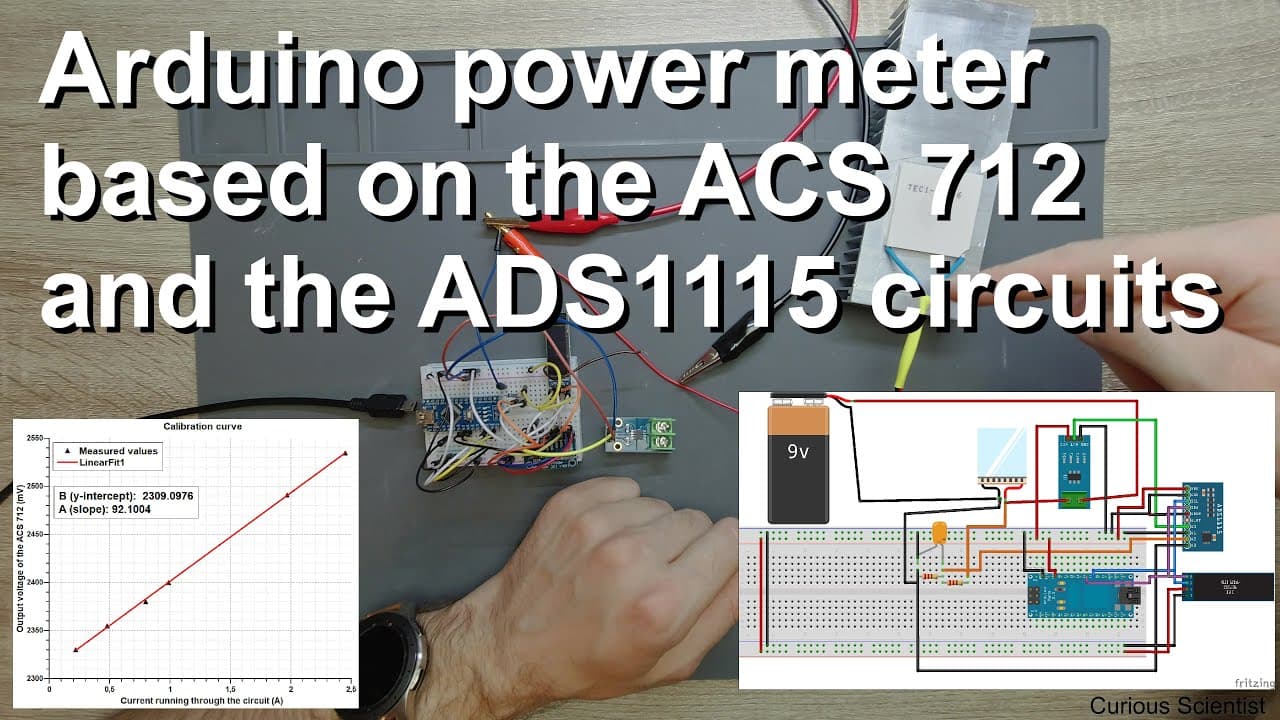
This video demonstrates how to measure voltage and current in a Peltier cooler circuit using Arduino.
Transcript
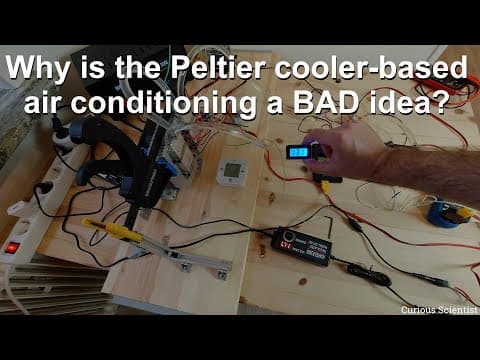
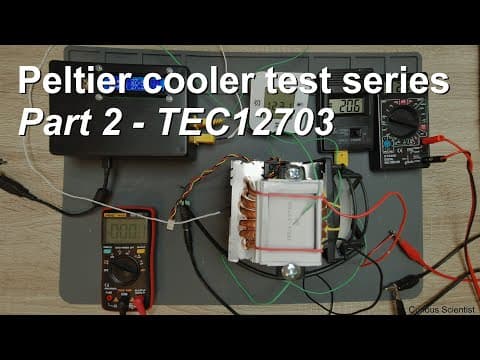
welcome everyone in this video I'm going to share my parameter with you so as you can see we have a little bit crowded breadboard and then we have a Peltier cooler attached to a heatsink so this is the tec 12 706 so it's a 6 ampere unit I will use this as our load it's not the best load because when it is under voltage or current it will change its... Read More
Key Insights
- 🧑🏭 The Peltier cooler acts as the primary load in the demonstration, showcasing how temperature affects current and resistance in a circuit.
- 👻 The Arduino Nano is central to processing data, allowing users to visualize and interpret measurements on the OLED display.
- ⚡ Accurate resistor values in voltage dividers are critical; even minor discrepancies can yield significant errors in voltage readings.
- 🛩️ The ADS1115's differential mode facilitates enhanced measurement of small voltage changes, making it ideal for applications where precision is crucial.
- ❓ Results from the current measurements reveal fluctuations that can be attributed to the thermal dynamics of the Peltier device.
- 😎 The setup offers practical insights into working with Peltier coolers in cooling and heating applications, emphasizing power management.
- 🧡 Users can apply the knowledge gained from this video to a range of projects involving similar electronic measurement tasks.
Install to Summarize YouTube Videos and Get Transcripts
Explore YouTube Video Summarizer or Get YouTube Transcript Extractor
Questions & Answers
Q: What components are used in the Peltier cooler measurement setup?
The setup utilizes a Peltier cooler (TEC 12-706), an Arduino Nano, a 128x32 OLED display, an ADS1115 ADC for voltage measurements, and an ACS712 current sensor to monitor current flow. Each component plays a critical role in ensuring accurate readings and overall circuit performance.
Q: How does the ADS1115 ADC work in this circuit?
The ADS1115 ADC converts the analog voltage from the voltage divider in the circuit into a digital signal readable by the Arduino. It has a 16-bit resolution, which provides high precision in measuring the voltage across components. By configuring it in differential mode, the ADC can effectively track small voltage differences caused by changes in load.
Q: Why is calibration important in this measurement setup?
Calibration ensures that the data collected from the sensors accurately reflects the actual current and voltage values. By measuring known quantities and establishing a linear relationship between sensor output and real values, users can adjust their readings, making them reliable for further analysis and experimentation.
Q: What is the role of the voltage divider in this setup?
The voltage divider reduces the voltage range to a level that can be safely measured by the ADS1115, which cannot exceed its maximum input voltage of 5 volts. By choosing appropriate resistor values, the divider ensures that the voltage applied to the ADC remains within safe limits, allowing for accurate voltage readings from the Peltier cooler.
Summary & Key Takeaways
-
The video outlines the construction of a circuit involving a Peltier cooler, Arduino, and additional components for measuring voltage and current.
-
It explains the operation of an ADS1115 ADC for precise voltage measurements and an ACS712 current sensor for current readings, showcasing the necessary configurations and connections.
-
Calibration techniques are discussed to ensure accurate current and voltage readings, reinforcing the importance of resistor values in voltage dividers for optimal performance.
Read in Other Languages (beta)
Share This Summary 📚
Summarize YouTube Videos and Get Video Transcripts with 1-Click
Try YouTube Summary with ChatGPT & Claude or YouTube Transcript Generator
Explore More Summaries from Curious Scientist 📚
Summarize YouTube Videos and Get Video Transcripts with 1-Click
Try YouTube Summary with ChatGPT & Claude or YouTube Transcript Generator