How Does Comma AI Achieve Self-Driving with End-to-End ML?
TL;DR
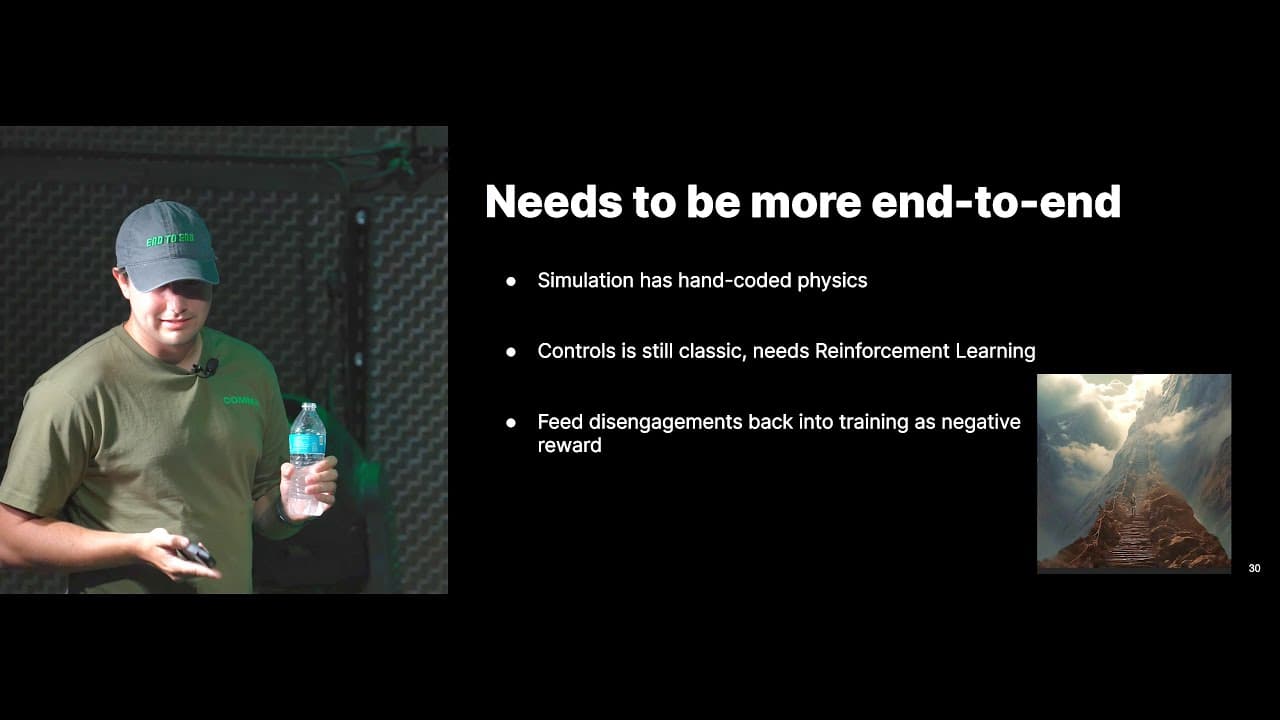
Comma AI's end-to-end machine learning approach aims to create a superhuman driving agent by processing raw sensor data directly without hand-coded rules. This method allows for scalability and adaptability in driving behavior, overcoming challenges related to simulator accuracy and bug fixing for lateral and longitudinal control. Recent advancements demonstrate real-time autonomous driving capabilities, as evidenced by their successful drive to Taco Bell.
Transcript
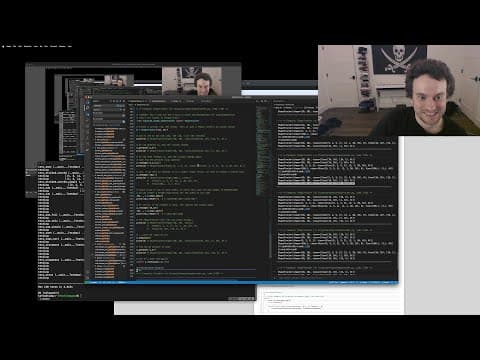
hello good morning welcome to Comic-Con and uh yeah so I'm Harold I'm CTO and I'll be walking through our drive to Taco Bell last year we drove to Taco Bell with one of our open pilot cars in uh mostly end-to-end system I'm gonna be walking through that and just general stuff that research is working on so we start off with I'm gonna just recap som... Read More
Key Insights
- ❤️🩹 End-to-end autonomous driving system for self-driving cars aims for a superhuman driving agent surpassing human capabilities.
- 🤗 Training models directly on sensor data without hand-coded constraints allows for flexible machine learning behavior and scalability with increasing compute power.
- 🐛 Challenges include refining simulators for diverse scenarios, bug fixes, and optimization to achieve reliable lateral and longitudinal control.
Install to Summarize YouTube Videos and Get Transcripts
Explore YouTube Video Summarizer or Get YouTube Transcript Extractor
Questions & Answers
Q: How does the end-to-end system for self-driving cars differ from traditional perception-based approaches?
The end-to-end system puts sensor data directly into neural networks to make driving decisions without relying on hand-coded constraints or intermediate layers like perception systems.
Q: What are the key components of the end-to-end autonomous driving system discussed in the presentation?
The system consists of end-to-end lateral control for steering, end-to-end longitudinal control for gas and brakes, and map-based navigation to reach a destination, all trained with machine learning models.
Q: How does the system handle challenges like simulating real-world scenarios for training neural networks?
The system uses a simulator that augments real video data to reflect diverse driving situations and interactions while continuously refining the models based on feedback from real-world driving.
Q: What are some future advancements planned for the end-to-end autonomous driving system in terms of reinforcement learning and general-purpose robotics applications?
The team aims to explore reinforcement learning for iterative improvements, simplify controls, leverage machine learning for simulations, and expand into general-purpose robotics beyond driving applications.
Summary & Key Takeaways
-
Harold, CTO, discusses the research's goal to create a superhuman driving agent through an end-to-end self-driving system.
-
The system is designed for scalability with increasing compute power and relies on machine learning models trained on diverse data without hand-coded constraints.
-
Challenges such as simulator refinement and bug fixing have led to progress in lateral and longitudinal control for safe autonomous driving.
Read in Other Languages (beta)
Share This Summary 📚
Summarize YouTube Videos and Get Video Transcripts with 1-Click
Try YouTube Summary with ChatGPT & Claude or YouTube Transcript Generator
Explore More Summaries from george hotz archive 📚

Summarize YouTube Videos and Get Video Transcripts with 1-Click
Try YouTube Summary with ChatGPT & Claude or YouTube Transcript Generator