How Does a Machine Learning Driving Simulator Work?
TL;DR
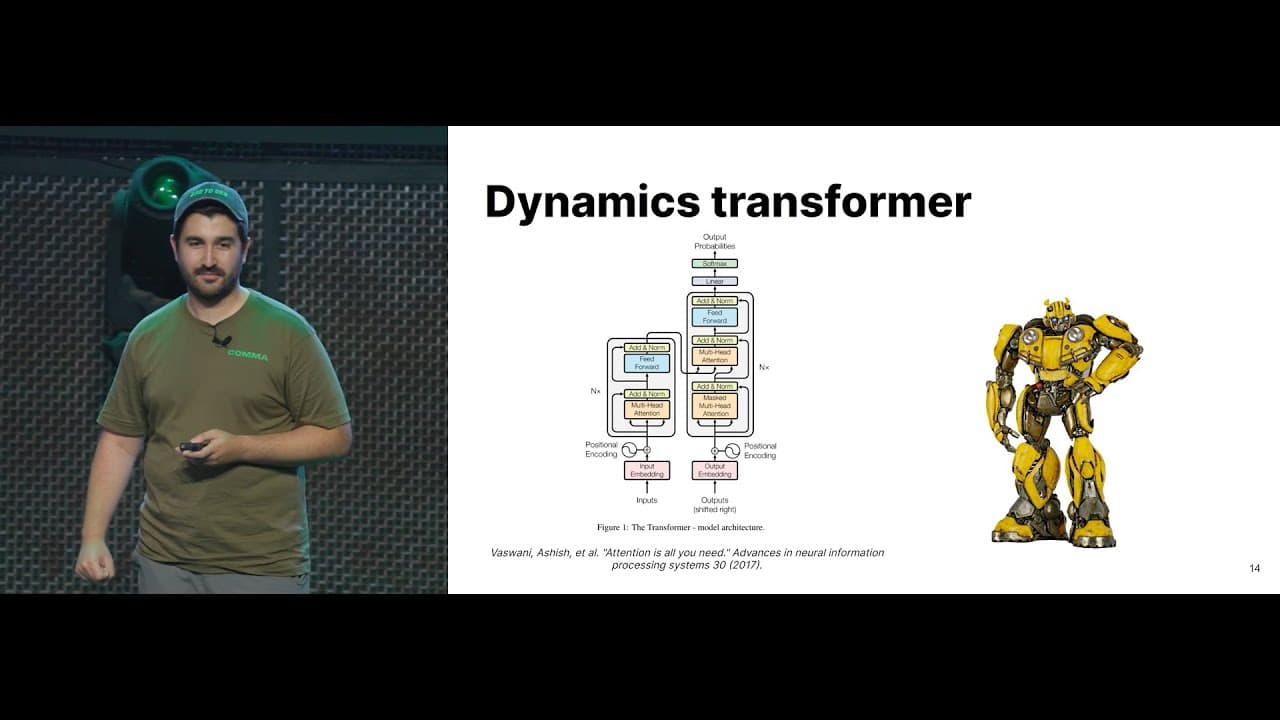
A machine learning driving simulator uses image and pose tokenization to predict future frames and improve driving models by exposing them to varied scenarios and noise. This approach overcomes the limitations of traditional simulators, enabling more realistic training environments. The simulator consists of components like an image tokenizer, pose tokenizer, and dynamic transformer to enhance driving dynamics and reduce artifacts.
Transcript
hi everyone uh my name is Yin I work uh in research here at Kama and uh I was excited about some machine learning yes I heard that I haven't started presenting yet and I already have some questions so I guess I'll answer them later not forget so uh today I'm going to talk to you about our progress in learning a drive-in simulator um so it's been a ... Read More
Key Insights
- 🌍 A simulator is necessary to expose driving models to real-world noise and deviations.
- 🏛️ Classic simulators are useful for testing but not suitable for training driving models at scale.
- 🎰 The machine learning simulator consists of image tokenizer, pose tokenizer, and dynamic transformer components.
- ◾ The current small offset simulator has limitations in terms of simulator artifacts and lack of temporal consistency.
- 🈸 The simulator has the potential to improve driving models and can be extended to other applications such as robotics.
- 🎮 Further improvements can be made in training efficiency and reducing flickering in the generated videos.
- 😒 The use of tokenization allows for a compressed representation of driving data, providing a more efficient training method.
Install to Summarize YouTube Videos and Get Transcripts
Explore YouTube Video Summarizer or Get YouTube Transcript Extractor
Questions & Answers
Q: Why is a simulator necessary for training driving models?
A simulator is needed to expose driving models to significant noise and deviations, which allows them to learn to recover from mistakes and handle real-world driving situations.
Q: Why not use a classical simulator like Unity or Unreal Engine?
Classic simulators are useful for testing but not ideal for training driving models. They require manually coding various scenarios and struggle to match the complexity and distribution of real-world driving data.
Q: How does the machine learning simulator work?
The simulator consists of three components - an image tokenizer, a pose tokenizer, and a dynamic transformer. The image tokenizer compresses images into tokens, while the pose tokenizer quantizes pose information. The dynamic transformer is based on the Transformer architecture and generates future frames in a video.
Q: What are the limitations of the current simulator?
The small offset simulator suffers from simulator artifacts and struggles to handle large offsets in driving. Additionally, it lacks temporal consistency due to its frame-by-frame encoding approach.
Summary & Key Takeaways
-
The presenter introduces their progress in developing a machine learning simulator for driving, which generates realistic videos based on a few frames of context.
-
The simulator addresses the need for exposure to significant noise and deviations in training driving models, which is not possible without a simulator.
-
The current simulator, known as the small offset simulator, has limitations in terms of driving dynamics and simulator artifacts, and the presenter explains the need for a new approach.
Read in Other Languages (beta)
Share This Summary 📚
Summarize YouTube Videos and Get Video Transcripts with 1-Click
Try YouTube Summary with ChatGPT & Claude or YouTube Transcript Generator
Explore More Summaries from george hotz archive 📚
Summarize YouTube Videos and Get Video Transcripts with 1-Click
Try YouTube Summary with ChatGPT & Claude or YouTube Transcript Generator