How to Code a Deep Q Learning Agent with PyTorch
TL;DR
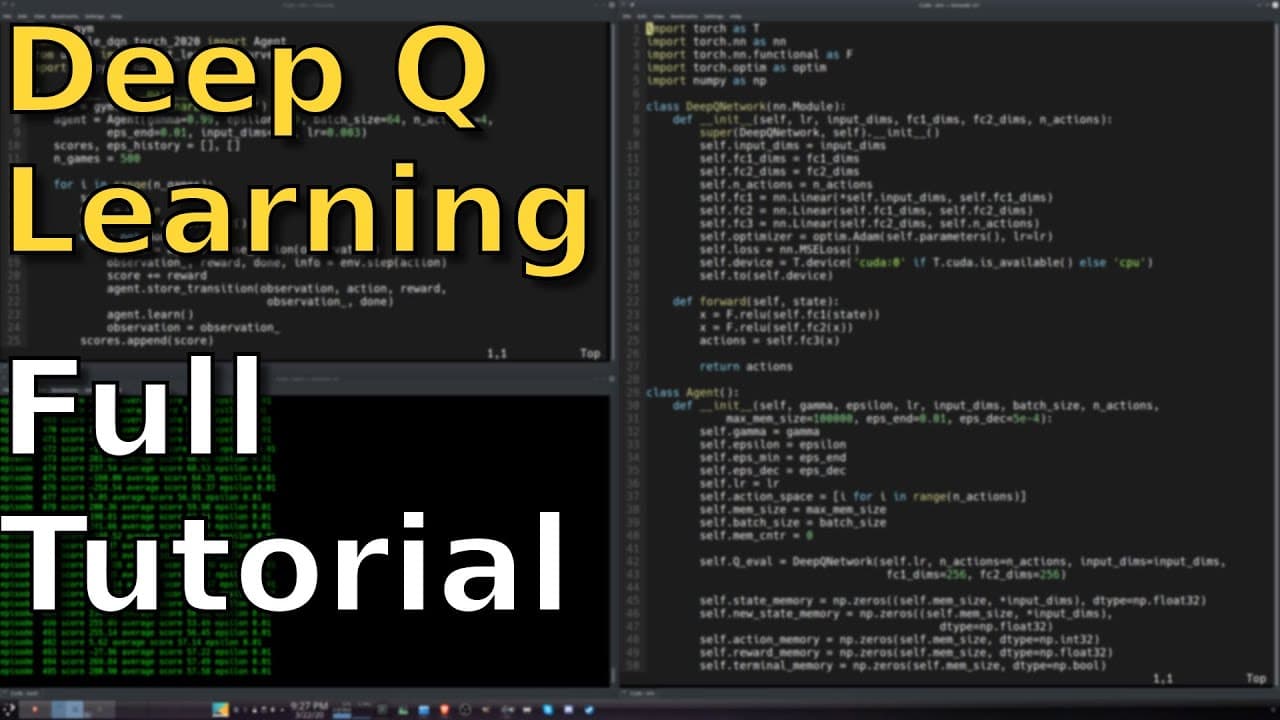
To code a deep Q learning agent using PyTorch, follow a structured approach that includes creating the agent and network classes, managing a replay memory, and implementing an epsilon-greedy policy for action selection. This tutorial simplifies the process, not utilizing a target network, yet allows the agent to learn effectively from experience, balancing exploration and exploitation as it interacts with the environment.
Transcript
in today's video you're gonna learn how to code a deep Q learning agent from scratch in the PI towards framework you don't need any prior exposure to deep learning you don't need any prior exposure to reinforcement learning you just have to follow along let's get started so first a couple announcements first of all this is a repeat of an earlier vi... Read More
Key Insights
- 🇶🇦 PyTorch is used to implement deep Q learning and create a deep neural network for action value estimation.
- 🍝 The deep Q learning agent maintains a replay memory of past experiences.
- ⚾ The agent learns by updating its action value function based on a batch of memory samples.
- ⚖️ The agent balances exploration and exploitation through an epsilon-greedy policy.
- 🎯 The simplified agent in this tutorial does not include a target network but still achieves decent performance on the Lunar Lander environment.
- ☠️ The learning rate parameter in the agent's optimizer affects the agent's performance and may need to be adjusted.
- 😘 The agent's performance can be improved by using a lower learning rate and potentially including a target network in the future.
Install to Summarize YouTube Videos and Get Transcripts
Explore YouTube Video Summarizer or Get YouTube Transcript Extractor
Questions & Answers
Q: What is the main purpose of using PyTorch in this coding tutorial?
PyTorch is used to implement deep Q learning and create a deep neural network to estimate action values based on observed states.
Q: What is the significance of using a replay memory in the deep Q learning agent?
Replay memory allows the agent to store and sample past experiences, reducing the correlation between consecutive samples and improving learning stability.
Q: Why is the target network not included in the simplified version of the agent?
In this case, the target network is not necessary for the Lunar Lander environment, but it is typically used in more advanced versions of the agent to improve learning stability.
Q: How is the exploration-exploitation dilemma handled in the agent's action selection?
The agent uses an epsilon-greedy policy, where it chooses the best-known action with a probability of (1-epsilon) and explores randomly with a probability of epsilon.
Summary & Key Takeaways
-
The video provides a step-by-step guide on coding a deep Q learning agent using PyTorch, with no prior knowledge required.
-
The code uses a simplified version of the agent and the DLQ network classes, without including a target network.
-
The agent stores memories of states, actions, rewards, new states, and terminal flags, and learns by updating its action value function based on the memory samples.
-
The learning process includes choosing actions, updating Q values, and gradually reducing the exploration rate.
Read in Other Languages (beta)
Share This Summary 📚
Summarize YouTube Videos and Get Video Transcripts with 1-Click
Try YouTube Summary with ChatGPT & Claude or YouTube Transcript Generator
Explore More Summaries from Machine Learning with Phil 📚


Summarize YouTube Videos and Get Video Transcripts with 1-Click
Try YouTube Summary with ChatGPT & Claude or YouTube Transcript Generator