What Are Peptide Therapies and How Do They Work?
TL;DR
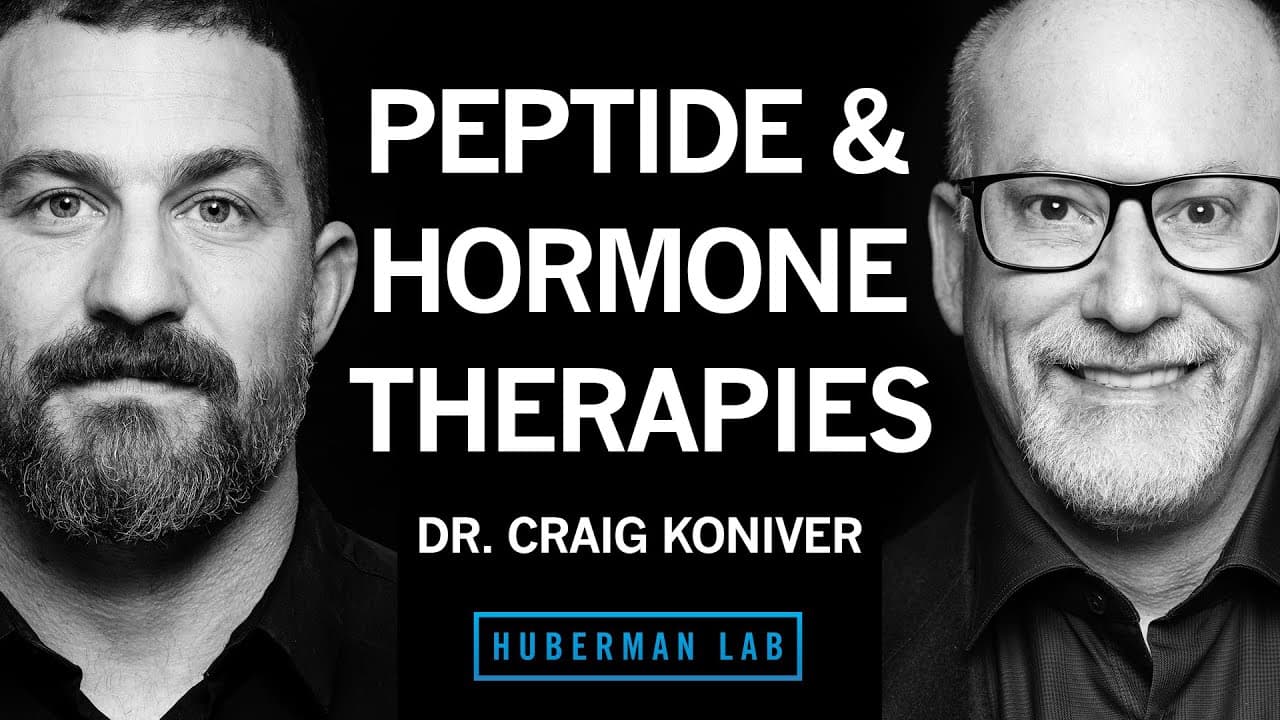
Peptides are chains of amino acids, defined as 40 amino acids or fewer, with anything 41 or longer classed as a protein. The body makes roughly 300,000 of them, while only about 150 have been used therapeutically. Peptide therapies sit between supplements and full hormone therapies because they can augment hormone pathways without shutting down the body's own production.
Transcript
welcome to the huberman Lab podcast where we discuss science and science-based tools for everyday life I'm Andrew huberman and I'm a professor of neurobiology and Opthalmology at Stanford School of Medicine my guest today is Dr Craig conver Dr Craig conver is a medical doctor who did his training at Brown University and Thomas Jefferson University ... Read More
Key Insights
- A peptide is defined by length: chains of 40 amino acids or fewer are peptides, and 41 or more makes it a protein. Amino acids are all naturally occurring molecules, so peptides are built from the same components the body already uses.
- The human body makes roughly 300,000 peptides, according to Koniver, while only around 150 have been used therapeutically over the years. That gap is why the field is described as blossoming and still very early in clinical understanding.
- Peptide therapies occupy a middle rung between supplementation and advanced hormone therapies. Growth hormone and testosterone therapies can shut down the body's own endogenous production through negative feedback, whereas peptides tend not to operate in that feedback cycle.
- Insulin is a peptide, and peptide-based treatment is not new: insulin has been used for many years to treat conditions such as diabetes. What is new is the use of exogenous peptides to activate multiple pathways in the brain and body for health augmentation.
- Semaglutide was approved for type 2 diabetics to help with glucose control and glucose utilization before weight loss became its headline use. Weight loss emerged as a side effect in those patients, and word of that effect drove adoption.
- GLP-1 agonists have accelerated to become the number one prescribed drug category in America, according to Koniver, with the weight loss application only taking hold in the last couple of years despite the earlier diabetes approval.
- BPC-157, or body protection compound 157, is used to treat inflammation and accelerate wound healing among other applications. It is one of the lesser known peptides that is growing in use outside the widely publicized GLP-1 category.
- Most medicines prescribed in America are prescribed off label, meaning they were never approved for the indication they are used for. Koniver says the vast majority fall into this category and that physicians are permitted to prescribe this way.
Install to Summarize YouTube Videos and Get Transcripts
Explore YouTube Video Summarizer or Get YouTube Transcript Extractor
Questions & Answers
Q: What is a peptide?
A peptide is a chain of amino acids, which are all naturally occurring molecules. The distinction from a protein is purely length: a chain of 40 amino acids or fewer is called a peptide, while 41 amino acids or more is called a protein. Insulin is an example of a peptide, and it has been used therapeutically for many years to treat conditions such as diabetes. Koniver states the body makes around 300,000 peptides, which perform a wide variety of roles throughout the brain and body.
Q: How do peptide therapies differ from hormone therapies like testosterone or growth hormone?
Huberman frames peptide therapies as sitting between doing nothing beyond diet and exercise, supplementation, and advanced prescription hormone therapies. Hormone therapies such as growth hormone and testosterone can modify hormone pathways, but because they are themselves hormones, they can shut down the body's own natural production through negative feedback. Peptide therapies can augment specific hormone pathways and multiple processes in the brain and body without tending to operate in that negative feedback cycle, which is a major reason Huberman believes they are growing in popularity.
Q: What is BPC-157 used for?
BPC-157 stands for body protection compound 157. According to the episode, it is used to treat inflammation, to accelerate wound healing, and for a variety of other applications. It is described as one of the lesser known peptides, meaning it has far less public recognition than the GLP-1 analogs, but its use is growing. It sits in the broader category of exogenous peptides taken to activate multiple pathways in the brain and body for health purposes rather than to treat a single approved disease indication.
Q: Why did GLP-1 drugs like semaglutide become popular for weight loss?
Semaglutide, marketed as Ozempic, was approved earlier than its weight loss use for type 2 diabetics, where it helped with glucose control and glucose utilization. What clinicians observed was that these patients were losing weight as a side effect of the treatment. Word of that effect spread, and prescribing for weight loss accelerated dramatically over roughly the last couple of years, to the point that Koniver describes this class as becoming the number one prescribed medication in America.
Q: Can peptides be used to improve sleep?
Yes. The episode covers peptides used specifically to increase growth hormone secretion during sleep, as well as certain peptides that Huberman says can dramatically increase rapid eye movement sleep. Growth hormone secretagogues are a named family in this space: CJC-1295 and ipamorelin both belong to it, meaning they promote the release of growth hormone. These are prescription compounds, and the discussion emphasizes working with a board-certified physician rather than self-administering.
Q: What is the FDA status of peptides like CJC-1295 and ipamorelin?
The status changed between recording and release of the episode. During the recorded conversation, CJC-1295, ipamorelin, and thymosin beta were discussed as having been recently removed from the market by the FDA. Just before the episode was published, Huberman learned that all three had been re-allowed for prescription in the United States. CJC-1295 and ipamorelin are growth hormone secretagogues, while thymosin beta sits in the anti-inflammatory and tissue repair pathway.
Q: How can you offset the muscle loss associated with GLP-1 peptides?
The episode addresses this directly. The discussion covers microdosing GLP-1 peptides rather than using standard full doses, combining those peptides with other peptides, and pairing them with behavioral practices specifically to offset the muscle loss associated with GLP-1 use. This reflects a broader theme in the conversation of using peptides in combination and alongside behavior rather than as isolated single-compound interventions.
Q: What supplements does Dr. Craig Koniver recommend?
Koniver is not a strong proponent of supplements generally, and he explains in the episode why he takes that stance. He does name several he considers particularly useful, including coenzyme Q10 and some of the methylated B vitamins. The wider discussion also covers NAD, NMN, and NR supplementation, along with methylene blue for mitochondrial health, though these are treated as distinct from the basic supplement category.
Summary & Key Takeaways
-
Dr. Craig Koniver, a medical doctor trained at Brown University and Thomas Jefferson University, practices what he calls performance medicine: the use of peptides and other therapies to improve mental health, physical health, and performance. He has been using peptides clinically for about eight years, though the field remains early in understanding how best to apply them.
-
A peptide is a chain of amino acids, all naturally occurring molecules. The cutoff is 40 amino acids or fewer for a peptide and 41 or more for a protein. Insulin is a peptide, and insulin therapies have treated conditions such as diabetes for many years. The body produces roughly 300,000 peptides.
-
GLP-1 analogs such as semaglutide and tirzepatide are the most widely known peptides right now. Semaglutide was approved earlier for type 2 diabetics to help with glucose control and utilization, and weight loss showed up as a side effect. Weight loss prescribing has only taken off in the last couple of years.
-
The episode covers microdosing GLP-1 peptides, combining them with other peptides and behavioral practices to offset associated muscle loss, plus BPC-157 for inflammation and wound healing, peptides that raise growth hormone secretion during sleep, and peptides that sharply increase rapid eye movement sleep.
-
Testosterone therapy for both men and women, NAD, NMN, NR, methylene blue for mitochondrial health, and stem cell therapies are also discussed. Koniver is not a strong proponent of supplements, but he names coenzyme Q10 and methylated B vitamins as ones he considers particularly useful, and explains his reasoning.
-
Regulatory status is actively shifting. At the time of recording, several peptides had been removed from the market by the FDA. Just before release, Huberman learned that CJC-1295, ipamorelin, and thymosin beta had been re-allowed for prescription in the United States.
-
Safety is treated as central rather than an afterthought. The discussion covers potential side effects, effective dosages, the critical issue of sourcing clean peptides, and the importance of working with a board-certified, knowledgeable physician before pursuing peptide use.
-
Most medicines prescribed in America are prescribed off label, meaning they were never approved for the use they are being prescribed for. Koniver notes that the vast majority fall into this category, and that as a physician he is permitted to prescribe drugs outside their approved indication.
Read in Other Languages (beta)
Share This Summary 📚
Summarize YouTube Videos and Get Video Transcripts with 1-Click
Try YouTube Summary with ChatGPT & Claude or YouTube Transcript Generator
Explore More Summaries from Andrew Huberman 📚



Summarize YouTube Videos and Get Video Transcripts with 1-Click
Try YouTube Summary with ChatGPT & Claude or YouTube Transcript Generator