How Do Extroverts Spot a Fake Extrovert in a Group?
TL;DR
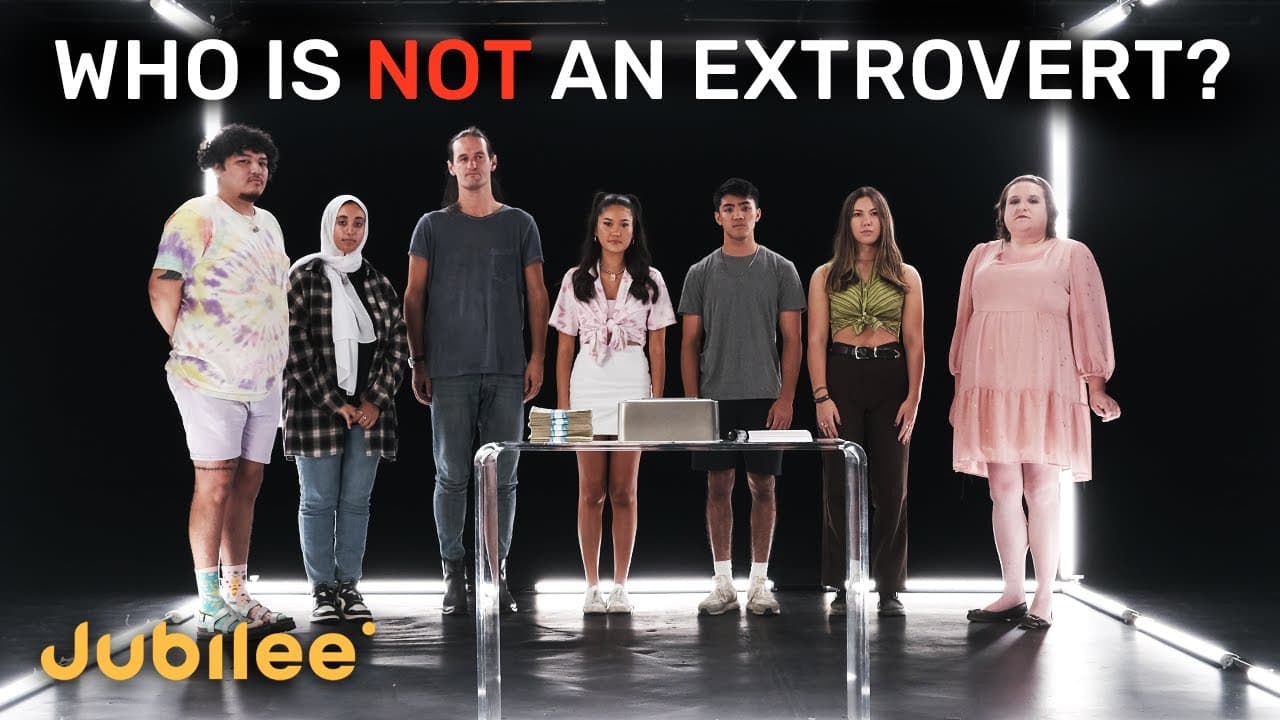
The group's main tells were energy level and overcompensation: players suspected anyone who seemed too excited, too quiet, or like they were pushing their energy. Voting rounds ended in ties twice, and the group eliminated genuine extroverts instead of the hidden introvert. Questions about jobs and hobbies produced answers everyone agreed proved little.
Transcript
(hip-hop jazz music) - Hey, good humans. Before we start this episode, we've got a big announcement to make. We're going to be having a-- - Are you tired of seeing this guy intro every single Jubilee video? - What about "6 Christians vs 1 Atheist"? - Ooh, I like that. - Or how about Republicans and Democrats? - [Jason] Perfect. - Are you tired of s... Read More
Key Insights
- Being talkative is not the same as being extroverted, according to the group. They agree some introverts talk a lot, and that an extrovert with good people skills who can lead a group is not always the person talking the most in a conversation.
- Extroversion is defined by the players as gaining energy from being around other people. One participant says extroverts literally gain energy from company, and another notes it is easier to reflect energy back from the people around them.
- Extroverts still need downtime, the group agrees. They say people do not always have to be social to count as extroverts, and one player points out that being in a bad mood just means being a human being, not being an introvert.
- Overcompensation is the group's main suspicion trigger. Zed is repeatedly accused of being overexcited and standing out too much, though he responds that if anything he was under compensating rather than pushing his energy too hard.
- Low energy draws suspicion just as strongly as high energy. Alaa is described as the quietest in the group and one voter calls the choice between Alaa and Zed an eeny meeny miny moe decision, showing the vote was near random.
- Occupation-based questions produced weak evidence. After everyone shared jobs including teaching kids to code, Build-A-Bear, photography, Apple retail, sales, and a trampoline park, one player asked whether occupations and hobbies were really giving the information they needed.
- A single word choice became evidence. When one player said, 'If I were extroverted like yeah I'd want to get everyone's phone number,' another immediately flagged the conditional phrasing as a possible slip revealing he was actually the introvert.
- Myers-Briggs results were used as self-defense in the game. Zed cited being an ENTJ and Aliya said she scored 99% in the extroverted category, both offering test results as proof rather than in-room behavior.
Install to Summarize YouTube Videos and Get Transcripts
Explore YouTube Video Summarizer or Get YouTube Transcript Extractor
Questions & Answers
Q: What is the Odd One Out game format?
Jubilee's Odd One Out brings together a group of people who all publicly claim the same identity, with one person secretly lying. In this episode, seven people all say they are extroverts and one is actually an introvert. The group holds discussion rounds and then votes to eliminate whoever they suspect is the liar. If the group successfully discovers the liar, everyone splits a cash prize. If the liar survives the game undetected, that person wins the entire prize alone.
Q: How do you tell if someone is faking being an extrovert?
The players in this episode relied mostly on energy level, which proved unreliable. They suspected people who seemed to be overcompensating with excessive enthusiasm, like Zed, and equally suspected the quietest person in the room, like Alaa. Other tells they used included avoiding eye contact, getting defensive when a topic came up, seeming to push energy rather than have it naturally, and conditional phrasing such as saying 'if I were extroverted.' Both of the first two votes ended in ties, and the group eliminated genuine extroverts.
Q: What is the difference between being extroverted and being talkative?
The group explicitly separates the two early in the discussion. They agree that extroversion is not the same as talkativeness and that some introverts talk a lot. One player argues that an extrovert who has good people skills and can lead a group is not always the person talking the most. He describes enjoying groups of around 20 people because he gets to meet many people without needing to dominate the conversation the entire time.
Q: Do extroverts ever need alone time?
Yes, and the group agrees on this unanimously in the video. One player says what a lot of people do not realize is that extroverts can also need to take a step back. Another adds that they do not always need to be social to be considered an extrovert. A third points out that sometimes she is in a bad mood, and that does not mean she is an introvert, it just means she is a human being. The group concludes that energy fluctuates.
Q: Why did the players ask about jobs and hobbies?
One player proposed asking what everyone does as hobbies as a way to surface behavior that would be hard to fake. The answers included teaching little kids to code, working at Build-A-Bear, photography after three years at Apple retail, sales, working at a trampoline park, going to the ocean, playing ukulele, acting, filmmaking, and a list of hobbies all starting with C: Christ, coffee, cycling, computers, cameras, and chess. One player then questioned whether occupations and hobbies were really giving the group the information it needed.
Q: What happens when the vote ends in a tie in Odd One Out?
When the votes are counted and two players are tied, the host announces the tie and gives each tied player 30 seconds to state their case to the group. In this episode this happened twice. The first tie was between Zed and Brayan, and each defended themselves by describing their outgoing behavior. The second tie was between Aliya and Ellie, and they were asked to share their most extroverted experience in 30 seconds before the group voted again.
Q: Why did the group suspect Zed of being the introvert?
Zed was suspected because he stood out as the most energetic person in the room, which several players read as overcompensating. Alaa said she voted for him for exactly that reason, and another player described him as the one out of the group who was really overexcited. In his defense Zed said he is an ENTJ on the Myers-Briggs test, that he loves talking to people all the time, and that he planned to get everyone's phone numbers after the show. He also said he was deliberately trying not to be super bubbly because the show usually votes off the most stereotypical person first.
Q: How did acting come up as a suspicion in the game?
When the group shared hobbies, Alex said he was an actor and another player immediately said the same. One player interpreted this as Alex setting himself up, arguing that acting proves you have to be extroverted. Another player said she actually did not want to say she was an actress because she worried it would plant the seed that she was faking, and clarified that she is not just on stage but is a filmmaker. A third player observed that she only started talking about acting after Alex brought it up, seemed defensive, and avoided eye contact.
Summary & Key Takeaways
-
Jubilee's Odd One Out format brings together seven people who all claim to be extroverts, one of whom is secretly an introvert. If the group identifies the liar, they split a cash prize; if the liar survives, they take the entire prize alone. Rounds of discussion are followed by group votes.
-
The players open by defining what an extrovert actually is: outgoing and friendly, energized by being around people, and not necessarily the loudest person in the room. They agree extroverts still need to step back sometimes, that a bad mood does not make someone an introvert, and that energy fluctuates.
-
Suspicion falls on both extremes. Zed is accused of overcompensating with high energy, while Alaa is flagged as the quietest in the group. Two consecutive votes end in ties, requiring 30-second defenses, and the group eliminates Ellie and later has to keep playing because doubts remain.
Read in Other Languages (beta)
Share This Summary 📚
Summarize YouTube Videos and Get Video Transcripts with 1-Click
Try YouTube Summary with ChatGPT & Claude or YouTube Transcript Generator
Explore More Summaries from Jubilee 📚





Summarize YouTube Videos and Get Video Transcripts with 1-Click
Try YouTube Summary with ChatGPT & Claude or YouTube Transcript Generator