How to Speak with Natural American English Rhythm
TL;DR
Natural American English depends on strong contrast between long, clear stressed syllables and fast, reduced unstressed words. To match conversational speech, connect words smoothly, simplify mouth movements, use schwa in weak syllables, and practice common changes such as dropped T sounds, reduced pronouns, linking, and pitch movement.
Transcript
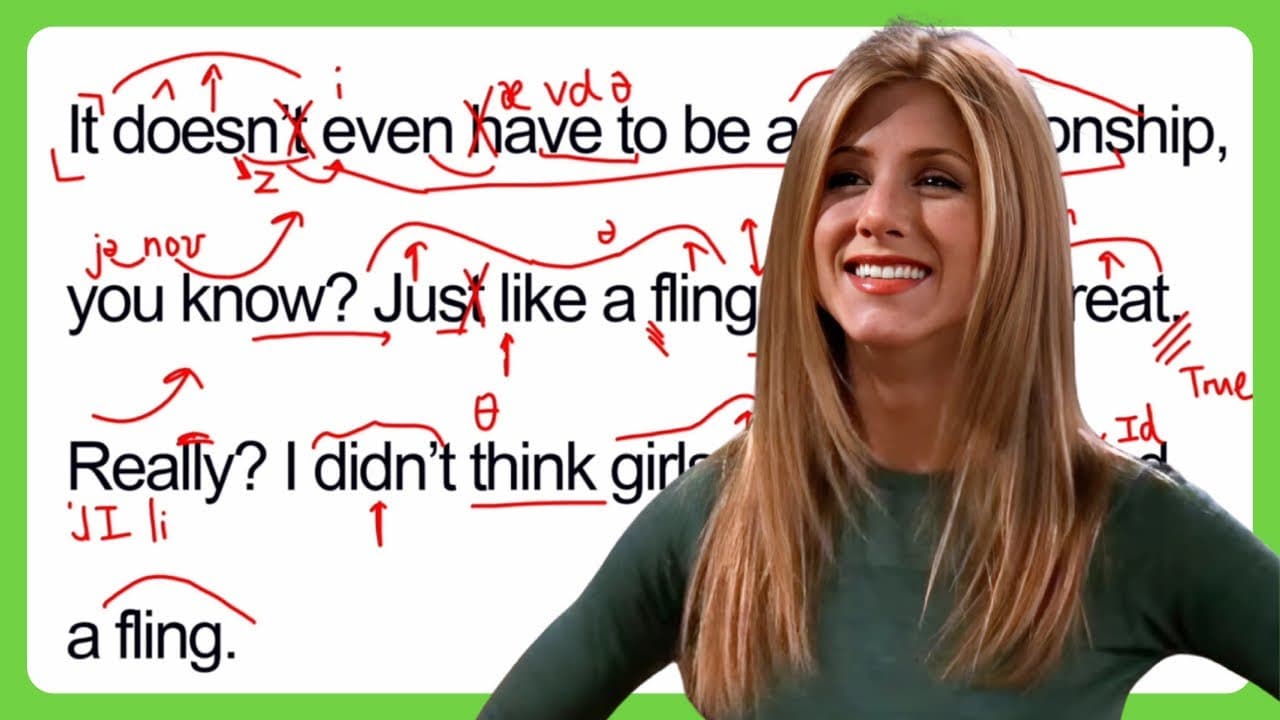
I love Sweater Weather and the holidays. Today we're studying English by analyzing a scene from the TV show, Friends. What exactly makes American English sound American? We'll look at the music of English. What words might change in a full sentence? First, here's the scene we'll study. It doesn't even have to be a big relationship, you know? J... Read More
Key Insights
- American English rhythm is created by contrasting long, clear stressed syllables with short, compressed unstressed syllables. Stressed words provide recognizable rhythmic anchors, while surrounding function words may become flatter, quieter, less distinct, and dramatically faster in connected speech.
- Stressed syllables are typically longer, louder, clearer, and marked by an up-and-down pitch shape. In the phrase about a “big relationship,” the prominent words carry the structure, allowing numerous reduced words before them to remain understandable despite their speed.
- Unstressed sequences require simplified mouth movements to match a natural conversational pace. The phrase “even have to be a” is produced rapidly and with reduced clarity, showing why carefully articulating every sound can disrupt the timing and musical pattern of American speech.
- The T in negative contractions is commonly dropped before a following vowel in the examples analyzed. In “doesn't even,” the speaker moves directly from the N sound into the initial vowel of “even,” without producing a T, pause, or stop.
- The T in an ST cluster is often dropped when the next word begins with a consonant. Both “just like” and “just wanted” move directly from the S into the following consonant, producing a smoother and faster connection than a fully released T would allow.
- Reduced words link directly into neighboring words during fluent speech. “You know” becomes “y'know,” “tell you” becomes “tell ya,” and the article in “like a” becomes a quick schwa, creating continuous sound rather than a sequence of isolated words.
- Pitch movement communicates both stress and conversational meaning. A wider difference between high and low pitch makes a word feel more strongly stressed, while the rising intonation on “Really?” signals questioning even though its individual sounds are quick, unclear, and somewhat mumbled.
- Careful repetition is most effective when learners first identify stress, reductions, and links. Difficult words such as “girls” can be practiced slowly with an up-and-down stress shape, then accelerated after the tongue movements for the R sound and dark L become comfortable.
Install to Summarize YouTube Videos and Get Transcripts
Explore YouTube Video Summarizer or Get YouTube Transcript Extractor
Questions & Answers
Q: How does stress create natural American English rhythm?
Stress creates rhythm by establishing clear anchors within a sentence. Stressed syllables are longer, louder, clearer, and shaped by noticeable pitch movement. Unstressed words between those anchors are spoken much faster and with flatter pitch. This contrast makes rapid speech understandable. Giving every word equal length and emphasis removes the rhythmic pattern demonstrated in the conversation.
Q: How should unstressed words be pronounced in fast English?
Unstressed words should generally be shorter, flatter in pitch, and less carefully articulated than stressed words. Rapid sequences such as “even have to be a” require simplified mouth movements so the speaker can maintain the conversational pace. The goal is not to emphasize every sound, but to connect the weak words smoothly while preserving clear stressed anchors.
Q: When is the T dropped in negative contractions?
The lesson shows that the T in an N-apostrophe-T contraction is commonly dropped when the next word begins with a vowel. In “doesn't even,” the pronunciation moves directly from the N sound into the initial vowel of “even.” There is no T sound, break, or stop, which allows the two words to connect smoothly in fast speech.
Q: Why is the T dropped in phrases such as “just like”?
The T is dropped because “just” ends with an ST consonant cluster and the next word begins with another consonant. In “just like,” the S connects directly to the L. The same pattern appears in “just wanted,” where the S connects to the W. Removing the T makes both phrases quicker and easier to link.
Q: How is “wanted” pronounced in natural American speech?
“Wanted” is presented as a two-syllable word because the ED ending adds a syllable, but its internal T is dropped. The resulting pronunciation sounds like “wanid,” without a T sound or stop. Its ending then links smoothly into the schwa of the following article in “wanted a fling,” creating one continuous connected phrase.
Q: How are “you know” and “tell you” reduced in conversation?
“You know” is reduced to a form like “y'know,” with “you” compressed to a Y sound that links directly into “know.” In “tell you something,” “you” becomes “ya,” producing “tell ya.” These reductions shorten common words, remove unnecessary separation, and help the phrases fit naturally into the rhythm of conversational American English.
Q: How does pitch change the meaning and stress of words?
Pitch helps mark both prominence and conversational intention. A stressed word has an up-and-down pitch shape, and a larger difference between its highest and lowest pitch makes the stress feel stronger. Rising pitch on the quick, somewhat mumbled “Really?” signals a question. Flat pitch, by contrast, helps identify rapidly spoken unstressed material.
Q: How can learners practice connected American English speech?
Learners can practice by replaying short sections, finding the longest and clearest stressed syllables, and imitating their timing and pitch. They should notice dropped sounds, reduced vowels, and links between words, then pause and repeat each phrase. Difficult tongue movements can be practiced slowly first and accelerated after the pronunciation pattern feels stable.
Summary & Key Takeaways
-
American English rhythm comes from alternating prominent stressed syllables with compressed unstressed material. Stressed words are longer, louder, clearer, and shaped by noticeable pitch movement. Unstressed words are flatter and much faster. Speakers must preserve this contrast instead of pronouncing every word with equal weight, clarity, and duration.
-
Connected speech changes many familiar dictionary pronunciations. The lesson identifies dropped T sounds in phrases such as “doesn't even,” “just like,” and “just wanted.” It also demonstrates reduced forms such as “y'know,” “tell ya,” and “like a,” plus smooth links between final consonants, vowels, and following words.
-
Effective imitation requires listening to short sections repeatedly, locating the stressed syllables, and copying their timing and pitch. Learners should simplify mouth movements in rapid unstressed sequences, then practice difficult words slowly before increasing speed. Pausing and repeating each section helps turn detailed pronunciation observations into practical speaking practice.
Read in Other Languages (beta)
Share This Summary 📚
Summarize YouTube Videos and Get Video Transcripts with 1-Click
Try YouTube Summary with ChatGPT & Claude or YouTube Transcript Generator
Explore More Summaries from Rachel's English 📚






Summarize YouTube Videos and Get Video Transcripts with 1-Click
Try YouTube Summary with ChatGPT & Claude or YouTube Transcript Generator