How to Speak Natural English While Shopping
TL;DR
Natural shopping conversations use flexible vocabulary, softened opinions, linked sounds, and short phrases that draw listeners into a story. Practice expressions such as “short on,” “not a bad deal,” and “I’ve got to say” in context, and use informal endings like “-y” or “-ish” to describe items when an exact adjective is unnecessary.
Transcript
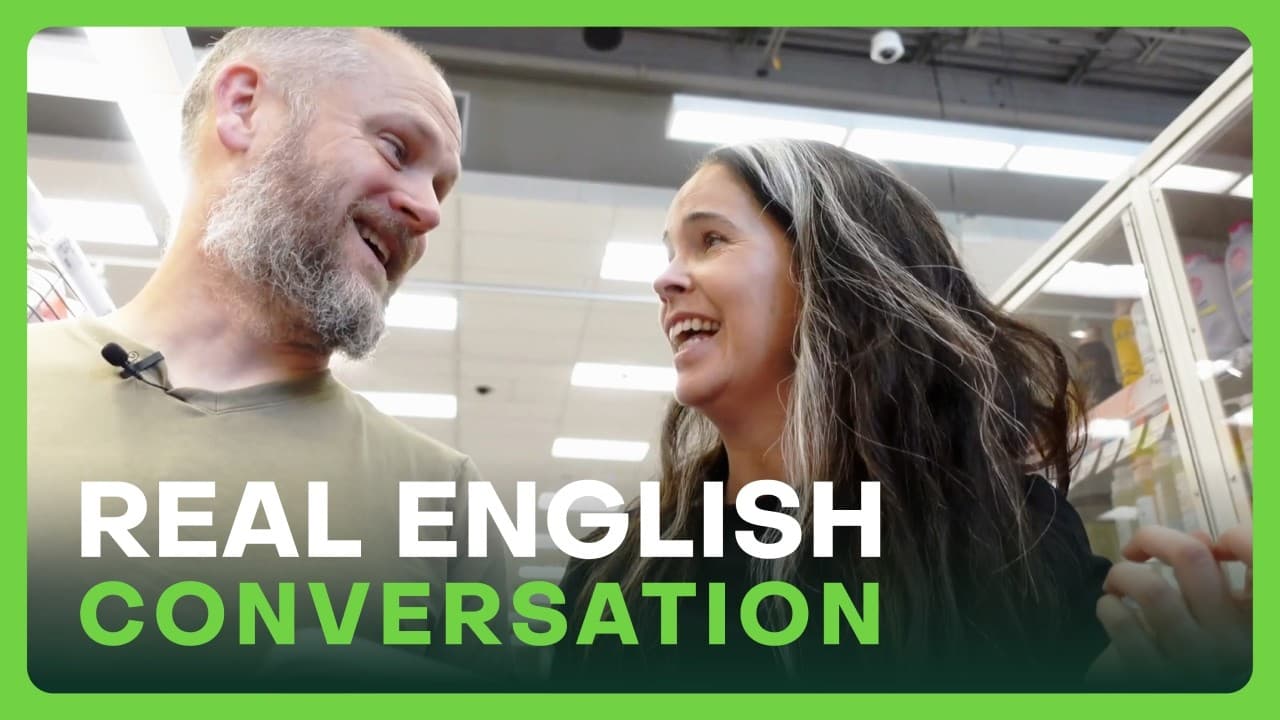
Today, my husband and I are going shopping to buy some things for our upcoming vacation. Come with us and learn some English. Are you wondering why I choked you? Yeah. I don't know. I thought it would look good on camera. Great. Also, won't that make a good thumb? Lots of clicks. Alright, so we're getting some groceries. No, I do want to get some... Read More
Key Insights
- “Big box store” is a term for a huge store with many sections, including pharmacy, clothing, toys, electronics, groceries, and home goods. Target provides the lesson’s real-world setting, allowing shopping vocabulary and ordinary conversation patterns to appear naturally in context.
- “All-in-one” is used while choosing a single children’s product instead of separate shampoo and body wash. The exchange shows how shoppers can state a need, suggest a practical substitute, accept the suggestion, and quickly confirm that the selected travel-sized items are suitable.
- “Short” has several meanings in the same sentence: a YouTube Short is a vertical video with time constraints, “short on” means lacking enough of something, and “shorts” names the clothing item. The repeated wordplay remains grammatically correct despite the changing meanings.
- “Short on” is pronounced with connected speech, including a flap T that links “short” and “on.” In the shopping example, saying someone is “short on shorts” means that the person does not have enough pairs of shorts, so the family decides to buy more.
- Informal adjectives can be created by adding “-y” or “-ish” to a word when listeners can infer the intended quality. “Chinoey” describes shorts resembling chinos in cut or material, while “hippie-ish” describes someone with some, but not necessarily all, hippie traits.
- “Not a bad deal” is a softened way to express approval of an $8 purchase. Similar negative expressions include “not really my thing,” which is gentler than directly saying “I don’t like this,” and “could be worse,” which communicates mild approval or acceptance.
- Storytelling openers are short phrases that prepare listeners for noteworthy information. “Okay, get this” introduces a story or fun fact, “you’re not going to believe this” builds suspense, and “this really cracked me up” signals that a funny account will follow.
- “Spaghetti strap” means a very thin clothing strap, with the name explained through its resemblance to spaghetti. The phrase appears while the couple examines white tops and distinguishes a tank top with thin straps from the white T-shirt they actually want to purchase.
Install to Summarize YouTube Videos and Get Transcripts
Explore YouTube Video Summarizer or Get YouTube Transcript Extractor
Questions & Answers
Q: How can English learners practice natural shopping conversations?
English learners can follow a real shopping exchange and notice how speakers ask what is on the list, identify store sections, compare sizes, react to products, and divide tasks. Useful patterns include “What do we need?”, “Does that look like his size?”, “What do you think of this color?”, and “What’s next?” These phrases model practical, brief communication during an ordinary store visit.
Q: What does “big box store” mean in American English?
A “big box store” is a huge store containing many different departments. The lesson uses Target as its example and lists sections for pharmacy items, clothing, toys, electronics, groceries, and home goods. A shopper can therefore buy personal care products, children’s clothes, food, and household items during one visit instead of visiting separate specialized stores.
Q: What does “short on shorts” mean?
“Short on shorts” means not having enough pairs of shorts. In this expression, “short on” combines the adjective “short” with the preposition “on” to describe a shortage, while the final “shorts” is the plural noun for clothing. The lesson also notes that the sounds connect, with a flap T linking “short” and “on” in natural American speech.
Q: How can one English word have several meanings in a sentence?
Context allows the word “short” to carry three meanings in the sentence about making a short while being short on shorts. The first “short” is a vertical YouTube video that must currently be shorter than three minutes. “Short on” means lacking enough of something, and “shorts” refers to the clothing the family plans to buy.
Q: How do speakers create informal adjectives with “-y” and “-ish”?
Speakers can attach “-y” or “-ish” to a word to suggest that something partly resembles a quality, material, shape, or style. Some forms, including “reddish,” “yellowy,” “velvety,” “sporty,” and “boxy,” are established words. Others can be playful inventions. For example, “chinoey” describes shorts resembling chinos, while “hippie-ish” describes someone showing some hippie traits.
Q: Why do English speakers say “not a bad deal”?
English speakers may say “not a bad deal” to express approval in a softer, more indirect way than calling something a great deal. In the shopping conversation, the phrase responds to shorts priced at $8. Related expressions include “not really my thing,” which softens dislike, and “could be worse,” which communicates mild approval or acceptance without sounding strongly enthusiastic.
Q: What phrases make English storytelling sound more natural?
Short introductory phrases can prepare listeners and create interest before a story begins. “Okay, get this” can introduce a story or fun fact, while “you’re not going to believe this” builds suspense. “Here’s something wild” signals unusual information, “I’ve got to tell you” sounds sincere, and “this really cracked me up” prepares the listener for something funny.
Q: What everyday clothing vocabulary appears in the shopping conversation?
The conversation includes shorts, white T-shirts, swimsuits, socks with ruffles, chinos, tank tops, collars, terry cloth, drawstrings, and spaghetti straps. A spaghetti strap is described as a very thin strap. The couple also uses practical clothing language about cuts, fabrics, colors, sizes, fit, and whether particular items may feel itchy, annoying, or too small.
Summary & Key Takeaways
-
A couple shops at Target for vacation supplies, including children’s body wash, shorts, white shirts, cottage cheese, rice, and outdoor pillows. Their unscripted decisions demonstrate practical questions, brief confirmations, size comparisons, divided shopping tasks, and reactions when the store does not carry a preferred item or suitable product.
-
The lesson examines flexible English vocabulary through “short,” which can describe a YouTube video, a shortage, or an item of clothing. It also shows how speakers add “-y” or “-ish” to words, producing descriptive forms such as “chinoey,” “hippie-ish,” “boxy,” “reddish,” and “yellowy.”
-
Natural conversation often sounds indirect and engaging. Expressions such as “not a bad deal,” “not really my thing,” and “could be worse” communicate softened opinions. Story introductions such as “I’ve got to say,” “Okay, get this,” and “You’re not going to believe this” prepare listeners for interesting information.
Read in Other Languages (beta)
Share This Summary 📚
Summarize YouTube Videos and Get Video Transcripts with 1-Click
Try YouTube Summary with ChatGPT & Claude or YouTube Transcript Generator
Explore More Summaries from Rachel's English 📚



Summarize YouTube Videos and Get Video Transcripts with 1-Click
Try YouTube Summary with ChatGPT & Claude or YouTube Transcript Generator