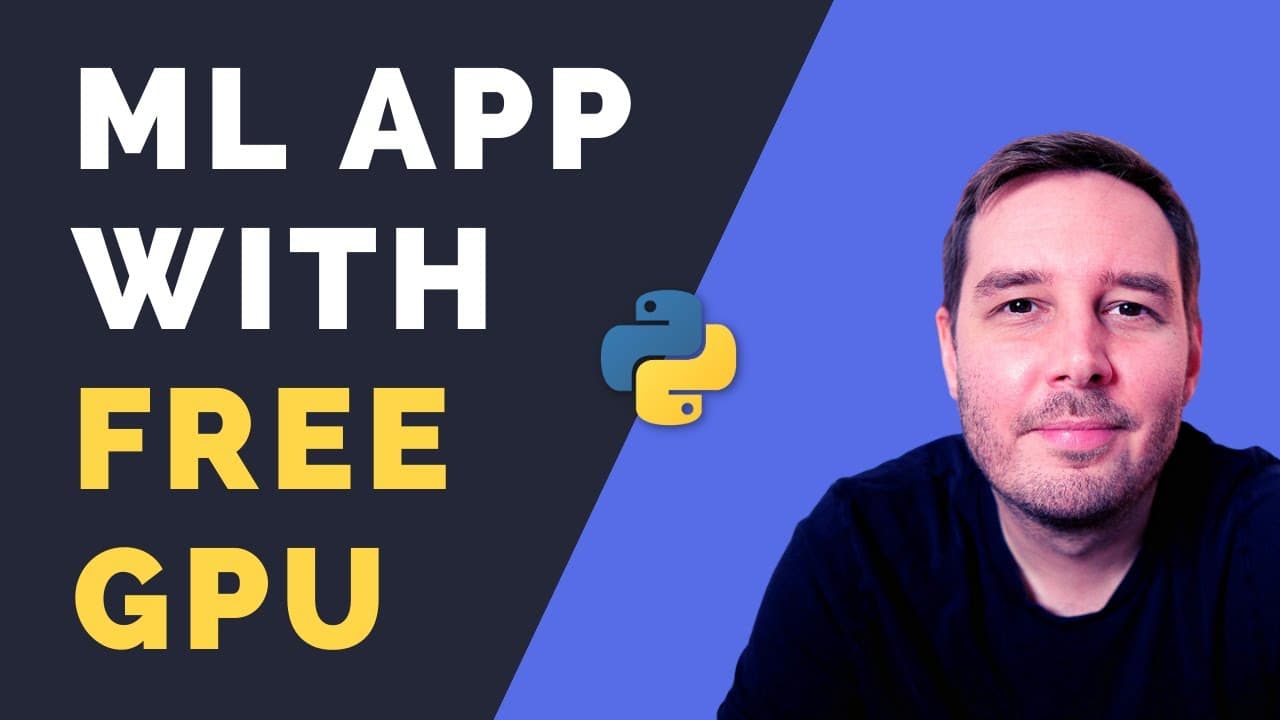
How to Create a Free GPU-Powered ML App in Python
TL;DR
To create a free GPU-powered machine learning app in Python, use Flask, Google Colab, and Ngrok. Start by implementing a Flask app that integrates with a stable diffusion model to generate images from prompts, then run it in Google Colab, exposing it to the public via Ngrok for easy access.
Transcript
hi this is Patrick from assembly Ai and in this video you will learn how you can build your own machine learning app that is powered with a free GPU by using flask a Google collab and ngrok in the video we built a concrete example with stable diffusion so in the end you have your own stable diffusion app that can generate images from prompts the ap... Read More
Key Insights
- 😀 Utilize Flask, Google Colab, and Ngrok to create a machine learning app with a free GPU.
- 😀 Incorporate stable diffusion to generate images from prompts in the app.
- 😫 Set up endpoints in Flask for handling requests and rendering generated images.
- 🏃 Ensure the model is run on the GPU in Google Colab for optimal performance.
- 🫷 Create a requirements.txt file with dependencies and push the code to a GitHub repository.
- 😀 Access the GitHub repository from Google Colab to run the Flask app.
- 👏 Use Ngrok to expose the Flask app to a public URL for access.
Install to Summarize YouTube Videos and Get Transcripts
Explore YouTube Video Summarizer or Get YouTube Transcript Extractor
Questions & Answers
Q: What tools are needed to build a machine learning app with a free GPU?
To create the app, you will need Flask for the web app, Google Colab for the free GPU, and Ngrok to expose the app to the public.
Q: How can one create endpoints for a Flask app to handle image generation?
Endpoints can be set up in Flask to handle image generation by defining routes that can receive prompts, call the model pipeline, and render the generated images.
Q: Why is it important to run the model on the GPU in Google Colab?
Running the model on the GPU in Google Colab is crucial for leveraging the free GPU's processing power and speeding up the image generation process.
Q: What steps are involved in accessing and running the Flask app with a free GPU in Google Colab?
To access and run the Flask app with a free GPU in Google Colab, one needs to clone the repository, install dependencies, set the Ngrok authentication token, set the runtime type to GPU, and run the app.
Summary & Key Takeaways
-
Use Flask, Google Colab, and Ngrok to build a machine learning app with a free GPU.
-
Implement a stable diffusion example to generate images from prompts.
-
Run the Flask app in Google Colab, exposing it to the public via Ngrok for a public URL.
Read in Other Languages (beta)
Share This Summary 📚
Summarize YouTube Videos and Get Video Transcripts with 1-Click
Try YouTube Summary with ChatGPT & Claude or YouTube Transcript Generator
Explore More Summaries from AssemblyAI 📚


Summarize YouTube Videos and Get Video Transcripts with 1-Click
Try YouTube Summary with ChatGPT & Claude or YouTube Transcript Generator