How Does a 33-Year E. coli Experiment Show Evolution?
TL;DR
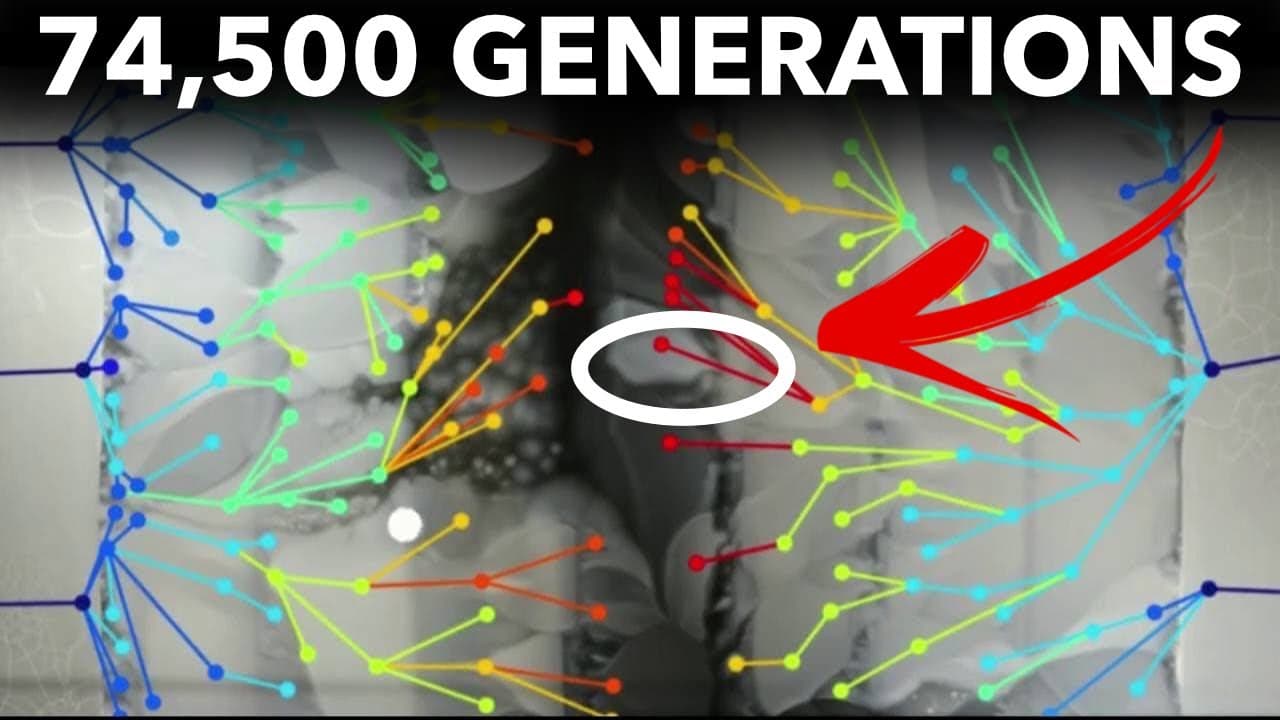
A 33-year evolution experiment on E. coli demonstrated that bacteria can rapidly adapt through mutations and natural selection, achieving significant resistance to increasing antibiotic concentrations. This long-term study, with 74,500 generations, revealed how competitive advantages arise from rare mutations, allowing certain bacteria to thrive while others perish.
Transcript
- These are bacteria growing into increasingly concentrated antibiotics. The bacteria stop growing when they hit the first antibiotic strip, but then a mutant appears capable of surviving in the antibiotic. Then another mutation occurs and now the bacteria can survive 10 times the concentration, then a hundred times, and finally, after just 11 days... Read More
Key Insights
- ❓ Bacteria become increasingly resistant to antibiotics through mutation and natural selection.
- 🍉 Long-term experiments in controlled lab environments can provide valuable insights into evolutionary processes.
- 🖐️ The resources available to bacteria, such as glucose, play a crucial role in their growth and adaptation.
- 🪛 Rare mutations that provide a competitive advantage drive evolutionary changes and become prevalent in subsequent generations.
Install to Summarize YouTube Videos and Get Transcripts
Explore YouTube Video Summarizer or Get YouTube Transcript Extractor
Questions & Answers
Q: How did the long-term experiment on E. coli bacteria reveal insights into their evolutionary adaptation?
The experiment showed that bacteria became better competitors over time, demonstrating Darwinian adaptation through natural selection. It also highlighted the significance of rare mutations that provide a competitive advantage, allowing them to spread through the population.
Q: Why did the bacteria populations decrease in number but increase in size over time?
The resources available to the bacteria were limited, which led to a decrease in overall population size. However, individual bacteria became larger to compensate for this limitation and maximize their ability to consume glucose for reproduction.
Q: What led to the surprising discovery of some bacteria populations evolving hypermutability?
Six out of the 12 bacterial populations evolved higher mutation rates. However, subsequent mutations brought the mutation rate back down to avoid accumulating too many deleterious mutations. This allowed for a balance between faster evolution and avoiding excessive negative effects of mutations.
Q: How does the experiment predict the future course of bacterial evolution?
The experiment's data suggests that the future trajectory of bacterial evolution follows a power law model, which predicts a continuous but slowing down improvement without reaching an upper bound. This indicates that even in a constant environment, evolution would continue to make progress, albeit at a slower pace.
Summary & Key Takeaways
-
A long-term experiment has been conducted on 12 separate populations of E. coli bacteria over 33 years, resulting in 74,500 generations and providing insights into evolution in a lab setting.
-
The bacteria primarily grow and divide based on their ability to consume glucose and convert it into offspring, driving their growth and natural selection.
-
Mutations occur rarely but have a significant impact when they provide a competitive advantage, leading to the survival and proliferation of these mutations in subsequent generations.
Read in Other Languages (beta)
Share This Summary 📚
Summarize YouTube Videos and Get Video Transcripts with 1-Click
Try YouTube Summary with ChatGPT & Claude or YouTube Transcript Generator
Explore More Summaries from Veritasium 📚





Summarize YouTube Videos and Get Video Transcripts with 1-Click
Try YouTube Summary with ChatGPT & Claude or YouTube Transcript Generator