How Does the Musical Fire Table (Pyro Board) Visualize Sound?
TL;DR
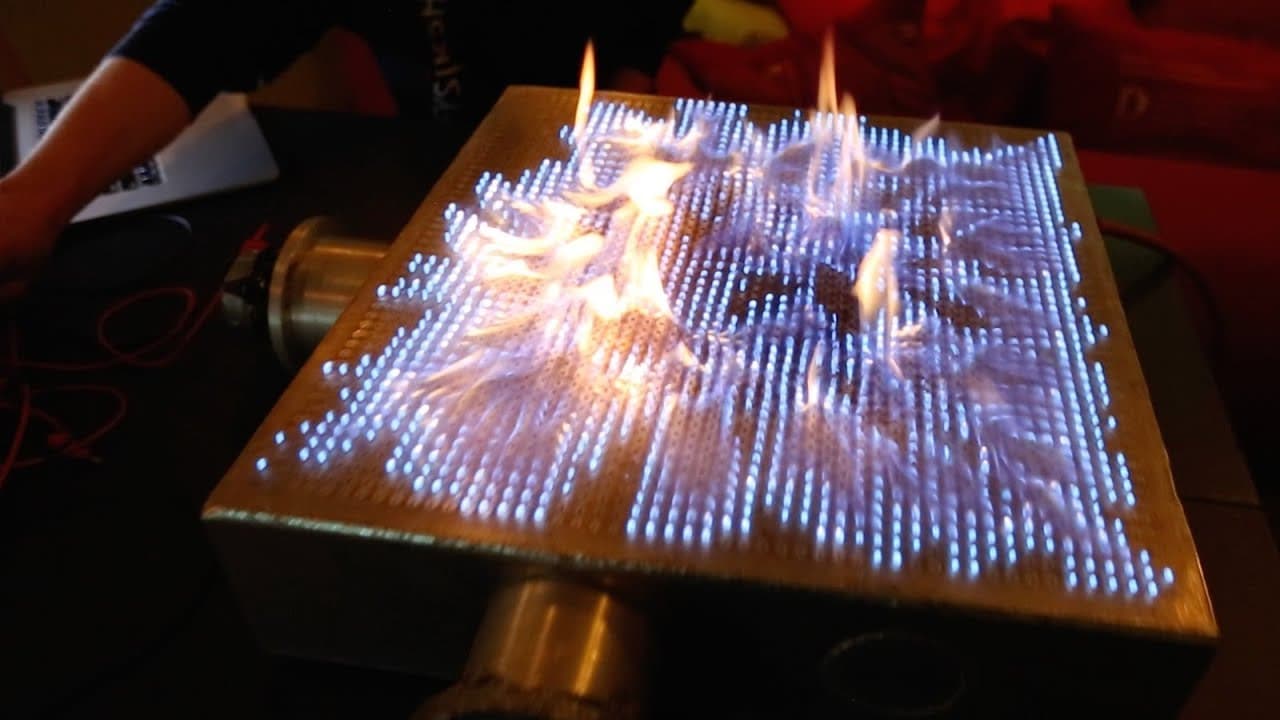
The Musical Fire Table visualizes sound by using standing waves to change the heights of 2,500 gas flames across a two-dimensional Pyro Board. Nodes have little vibration and lower flames, while anti-nodes produce intense flames; changing the frequency or volume creates different patterns. Read on to understand how this expanded Ruben's tube makes sound waves visible and audible.
Transcript
- Just press play, you mean? - [Voiceover] Yeah, go for it. Whoa! - Now, you may have seen a Ruben's tube before. That's basically a pipe with a bunch of holes in it, and you pump in a flammable gas, and light it on fire, so you basically create a row of Bunsen burners. What's really cool is to play some sounds into the tube, and you can actually s... Read More
Key Insights
- 💨 The Pyro Board is a visually stunning way to observe standing wave patterns created by sound.
- 👋 Different frequencies and volumes result in unique standing wave patterns on the Pyro Board.
- 😒 The use of microphones allows for the visualization of standing wave nodes and anti-nodes.
- 🧑🎓 The Pyro Board provides an engaging tool for teaching physics and chemistry to students.
- 😤 The team in Denmark has a YouTube channel where they share their experiments with the Pyro Board and other science demonstrations.
- 👋 The Pyro Board highlights the relationship between sound waves and flame height.
- 🧪 The creation of the Pyro Board demonstrates the desire to enhance and innovate experiments like the Ruben's tube.
Install to Summarize YouTube Videos and Get Transcripts
Explore YouTube Video Summarizer or Get YouTube Transcript Extractor
Questions & Answers
Q: How does the Musical Fire Table visualize sound?
Sound creates standing waves inside the Pyro Board, changing how quickly gas flows through its holes. Those changes alter the flame heights, making the standing-wave pattern visible across the board.
Q: What is the Pyro Board?
The Pyro Board is a two-dimensional version of a Ruben's tube created by a team of physics and chemistry demonstrators in Denmark. It forms a whole plane of small gas flames instead of a single row.
Q: How many flames does the Pyro Board produce?
The Pyro Board has 2,500 holes. When gas flows through the holes and is lit, the board produces 2,500 little flames.
Q: What is a Ruben's tube?
A Ruben's tube is a pipe with many holes that is filled with flammable gas and lit, creating a row of Bunsen burners. Playing sound into the tube establishes standing waves that affect the heights of the flames.
Q: What are nodes and anti-nodes on the Pyro Board?
Nodes are parts of a standing wave with relatively little vibration, while anti-nodes have much more vibration. On the Pyro Board, the flames rise at the anti-nodes, allowing these regions to be identified visually.
Q: How does sound frequency affect the Pyro Board's flame patterns?
Different frequencies establish different standing-wave patterns across the Pyro Board. Lower frequencies create longer-wavelength patterns, while higher frequencies produce shorter-wavelength patterns.
Q: What happens when the sound volume is changed?
Varying the volume changes the flame display produced by the standing wave. The demonstration shows the flames responding immediately as the volume is adjusted.
Q: Can the Pyro Board's standing waves be heard as well as seen?
Yes. Using microphones, the demonstrators could hear the differences between nodes and anti-nodes before the pattern became visually clear, while the flames showed where the anti-nodes occurred.
Summary & Key Takeaways
-
The Pyro Board is a two-dimensional version of a Ruben's tube, with 2,500 holes filled with flammable gas to create a row of Bunsen burners.
-
By playing sounds into the Pyro Board, standing waves are formed, resulting in areas with intense flames and areas with low flame height.
-
Different frequencies and volumes produce different standing wave patterns and can be seen and heard through the flames.
Read in Other Languages (beta)
Share This Summary 📚
Summarize YouTube Videos and Get Video Transcripts with 1-Click
Try YouTube Summary with ChatGPT & Claude or YouTube Transcript Generator
Explore More Summaries from Veritasium 📚
Summarize YouTube Videos and Get Video Transcripts with 1-Click
Try YouTube Summary with ChatGPT & Claude or YouTube Transcript Generator