How Do AI Agents Automate Dynamic Business Tasks?
TL;DR
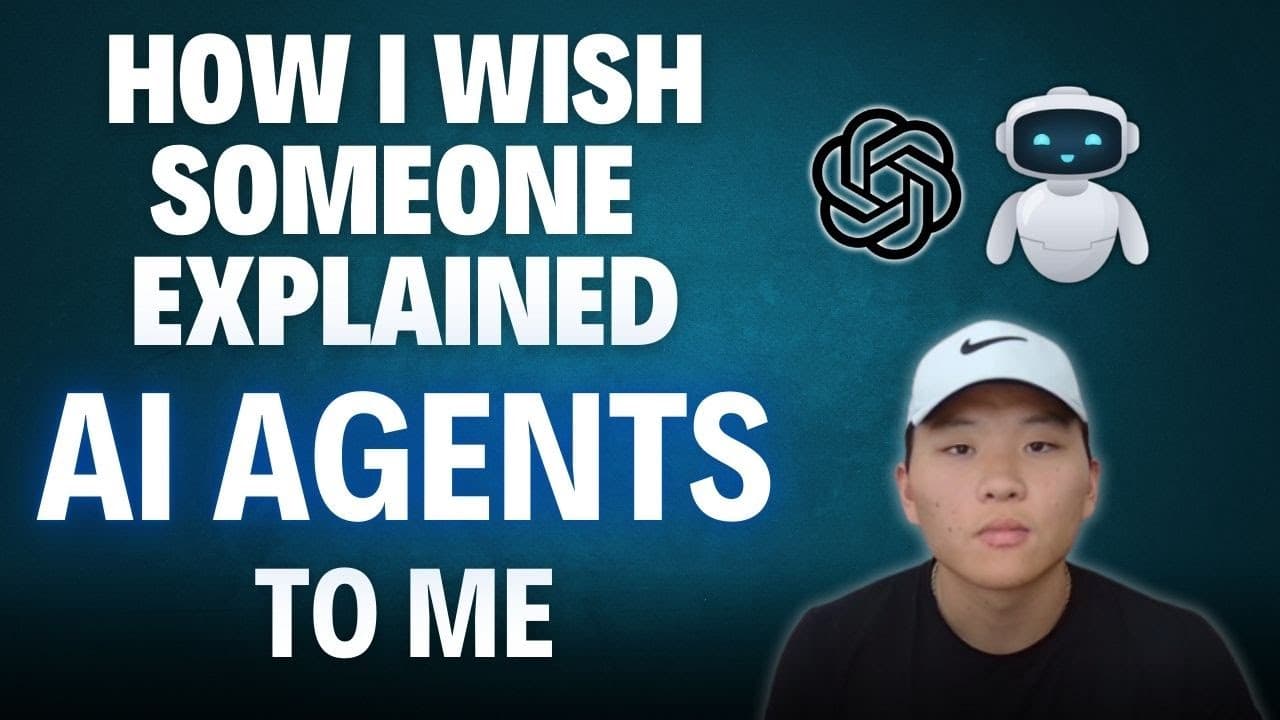
AI agents use large language models to reason, make decisions, and complete tasks through connected tools such as calendars, CRMs, email, spreadsheets, and messaging platforms. Unlike rigid traditional automations, they can respond to changing information, handle dynamic workflows, and automate business activities including outreach, onboarding, customer support, content creation, and project management.
Transcript
so AI agents there's so much information out there it can be overwhelming trying to learn about them so I wanted to come in here and break it down simply just the way that I wish someone would have explained it to me when I first started learning about them I'm pretty new to this space too and I've definitely felt confused when trying to learn abou... Read More
Key Insights
- An AI agent is a digital worker powered by an advanced AI model that follows instructions, recalls supplied information, operates continuously, and costs less than hiring a human employee, according to the presentation. Its behavior and capabilities depend on the prompts, information, and tools it receives.
- A large language model is the agent's reasoning system. Models such as ChatGPT or Claude allow an agent to evaluate information, make decisions, handle dynamic tasks, and adapt to new inputs instead of merely executing a fixed sequence of predefined actions.
- Tools give an AI agent the ability to act. Access to applications such as a calendar, CRM, Excel, LinkedIn, Slack, Google Drive, or email lets the agent combine reasoning with actions and complete the job described in its prompt.
- Traditional automation is effective for clear, rule-based decisions. It becomes difficult when a workflow requires interpretation, contextual thinking, or adaptation, while an AI agent can use its language model to reason through those less predictable decision points.
- End-to-end execution is a defining advantage of AI agents. A conventional AI-assisted email workflow may require a person to copy an email into a chatbot, generate a reply, paste it into Gmail, and send it, while an agent can perform the complete process automatically.
- Efficiency and scalability are central business benefits of AI agents. They can reduce time and labor costs, handle increasing workloads, and be duplicated when additional capacity is needed without introducing salaries, benefits, or employee training.
- Low-code and no-code tools make agent development accessible to beginners. The presentation identifies Relevance AI, Make, Zapier, and n8n as options for building agents without needing extensive experience in programming languages such as Python or Java.
- Business applications for AI agents include marketing, onboarding, customer success, and project management. Specific examples include researching prospects, personalizing outreach, scraping and qualifying leads, producing content, collecting onboarding documents, communicating with clients, and gathering feedback.
Install to Summarize YouTube Videos and Get Transcripts
Explore YouTube Video Summarizer or Get YouTube Transcript Extractor
Questions & Answers
Q: What is an AI agent and what can it do?
An AI agent is a digital worker powered by an advanced AI model and directed through prompts. It can recall information provided about a company or client, reason about incoming information, make decisions, and use connected tools to complete tasks. Depending on its access, it can manage email responses, communicate with prospects, create social content, support customers, and perform workflows continuously.
Q: How do AI agents work with large language models?
A large language model acts as the agent's brain, giving it the ability to reason, apply logic, analyze context, and respond to new information. The agent combines that reasoning ability with instructions and access to tools such as calendars, CRMs, spreadsheets, messaging platforms, or cloud storage. This combination lets it decide what to do and then perform the required actions.
Q: How are AI agents different from traditional automation?
Traditional automation is strongest when a process follows fixed rules, such as choosing between yes and no or checking whether a number is above a threshold. It becomes harder to use when a task requires judgment or adaptation. AI agents can address those dynamic points by using a language model to interpret context, reason through options, and choose an appropriate action.
Q: Can AI agents automate an entire email workflow?
AI agents can automate more of an email workflow than a basic chatbot interaction. A person using a chatbot might read an email, copy it into the chat, request a response, paste that response into Gmail, and send it manually. An agent with email access can read the message, generate the reply, and complete the sending process automatically according to its instructions.
Q: Why can AI agents reduce business costs?
AI agents can reduce costs by performing repeatable work without the salaries, benefits, and training associated with hiring additional employees. They can also operate continuously and respond without waiting for a person to become available. If workload increases, a business can build more agents or expand their responsibilities, provided the relevant work can be handled through the agent's prompts, logic, and connected tools.
Q: What business tasks can AI agents perform?
AI agents can support marketing, onboarding, customer success, and project management. Marketing uses include personalized cold outreach, prospect research, lead scraping, lead qualification, follow-ups, and content creation. During onboarding, agents can collect documents and client information while supporting communication. Customer success applications include responding to clients and gathering feedback, depending on the tools and instructions provided.
Q: Do beginners need coding skills to build AI agents?
Beginners do not necessarily need a computer science degree or extensive knowledge of Python or Java to start building AI agents. Low-code and no-code platforms can make the process more approachable. The presentation names Relevance AI, Make, Zapier, and n8n as available options and notes that tutorials can help newcomers learn how to assemble agents and connect them with useful business tools.
Q: How can AI agents personalize marketing outreach?
AI agents can research background information about a prospect and use that context to tailor an outreach message. This makes cold emails and follow-ups more specific than earlier forms of automated messaging. Agents can also scrape and qualify leads before contacting them, then use the gathered information to generate communications that reflect the recipient's circumstances instead of sending the same generic message to everyone.
Summary & Key Takeaways
-
AI agents are presented as digital workers powered by large language models. They can reason, follow prompts, recall supplied information, operate continuously, and use connected business tools. Their practical value comes from completing an entire workflow automatically instead of requiring a person to move information between an AI chat interface and another application.
-
Traditional automation works well when each decision has a clear rule, such as a yes-or-no condition or a numerical threshold. AI agents extend automation to tasks requiring judgment because their language models can consider context, analyze data, adapt to new information, and choose actions while working across multiple connected tools.
-
Businesses can apply agents to marketing, onboarding, customer success, and project management. Examples include personalized cold outreach, lead scraping and qualification, follow-ups, content creation, document collection, client communication, and feedback gathering. Low-code and no-code platforms make building these systems accessible without requiring a computer science degree or extensive programming experience.
Read in Other Languages (beta)
Share This Summary 📚
Summarize YouTube Videos and Get Video Transcripts with 1-Click
Try YouTube Summary with ChatGPT & Claude or YouTube Transcript Generator
Explore More Summaries from Nate Herk | AI Automation 📚


Summarize YouTube Videos and Get Video Transcripts with 1-Click
Try YouTube Summary with ChatGPT & Claude or YouTube Transcript Generator