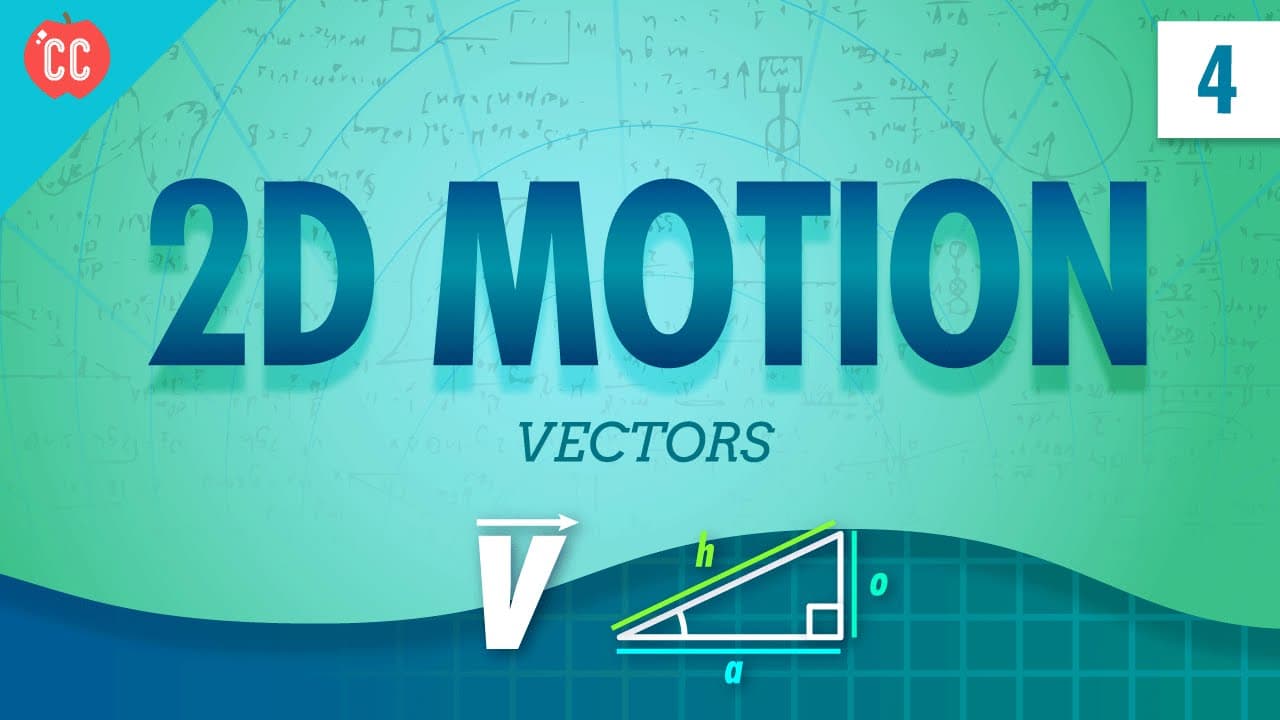
Vectors and 2D Motion: Crash Course Physics #4
TL;DR
Vectors help describe motion in multiple dimensions.
Transcript
So far, we've spent a lot of time predicting movement: where things are, where they're going, and how quickly they're gonna get there. But there's something missing -- something that has a lot to do with Harry Styles. And today, we're gonna address that. We've been talking about what happens when you do things like throw balls up in the air or driv... Read More
Key Insights
- Vectors allow us to describe motion in two dimensions by providing both magnitude and direction, unlike scalars which only have magnitude.
- In physics, vectors can be broken down into horizontal and vertical components, making it easier to analyze motion separately along each axis.
- The concept of vectors is crucial for understanding real-world motion, as it involves more than one direction, unlike simple linear motion.
- Unit vector notation, such as i, j, and k, helps denote direction in vector calculations, with i representing the x-axis and j the y-axis.
- Adding or subtracting vectors involves manipulating their components independently, while scalar multiplication affects each component equally.
- The pitching machine example illustrates how vectors can describe the motion of a ball launched at various angles and speeds.
- Vertical and horizontal motions are independent of each other; thus, a ball's horizontal velocity doesn't affect the time it takes to hit the ground.
- Trigonometry and kinematic equations are essential tools for resolving vectors into components and analyzing their effects on motion.
Install to Summarize YouTube Videos and Get Transcripts
Explore YouTube Video Summarizer or Get YouTube Transcript Extractor
Questions & Answers
Q: What is the main advantage of using vectors in physics?
The main advantage of using vectors in physics is their ability to describe motion in two dimensions. Vectors provide both magnitude and direction, allowing for a more comprehensive analysis of real-world motion, where objects often move in more than one direction simultaneously.
Q: How do vectors differ from scalars?
Vectors differ from scalars in that they have both magnitude and direction, while scalars only have magnitude. This distinction allows vectors to represent motion in multiple dimensions, making them essential for analyzing complex movements in physics.
Q: What is unit vector notation and why is it useful?
Unit vector notation, using symbols like i, j, and k, is useful for denoting direction in vector calculations. It simplifies the representation of vectors by indicating the direction along the x, y, and z axes, respectively, making it easier to perform vector operations.
Q: How can vectors be resolved into components?
Vectors can be resolved into components using trigonometry. By considering a vector as the hypotenuse of a right triangle, its horizontal and vertical components can be calculated using sine and cosine functions, allowing for separate analysis of motion along each axis.
Q: Why are horizontal and vertical motions independent in vector analysis?
Horizontal and vertical motions are independent in vector analysis because a change in one component does not affect the other. This principle allows physicists to analyze each direction separately, simplifying calculations and providing a clearer understanding of an object's overall motion.
Q: What role does trigonometry play in vector analysis?
Trigonometry plays a crucial role in vector analysis by allowing for the resolution of vectors into their horizontal and vertical components. By using sine and cosine functions, physicists can determine the magnitude of each component, facilitating the analysis of motion along different axes.
Q: How can vectors be added or subtracted?
Vectors can be added or subtracted by breaking them into their components and performing the operations separately for each axis. This involves adding or subtracting the horizontal and vertical components independently, resulting in a new vector that represents the combined effect.
Q: What is the significance of the pitching machine example in the episode?
The pitching machine example illustrates how vectors can describe the motion of a ball launched at various angles and speeds. By resolving the ball's velocity vector into horizontal and vertical components, viewers learn how to apply vector analysis to understand real-world motion scenarios.
Summary & Key Takeaways
-
Vectors are essential in physics for describing motion in two dimensions, providing both magnitude and direction. Unlike scalars, vectors can represent any direction, making them crucial for real-world motion analysis.
-
By breaking vectors into horizontal and vertical components, physicists can analyze motion along each axis separately. This allows for a more comprehensive understanding of how objects move in space.
-
The episode explains how to use unit vector notation and trigonometry to resolve vectors into components, enabling the calculation of motion in different dimensions using kinematic equations.
Read in Other Languages (beta)
Share This Summary 📚
Summarize YouTube Videos and Get Video Transcripts with 1-Click
Try YouTube Summary with ChatGPT & Claude or YouTube Transcript Generator
Explore More Summaries from CrashCourse 📚






Summarize YouTube Videos and Get Video Transcripts with 1-Click
Try YouTube Summary with ChatGPT & Claude or YouTube Transcript Generator