How Does Storytelling Help Us Accept Complexity?
TL;DR
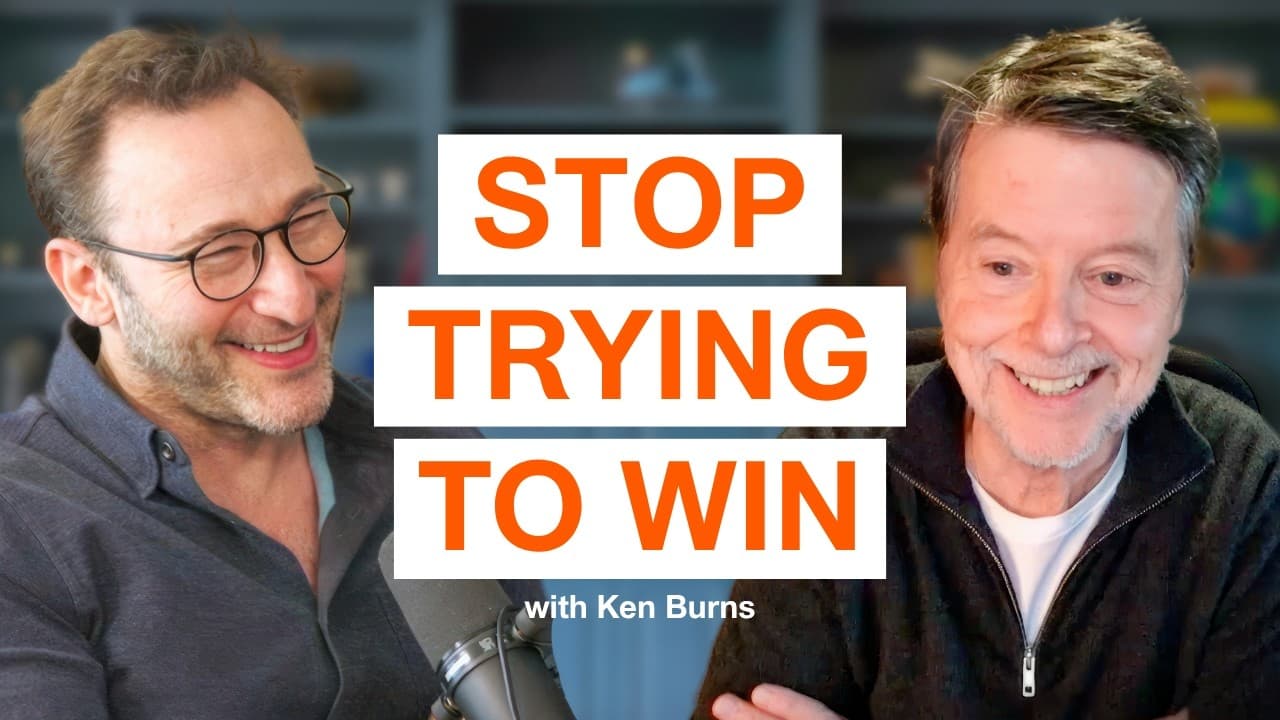
Good storytelling changes minds by presenting complexity, contradiction, and multiple human perspectives without dictating a conclusion. Ken Burns approaches documentary filmmaking with a blank slate, checks even minor uncertainties, and revises polished scenes when conflicting evidence appears, allowing audiences to hold opposing truths and reconsider simplified versions of history.
Transcript
It is okay to try and simplify the world so that we can understand it and feel like we matter in it. And we have to accept that there is complexity that sometimes we understand and sometimes we don't. Those things have to live together. You know, we make films and they're not additive. You don't build a film, you subtract a film. We have 500 hours ... Read More
Key Insights
- Complete documentary objectivity is impossible because pointing a camera in one direction necessarily excludes another direction. Burns therefore treats documentaries as works with degrees of subjectivity and tries to avoid imposing personal beliefs or committing the material to a single school of historical interpretation.
- The guiding principle of Burns's editing room is that history is complicated. When new contradictory information destabilizes a polished scene, his team includes it even if the scene becomes less perfect, because factual and moral complexity matters more than preserving a smooth narrative.
- A good story can change a point of view more effectively than even the best argument. Storytelling works by offering a range of complexity and allowing audiences to experience contradictions, rather than force-feeding them the interpretation or conclusion they are expected to adopt.
- Historical accuracy depends on repeated attention to seemingly minor uncertainties. Burns describes changing a definitive statement to say perhaps when another scholar questioned it, illustrating how careful qualification across countless editorial decisions can make a documentary trustworthy to viewers with different perspectives.
- Film is created through subtraction because filmmakers reduce vast amounts of footage into a coherent final work. The meaning emerges not only from the selected material, but also from the cuts and intervals, which preserve interpretive space and acknowledge that life cannot be captured completely.
- Human beings impose binaries such as good or bad and right or wrong on a reality that rarely conforms to them. Burns argues that people already accept contradiction in themselves and those they love, so historical storytelling should extend the same capacity to public figures and events.
- George Washington represents the difficulty of holding opposing truths at once. His ownership of enslaved people is described as morally indefensible, yet the conversation also presents him as essential to the country's existence, requiring an account that neither excuses his conduct nor erases his historical importance.
- Negative capability is the capacity to hold a character's strengths and weaknesses in tension without immediately deciding what the audience must think. The discussion uses Shakespeare's deeply flawed characters to show how moral ambiguity can create richer plots and reveal humanity in unexpected figures.
Install to Summarize YouTube Videos and Get Transcripts
Explore YouTube Video Summarizer or Get YouTube Transcript Extractor
Questions & Answers
Q: How can storytelling change someone's point of view?
Storytelling can change a point of view by presenting people, events, and contradictions in a form the audience can experience without being told exactly what to conclude. The conversation argues that even strong arguments often fail to persuade, while a good story offers enough complexity for people to sit with opposing truths and reconsider an established interpretation themselves.
Q: Can a documentary ever be completely objective?
A documentary cannot be completely objective because every production decision introduces subjectivity. A filmmaker points the camera toward one subject instead of another, selects some footage, removes other footage, and arranges the remaining material. Burns therefore speaks of degrees of subjectivity and focuses on avoiding a predetermined agenda rather than claiming that his films offer a perfectly neutral view.
Q: How does Ken Burns reduce bias in his documentaries?
Ken Burns reduces bias by beginning without an axe to grind, resisting commitment to a single form of historiography, and allowing evidence to direct the story. His team checks factual claims, consults scholarship, includes conflicting information, and revises completed material when uncertainty emerges. The goal is to produce a dynamic account that can speak across different viewpoints without becoming vague.
Q: Why is complexity important when telling history?
Complexity is important because historical people and events rarely fit clean categories such as good or bad. A simplified account can hide moral failures, overlooked participants, uncertainty, and conflicting motives. Burns's approach preserves major achievements while also introducing evidence that unsettles familiar myths, allowing audiences to understand history without turning flawed people into either spotless heroes or disposable villains.
Q: What does filmmaking by subtraction mean?
Filmmaking by subtraction means shaping a documentary by removing material from a much larger collection of footage rather than simply assembling pieces until the work is complete. The transcript describes reducing 500 hours of footage to 12. Selection creates clarity, while the cuts between images leave interpretive space, much as intervals between notes contribute to music.
Q: Why would an editor weaken a scene with contradictory evidence?
An editor may weaken an effective scene because accuracy and honesty take priority over narrative perfection. Burns says filmmakers naturally want to leave a working scene untouched, but new contradictory information may require changing it. Including that evidence can make the scene less smooth while producing a more credible account that acknowledges uncertainty instead of protecting a convenient conclusion.
Q: How does the American Revolution documentary challenge familiar myths?
The six-part series presents the American Revolution as more than a bloodless, gallant story about men in Philadelphia thinking great thoughts. It adds perspectives and information that expose warfare, slavery, overlooked people, and moral contradiction. The founding ideas remain important, but they appear within a broader human story that complicates the familiar national narrative rather than simply discarding it.
Q: What can Shakespeare teach documentary filmmakers about storytelling?
Shakespeare's characters demonstrate what the conversation calls negative capability, the ability to hold strengths and weaknesses in tension without deciding everything for the audience. Major, secondary, and tertiary characters can be deeply flawed while still expressing recognizable humanity. Documentary storytelling can use the same principle by resisting immediate moral simplification and allowing contradictory qualities to coexist within one person.
Summary & Key Takeaways
-
Ken Burns rejects the idea that documentaries can be completely objective because every filmmaker chooses where to point the camera and what to exclude. His approach is therefore not neutrality, but disciplined subjectivity: beginning without an axe to grind, following the available material, and remaining willing to complicate an effective scene with contradictory evidence.
-
Burns describes filmmaking as subtraction rather than addition. Hundreds of hours of footage may become a much shorter finished work, making selection and editing central to meaning. Like intervals between musical notes, cuts between shots create space for mystery, interpretation, and empathy while transforming complex historical material into a comprehensible narrative.
-
The American Revolution series challenges a simplified account centered on gallant founders and political ideas in Philadelphia. It preserves the importance of those ideas while adding warfare, slavery, overlooked participants, and moral contradiction. This approach presents figures such as George Washington as consequential and deeply flawed without forcing audiences into simple praise or rejection.
Read in Other Languages (beta)
Share This Summary 📚
Summarize YouTube Videos and Get Video Transcripts with 1-Click
Try YouTube Summary with ChatGPT & Claude or YouTube Transcript Generator
Explore More Summaries from Simon Sinek 📚

Summarize YouTube Videos and Get Video Transcripts with 1-Click
Try YouTube Summary with ChatGPT & Claude or YouTube Transcript Generator