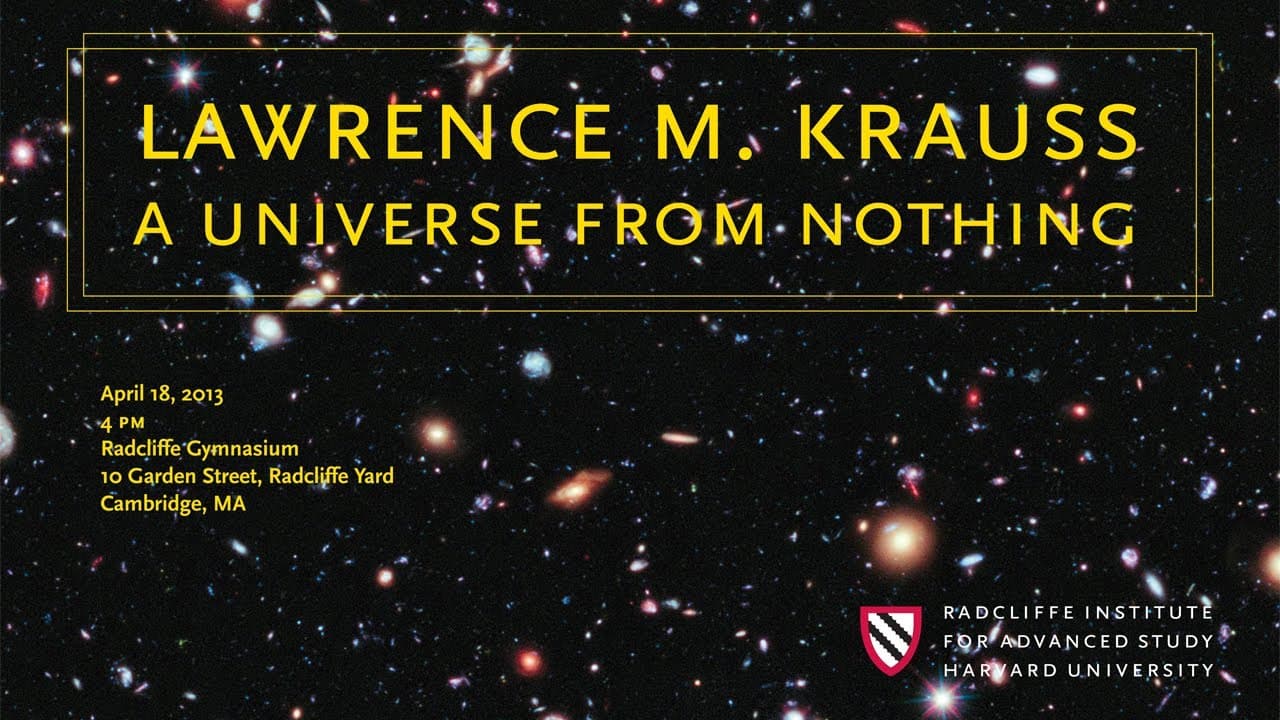
Lawrence M. Krauss || A Universe from Nothing || Radcliffe Institute
TL;DR
The universe can naturally arise from nothing without supernatural intervention, and the evidence suggests it probably did. Over the past 40 years, cosmology and particle physics have transformed our picture of both nothing and something, revealing that empty space is not empty but seething with energy and particles that constantly appear and disappear.
Transcript
[MUSIC PLAYING] LIZ COHEN: Good afternoon, everybody, and thank you for joining us today at the Radcliffe Institute. I'm Liz Cohen. And I'm the Dean of the Institute. I'm pleased to see you here for what promises to be an exciting lecture by Professor Lawrence Krauss, who is the Foundation Professor in the School of Earth and Space Exploration and ... Read More
Key Insights
- The central question 'Why is there something rather than nothing?' has been asked for as long as people have existed, often invoked to argue for a creator of the universe.
- The vacuum is not empty. Empty space contains energy, and particles are constantly being created and disappearing in what we call the vacuum, a discovery that fundamentally changed physics.
- The universe can naturally arise from nothing without supernatural intervention, and reviewing developments in cosmology and particle physics suggests it probably did, according to Krauss's thesis.
- Henrietta Swan Leavitt cataloged 1,777 variable stars by 1908 and roughly 2,400 by her career's end, working at Harvard Observatory though women were barred from using its telescopes.
- Leavitt's insight linked a star's brightness period to its distance: two stars with equal brightness periods but different apparent brightness are the same size, so the dimmer one lies farther away.
- Leavitt's distance measurements, combined with other advances, helped establish that galaxies exist beyond our own and that the universe is expanding.
- The Higgs boson, discovered the year before this lecture, is what imparts mass to elementary particles, described as one of the amazing discoveries continuing physics today.
- Science can advance cumulatively while simultaneously raising new questions, presenting a true picture of research in action rather than a set of settled mysterious facts.
Install to Summarize YouTube Videos and Get Transcripts
Explore YouTube Video Summarizer or Get YouTube Transcript Extractor
Questions & Answers
Q: What is the main argument of A Universe from Nothing?
The main argument is that our universe can naturally arise from nothing, without supernatural intervention, and that the evidence suggests it probably did. Krauss draws on remarkable developments in cosmology and particle physics over the past 40 years that revolutionized our picture of the universe, exploring discoveries that transformed our understanding of both nothing and something and addressing the long-standing question of why there is something rather than nothing.
Q: Why is empty space not actually empty?
According to the lecture, the vacuum is not empty because it contains energy, and there is all the time something being created and disappearing in what we call the vacuum. This means empty space seethes with activity as particles constantly appear and vanish. This fascinating fact about the vacuum having energy was a driving realization in modern physics and helped lead to later discoveries that still continue today.
Q: Who was Henrietta Swan Leavitt and why does she matter to cosmology?
Henrietta Swan Leavitt graduated in 1892 from the institution soon renamed Radcliffe and worked at the Harvard Observatory measuring stars on photographic plates, since women were not allowed to use the observatory's telescopes. She cataloged 1,777 variable stars by 1908 and about 2,400 by her career's end. Her discovery of the relationship between a star's brightness period and distance helped astronomers measure cosmic distances.
Q: How did Leavitt's work help measure distances between stars?
Leavitt noticed that variable stars' brightness fluctuated over repeating stretches of time and that brightness also indicated a star's size. Her insight was that if two stars had brightness phases lasting equal periods but were not equally bright, they were the same size, so the dimmer star must be farther away. This allowed astronomers to measure distances to stars, and combined with other advances, revealed other galaxies and the expanding universe.
Q: What is the Higgs boson and why was it significant to this talk?
The Higgs boson, discovered the year before this lecture, is what imparts mass to elementary particles. Sasselov described it as one of the amazing discoveries that still continue today, connecting to the idea that the vacuum is not empty. It exemplifies the frontier discoveries in particle physics that have deepened understanding of how the universe works and how something like mass emerges from underlying physical processes.
Q: What question does the lecture use as its starting point?
The lecture centers on the question 'Why is there something rather than nothing?' Krauss notes this question has been around for as long as people have been around and has often been used by those who argue for a creator of the universe. The talk takes a trip back to the beginning of the beginning and the end of the end to address this ancient question using modern cosmology and particle physics rather than supernatural explanations.
Q: Who is Lawrence Krauss and what is his background?
Lawrence Krauss is the Foundation Professor in the School of Earth and Space Exploration and the Physics Department at Arizona State University, and inaugural Director of its Origins Institute. He earned his PhD at MIT in 1982, was a Harvard fellow, became a physics professor at Yale, chaired the Physics Department at Case Western in Cleveland, and is known for explaining science to general audiences, including through his documentary The Unbelievers with Richard Dawkins.
Q: What is the Origins Project that Krauss directs?
The Origins Project is a program Krauss co-founded and directs at Arizona State University, described as an amazingly wide academic endeavor in both scope and talent. It combines understanding of the origins of the cosmos with human origins, the study of cognition, and the origins and evolution of culture. It embodies the interdisciplinary approach Krauss personally represents, connecting fundamental science with broader questions about humanity and knowledge.
Summary
This video lecture by Professor Lawrence Krauss explores the formation, expansion, and future of the universe. He discusses the concept of the universe from nothing and addresses the question of why there is something rather than nothing. Professor Krauss explains the significance of Henrietta Swan Leavitt's work in cataloging stars and how it helped astronomers measure the distances between us and other galaxies. He also talks about the discovery of dark matter and its implications for our understanding of the universe. The lecture concludes with a discussion on the curvature of the universe and the energy of empty space.
Questions & Answers
Q: What was Henrietta Swan Leavitt's contribution to astronomy?
Henrietta Swan Leavitt's work in cataloging stars and observing their brightness fluctuations helped astronomers measure the distances between us and other galaxies. She noticed that the brightness of certain stars correlated with their period of brightness, which led to the understanding that brightness can serve as a measure of a star's size. Her work paved the way for the discovery of other galaxies apart from our own and the understanding that the universe is expanding.
Q: How did Edwin Hubble change our understanding of the universe?
Edwin Hubble's discovery that there are other galaxies apart from our own revolutionized our understanding of the universe. Prior to his work, people believed that there was only one galaxy surrounded by an eternal void. Hubble used the Mount Wilson telescope to observe nebulae and found that they were actually other galaxies. He also discovered that these galaxies were moving away from us, indicating that the universe is expanding.
Q: What does it mean for the universe to be expanding?
The fact that galaxies are moving away from us suggests that the universe is expanding. This means that all objects in the universe are moving away from each other, and the space between them is getting larger. This also implies that the universe had a beginning, known as the Big Bang, and raises questions about the ultimate fate of the universe.
Q: How can we determine the curvature of the universe?
The curvature of the universe can be determined by measuring the sizes of lumps in the cosmic microwave background radiation, which is the afterglow of the Big Bang. In a closed universe, the lumps would appear larger as you go back in time, while in an open universe, the lumps would appear smaller. In a flat universe, the lumps would remain the same size. Observations and measurements of the cosmic microwave background have shown that the universe is flat.
Q: What is dark matter and why is it important?
Dark matter is a form of matter that does not emit or interact with light, making it invisible to traditional observational methods. However, its presence can be inferred through its gravitational effects on visible matter. Dark matter accounts for the majority of the mass in the universe, even though it cannot be seen directly. Scientists believe that dark matter is made up of a new type of elementary particle that interacts with ordinary matter only through gravity. Discovering the nature of dark matter is important for understanding the composition and structure of the universe.
Q: What is the energy of empty space and why is it a problem?
The energy of empty space, also known as vacuum energy, is the energy associated with the fluctuations of virtual particles that constantly pop in and out of existence in empty space. According to theoretical calculations, the energy of empty space should be much larger than what is observed in the universe. This discrepancy is known as the vacuum catastrophe. If the energy of empty space were as large as predicted, it would completely dominate the energy of everything we see in the universe. This dilemma has been a long-standing problem in physics.
Q: Why is it important to determine the energy of empty space?
Determining the energy of empty space is important for understanding the fundamental nature of the universe. If the energy of empty space is indeed as large as predicted, it would have significant implications for our understanding of gravity, particle physics, and the ultimate fate of the universe. It would require the discovery of a new symmetry in nature to explain why the energy cancels out and produces a net value of zero, as observed. Understanding the energy of empty space is a key puzzle that scientists hope to solve in order to provide a more complete picture of the universe.
Q: How can we measure the energy of empty space?
Measuring the energy of empty space is a challenging task. One approach is to study the effects of gravity and the expansion of the universe on the grand scale. By analyzing the distribution and motion of galaxies, as well as the curvature of space, scientists can make indirect measurements of the energy of empty space. Another approach is to study the cosmic microwave background radiation, which provides information about the early universe and the distribution of matter and energy. These measurements can help constrain the energy density of empty space.
Q: What implications would a non-zero energy of empty space have?
If the energy of empty space were non-zero and comparable to the energy of everything we see in the universe, it would have significant implications. It would mean that the expansion of the universe would accelerate over time, rather than slowing down or maintaining a constant rate. This would have profound consequences for the ultimate fate of the universe, as it would suggest that the expansion would continue forever, leading to a "Big Freeze" scenario. It would also challenge our understanding of gravity and may require the development of new theories to explain these observations.
Q: How can the energy of empty space be zero?
The energy of empty space can be zero if there is an as-yet-unknown symmetry in nature that cancels out the large contributions to the energy. This cancellation could occur between different forms of energy, resulting in a net value of zero. The exact mechanism behind this cancellation is currently unknown and is a subject of ongoing research. Discovering this symmetry and understanding its implications would provide valuable insights into the fundamental workings of the universe.
Q: What are the current theories and research on the energy of empty space?
There are several theories and ongoing research related to the energy of empty space. One hypothesis is that there could be a new particle, known as the dark energy particle, that is responsible for the observed acceleration of the universe's expansion. Scientists are also exploring the possibility of modifications to Einstein's theory of general relativity to account for the energy of empty space. Additionally, experiments are being conducted to directly detect the presence of dark energy and study its properties. Understanding the energy of empty space remains an active area of research in cosmology and fundamental physics.
Takeaways (in one paragraph)
In this lecture, Professor Lawrence Krauss explores the formation, expansion, and future of the universe. He discusses the concept of the universe from nothing and addresses questions about the existence of something rather than nothing. The talk highlights the significant contributions of scientists like Henrietta Swan Leavitt and Edwin Hubble in advancing our understanding of the universe. The discovery of dark matter and the measurement of the curvature of the universe are discussed, along with the challenges surrounding the energy of empty space. These topics demonstrate the ongoing quest to uncover the mysteries of the universe, and the potential implications for our understanding of physics, gravity, and the ultimate fate of the universe.
Summary & Key Takeaways
-
Lawrence Krauss, Foundation Professor at Arizona State University and inaugural Director of the Origins Institute, delivers the Radcliffe Institute lecture 'A Universe from Nothing,' examining what we know about the formation, expansion, and future of the universe and the enduring question of why there is something rather than nothing.
-
The talk is framed by the history of Henrietta Swan Leavitt, a Radcliffe graduate who cataloged variable stars at Harvard Observatory. Her discovery of the correlation between a star's brightness and its period let astronomers measure cosmic distances, revealing other galaxies and the expanding universe.
-
Krauss argues that over the past 40 years, cosmology and particle physics revolutionized our understanding of nothing and something. The vacuum is not empty but full of energy and fleeting particles, making it possible for a universe to arise naturally from nothing without supernatural explanation.
Read in Other Languages (beta)
Share This Summary 📚
Summarize YouTube Videos and Get Video Transcripts with 1-Click
Try YouTube Summary with ChatGPT & Claude or YouTube Transcript Generator
Explore More Summaries from Harvard University 📚



Summarize YouTube Videos and Get Video Transcripts with 1-Click
Try YouTube Summary with ChatGPT & Claude or YouTube Transcript Generator