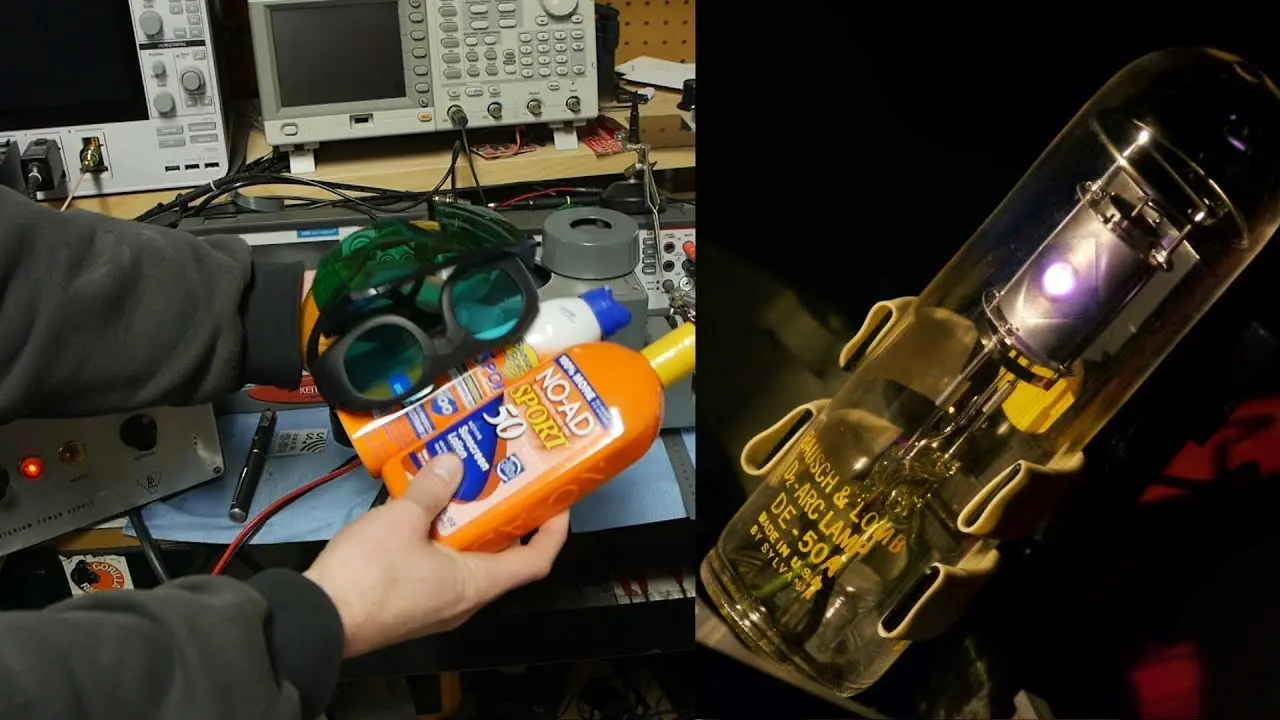
Testing UV absorption eyewear and sunscreen with a deuterium light source
TL;DR
Testing UV safety glasses, sunscreen effectiveness, and UV light transmission through materials.
Transcript
today on Applied Science we're going to talk about ultraviolet light I'm going to test different ultraviolet safety glasses and different kinds of sunscreen to see how effective they are and we'll try to answer the age-old question can you get sunburned through glass in addition if you want to find a material that passes ultraviolet light we'll che... Read More
Key Insights
- 🇧🇻 Deuterium lamps provide a smooth broadband UV output for precise experiments on UV light absorption.
- 🙂 Optical density is crucial for quantifying the amount of UV light blocked by materials for effective protection.
- 🦻 Understanding UVA, UVB, and UVC wavelengths aids in assessing sunburn risk and UV protection needs.
- 🇧🇻 The erythema action spectrum guides the selection of UV protection based on the skin's sensitivity to different UV wavelengths.
- 🇧🇻 Different materials exhibit varied UV light transmission properties, influencing their suitability for UV protection measures.
- 🇧🇻 SPF values in sunscreens may not always align with actual UV protection efficacy, requiring thorough testing and assessment.
- 🙂 Logarithmic optical density scales offer a precise measurement of UV light resistance in materials, especially in safety glasses.
Install to Summarize YouTube Videos and Get Transcripts
Explore YouTube Video Summarizer or Get YouTube Transcript Extractor
Questions & Answers
Q: How does a deuterium lamp provide a smooth broadband output in the UV spectrum?
A deuterium lamp emits continuous molecular spectra due to the difficulty of ionizing deuterium, resulting in a smooth UV output essential for experiments.
Q: Why is it important to understand optical density when discussing UV protection?
Optical density provides a logarithmic scale to quantify how much light is blocked, crucial in determining UV protection levels of materials.
Q: What are the differences between UVA, UVB, and UVC wavelengths in terms of sunburn potential?
UVA has minimal sunburn potential, while UVB poses a significant risk, making it essential to understand the wavelengths for effective UV protection.
Q: How does the erythema action spectrum impact the understanding of UV light and sunburn?
The erythema action spectrum shows the sensitivity to sunburn at different UV wavelengths, emphasizing the importance of selecting appropriate UV protection based on specific wavelengths.
Summary & Key Takeaways
-
Testing UV safety glasses and different sunscreens effectiveness in blocking UV light.
-
Using a deuterium lamp as a smooth broadband UV light source for experiments.
-
Studying UV light transmission through various materials and the concept of optical density.
Read in Other Languages (beta)
Share This Summary 📚
Summarize YouTube Videos and Get Video Transcripts with 1-Click
Try YouTube Summary with ChatGPT & Claude or YouTube Transcript Generator
Explore More Summaries from Applied Science 📚
Summarize YouTube Videos and Get Video Transcripts with 1-Click
Try YouTube Summary with ChatGPT & Claude or YouTube Transcript Generator