How to Build a Proactive AI Agent With Claude
TL;DR
A useful AI agent combines persistent memory, scheduled proactivity, and tools that can interact with external systems. Claude Code’s /loop can provide the recurring heartbeat, while a SQL database connected through an MCP server preserves history, allowing the agent to detect patterns, act on accumulated evidence, and complete recurring work without requiring a fresh prompt each time.
Transcript
You know, a few weeks ago I talked about open brain, which is a simple idea. You have a SQL database and you connect it via an MCP server to your AI and now your AI has a memory. And it's cheap because it's not disintermediated. It's not built on top of another company. It's just a clear, clean, free superbased database and that's it. So far so goo... Read More
Key Insights
- • An effective AI agent is a combination of memory, proactivity, and tools. Memory supplies continuity, proactivity initiates scheduled work, and tools provide the ability to retrieve information, update systems, generate artifacts, call APIs, and trigger workflows.
- • Persistent memory is what prevents every interaction from starting from zero. A database allows an agent to retrieve events and observations from previous days or weeks, compare them with current information, and reason across a history rather than treating every prompt as isolated.
- • Claude Code’s /loop is a heartbeat for recurring agent work. It allows a job to run while the user is away, so the agent can wake up, check relevant information, complete a task, and return to sleep according to a schedule.
- • OpenBrain is a personal knowledge database connected to AI tools through MCP servers. The recommended implementation uses a SQL database that the user owns, giving an agent a persistent place to read and write information without depending on a locked-in memory platform.
- • Proactivity without memory produces repeated but disconnected responses. A scheduled morning check-in can ask about sleep, food, and energy, but it cannot recognize that low energy has occurred repeatedly unless previous answers were stored and made available for comparison.
- • Memory plus proactivity enables pattern recognition across recurring cycles. In the energy example, the agent can compare 12 mornings, identify nine low-energy reports, inspect the three better mornings, and connect those outcomes with earlier meals and sleep rather than caffeine.
- • Tools give an AI agent practical reach beyond conversation. They let it pull data, call APIs, write database records, generate artifacts, and trigger workflows, turning a system that can only reason into one that can perform useful actions across connected services.
- • Simple, modular components make agent systems adaptable to new releases. A SQL database behind an MCP server can remain useful when capabilities such as /loop appear, because the new scheduling layer can be added without replacing the existing memory architecture.
Install to Summarize YouTube Videos and Get Transcripts
Explore YouTube Video Summarizer or Get YouTube Transcript Extractor
Questions & Answers
Q: What three components does a useful AI agent need?
A useful AI agent needs persistent memory, proactivity, and tools. Memory allows it to read and write information that remains available across days or weeks. Proactivity lets it wake up and perform scheduled work without receiving a new prompt each time. Tools let it pull data, call APIs, create artifacts, update databases, and trigger workflows in connected systems.
Q: What does Claude Code’s /loop feature do?
Claude Code’s /loop feature lets an agent run a recurring job without the user remaining at the computer. It acts as the agent’s heartbeat by allowing it to wake on a schedule, inspect relevant information, perform a task, and return to sleep. This removes the need for the user to initiate every individual cycle manually.
Q: How does OpenBrain give an AI agent persistent memory?
OpenBrain uses a personally owned SQL database as a persistent memory store and connects that database to AI tools through an MCP server. The agent can read information saved during earlier interactions and write new observations back to the database. The described implementation costs an estimated 10 to 30 cents per month and avoids platform lock-in.
Q: Why is proactivity alone insufficient for a capable AI agent?
Proactivity alone can make an agent run scheduled tasks, but it does not automatically give the agent historical context. A recurring morning check-in might ask about sleep, meals, and energy every day, yet each response remains isolated without memory. The agent needs stored records to notice repeated outcomes, compare successful days, and make recommendations based on accumulated evidence.
Q: How does memory improve an AI energy-tracking workflow?
Memory allows an energy-tracking agent to store daily reports about sleep quality, meal timing, and energy, then compare those records across multiple weeks. In the example, it identifies low energy on nine of 12 mornings and examines the three better mornings. It then associates those better outcomes with eating before 8:00 p.m. and earlier sleep rather than caffeine.
Q: What kinds of actions can an AI agent perform with tools?
Tools allow an AI agent to interact with systems outside the conversation. Depending on the connected tool set, the agent can retrieve data, query databases, call APIs, generate artifacts, write new records, and trigger workflows. These capabilities provide the practical hands and feet needed to act on conclusions produced through memory and scheduled reasoning.
Q: How can OpenBrain and /loop recreate OpenClaw-like capabilities?
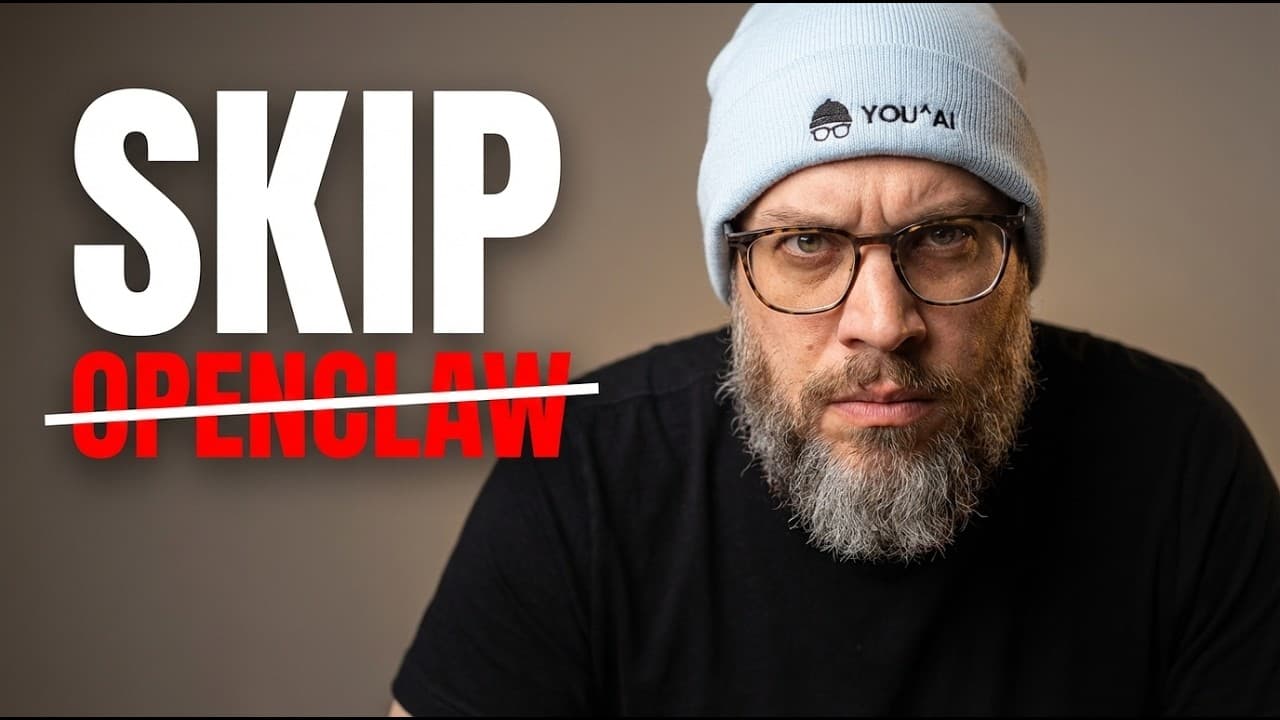
OpenBrain can provide the persistent database, /loop can provide scheduled proactivity, and connected tool sets can provide external actions. Together, these three components let an agent remember prior work, wake up independently, examine current conditions, and perform tasks. The claimed result is many OpenClaw-like capabilities without installing the OpenClaw repository or accepting its associated security concerns.
Q: Why is a modular architecture useful when building personal AI agents?
A modular architecture allows new capabilities to be added without rebuilding the entire agent. A SQL database behind an MCP server can continue serving as memory when a scheduling feature such as /loop becomes available. Tools can also be connected separately, so memory, proactivity, and actions can evolve as independent components while continuing to work together.
Summary & Key Takeaways
-
An AI system becomes more useful when it combines three components: persistent memory, proactivity, and tools. Memory preserves information across interactions, proactivity lets the system run scheduled jobs without fresh prompts, and tools let it query data, call APIs, create artifacts, update databases, and trigger workflows in external systems.
-
OpenBrain supplies persistent memory through a personally owned SQL database connected to AI tools by an MCP server. The proposed setup is simple, costs an estimated 10 to 30 cents per month, avoids platform lock-in, and remains compatible with new capabilities because its database and connection layer are modular components.
-
Claude Code’s /loop supplies the missing heartbeat by letting an agent wake on a schedule, inspect information, perform work, and return to an idle state. When combined with memory and tools, recurring runs can accumulate observations, recognize patterns, evaluate earlier experiments, and produce increasingly evidence-based recommendations or business actions.
Read in Other Languages (beta)
Share This Summary 📚
Summarize YouTube Videos and Get Video Transcripts with 1-Click
Try YouTube Summary with ChatGPT & Claude or YouTube Transcript Generator
Explore More Summaries from AI News & Strategy Daily | Nate B Jones 📚






Summarize YouTube Videos and Get Video Transcripts with 1-Click
Try YouTube Summary with ChatGPT & Claude or YouTube Transcript Generator