iPhone 17 Pro or DJI Pocket 3 for Video?
TL;DR
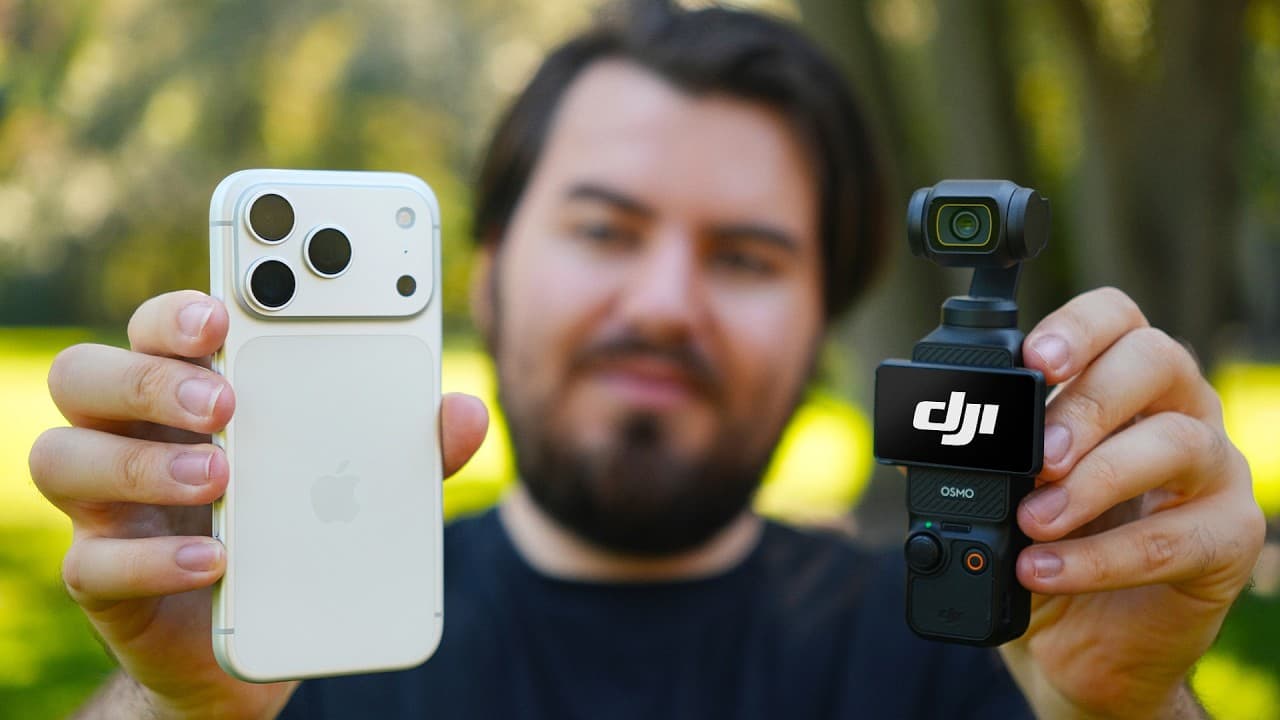
Choose the DJI Osmo Pocket 3 for smoother walking and running footage, discreet filming, and higher-quality self-recording. Choose the iPhone 17 Pro for greater durability, broader focal-length coverage, stronger dynamic range, and substantially more flexible Apple Log, ProRes, and ProRes RAW workflows, provided you can manage the heavy storage requirements.
Transcript
If you want one camera that can do it all, something small, powerful, and easy to take anywhere, there are two options that come really close. The DJI Pocket 3 and the iPhone 17 Pro. I've enjoyed using both, but they are built for very different kinds of creators. So, in this video, I'm breaking down the video quality, stabilization, audio, and a b... Read More
Key Insights
- The DJI Osmo Pocket 3 is better suited to walking-and-talking vlogging because its camera rotates toward the creator, preserving the quality of its main lens and sensor while producing a sharper image with more shallow depth of field than the iPhone selfie camera.
- The iPhone 17 Pro is the more durable outdoor camera because it is waterproof and does not require protection for a delicate mechanical gimbal. The Pocket 3 must be handled more cautiously and returned to its case after filming to protect the gimbal during travel.
- The iPhone 17 Pro delivers stronger automatic image processing through greater highlight and shadow detail, sharper rendering, and attractive straight-from-camera colors. The Pocket 3 remains crisp and detailed, but its more natural and flattering skin tones can look less heavily processed than the iPhone's output.
- Apple Log is substantially more flexible for color grading than the Pocket 3's D-Log M profile. The iPhone supports ProRes and ProRes RAW, providing formats described as comparable to those available on many mirrorless cameras, while aggressively grading Pocket 3 footage can make its image deteriorate sooner.
- ProRes RAW is highly demanding on storage because every 10 seconds of footage requires 1 GB. Recording it also requires an external SSD, although the format allows adjustments to ISO and white balance during post-production for more precise control of the finished image.
- Both cameras record 4K video at up to 120 frames per second, enabling crisp, smooth slow motion. The comparison favors the iPhone's slow-motion image quality, although both devices provide the same stated maximum resolution and frame rate for this type of recording.
- The iPhone 17 Pro offers substantially more framing choices through 13 mm, 24 mm, approximately 48 mm, 100 mm, and 200 mm equivalent views. The Pocket 3 uses a fixed 20 mm equivalent lens, with a 15 mm adapter and a quality-reducing 40 mm digital crop.
- The Pocket 3 provides smoother stabilization through its mechanical gimbal, particularly during running or more deliberate camera movements. The iPhone's combination of sensor and digital stabilization performs well during ordinary walking, but aggressive movements can reveal small artifacts or visible image warping.
Install to Summarize YouTube Videos and Get Transcripts
Explore YouTube Video Summarizer or Get YouTube Transcript Extractor
Questions & Answers
Q: Which is better for vlogging, iPhone 17 Pro or DJI Pocket 3?
The DJI Osmo Pocket 3 is the stronger choice for creators who frequently walk and talk to the camera. Its mechanical gimbal produces smoother motion, and its camera rotates to face the creator, allowing the main lens and sensor to remain in use. The resulting self-recorded image appears sharper and has slightly more shallow depth of field than footage from the iPhone's selfie camera.
Q: Which camera has better image quality in automatic mode?
The iPhone 17 Pro has several advantages in automatic mode, including greater dynamic range, more retained detail in highlights and shadows, sharper rendering, and strong straight-from-camera colors. The DJI Pocket 3 still creates a crisp, detailed picture and may be preferable for people because its colors and skin tones look more natural and flattering, with less visible processing than some iPhone shots.
Q: How do Apple Log and DJI D-Log M compare?
Apple Log provides considerably more flexibility for extensive color grading than DJI's D-Log M. The iPhone's log footage is flatter and supports ProRes as well as ProRes RAW, giving creators more freedom to shape the final appearance. D-Log M can still produce attractive grades, but pushing the image heavily may cause it to fall apart sooner than footage recorded in Apple Log.
Q: How much storage does iPhone ProRes RAW video require?
ProRes RAW on the iPhone requires 1 GB of storage for every 10 seconds of recorded footage, so available capacity can disappear quickly. An external SSD is required to use RAW recording. In exchange for those storage demands, the format provides extensive post-production flexibility, including the ability to adjust ISO and white balance while refining the final image.
Q: Which camera has better stabilization for walking and running?
The DJI Osmo Pocket 3 has the advantage because its mechanical gimbal keeps footage especially smooth during walking, running, and intentional camera movements. Both cameras perform well in a normal walking comparison, and the iPhone's sensor and digital stabilization remain effective. During more aggressive movement, however, the iPhone can show small stabilization artifacts or warping, while the Pocket 3 stays smoother.
Q: Which camera offers more focal lengths for creative filming?
The iPhone 17 Pro offers far more focal-length flexibility through its multiple cameras and crop options. Its available equivalent views include 13 mm ultra-wide, 24 mm wide, approximately 48 mm from a 2x crop, 100 mm telephoto, and 200 mm from an additional telephoto crop. The Pocket 3 has a 20 mm lens, a 15 mm wide adapter option, and a 40 mm digital crop that reduces image quality.
Q: Which camera is better for vertical social media video?
The iPhone 17 Pro records vertical footage in 4K simply by being held vertically. The DJI Osmo Pocket 3 is limited to 3K when filming in its vertical format. The resolution difference may have limited practical importance for social media because the finished upload is likely to be 1080, but the iPhone still provides the higher-resolution vertical source file.
Q: Which camera is easier and safer to carry while traveling?
The answer depends on whether convenience or discretion matters more. The iPhone is more durable, waterproof, familiar to existing users, and already carried as a phone, so it does not necessarily add another device to the travel kit. The Pocket 3 is more compact and discreet when filming publicly, but its delicate gimbal needs protection, regular use of its case, and space for any required accessories.
Summary & Key Takeaways
-
The iPhone 17 Pro is the more durable and convenient option because it is waterproof, familiar to existing iPhone users, and likely already with them. The Pocket 3 is smaller and more discreet, but its exposed gimbal requires careful handling, protective storage, and potentially additional accessories while traveling.
-
Automatic footage from the iPhone offers greater dynamic range, sharper detail, and pleasing color, while the Pocket 3 produces natural, flattering skin tones with less processed rendering. Apple Log provides much greater grading flexibility than D-Log M, and the iPhone also supports ProRes and storage-intensive ProRes RAW recording.
-
The Pocket 3 excels at movement because its mechanical gimbal remains smooth during walking, running, and intentional camera moves. The iPhone combines sensor and digital stabilization effectively, but aggressive motion can produce warping artifacts. Its major advantage is lens versatility, ranging from 13 mm ultra-wide to 200 mm equivalent framing.
Read in Other Languages (beta)
Share This Summary 📚
Summarize YouTube Videos and Get Video Transcripts with 1-Click
Try YouTube Summary with ChatGPT & Claude or YouTube Transcript Generator
Explore More Summaries from Think Media 📚



Summarize YouTube Videos and Get Video Transcripts with 1-Click
Try YouTube Summary with ChatGPT & Claude or YouTube Transcript Generator