How Did Modern AI Evolve From Transformers?
TL;DR
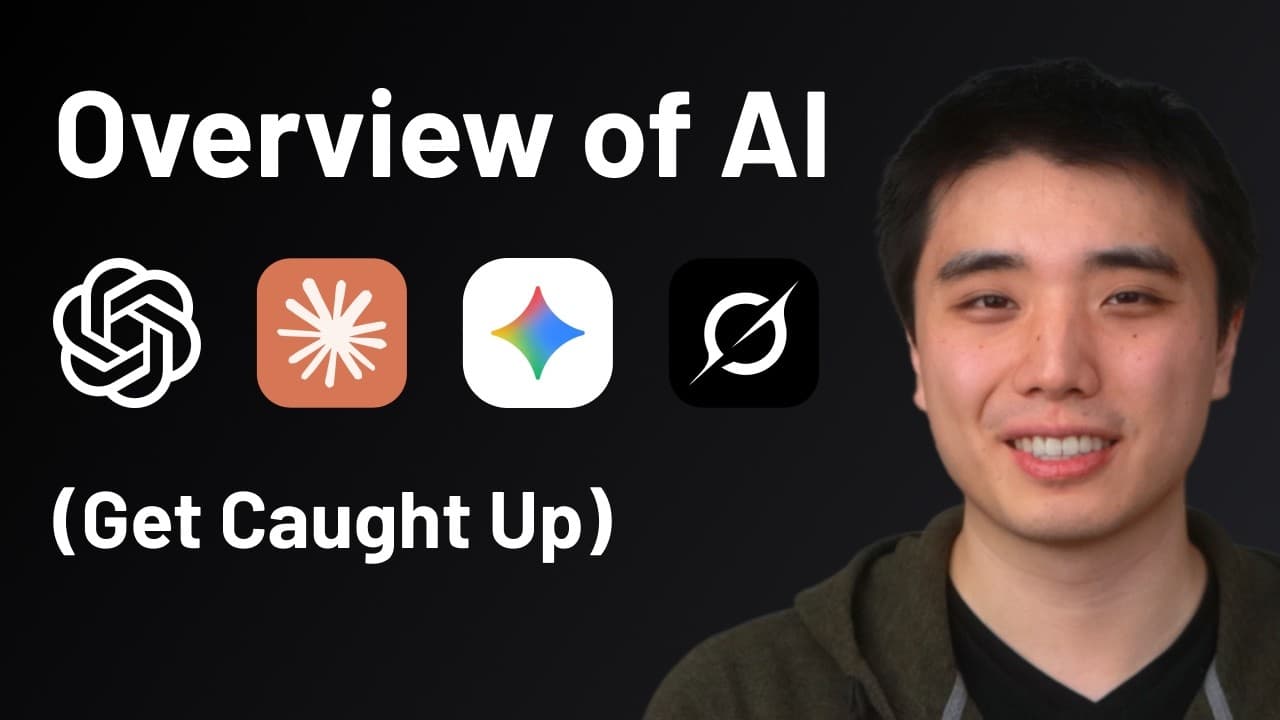
Modern AI grew from the transformer, a design that processes relationships among words in parallel and supports increasingly large language models. GPT models demonstrated that scaling data and parameters improves performance, while human feedback, multimodal inputs, tool use, APIs, and agentic loops made these systems more practical for conversations, applications, and complex tasks.
Transcript
In this video, I'm going to give you an overview of modern AI. We're going to go over the most important developments in AI so far to help you get caught up. So, I created this interactive diagram here that you can move around and zoom. And it will help you visualize the most important developments in AI over the past few years and how they connect... Read More
Key Insights
- The transformer is an AI design introduced in Google's 2017 Attention Is All You Need paper. It examines relationships among words simultaneously and makes training more parallel, supporting the creation of the larger models that underpin modern language AI.
- A language model is an AI system that understands and generates text. GPT-1 was trained on around 7,000 books to predict the next token, and its performance across multiple language tasks demonstrated that a transformer-based model could outperform some task-specific predecessors.
- A token is a word or part of a word used by an AI model because token-based processing is more efficient. GPT models learn by predicting the next token in a sequence, even though increasing scale can produce capabilities beyond that original training objective.
- Scaling is the process of increasing model size and training data to improve performance. GPT-2 expanded from GPT-1's 117 million parameters to 1.5 billion parameters and used about ten times more text, producing a substantial improvement over its predecessor.
- Emergent abilities are capabilities gained without direct training for those particular tasks. After GPT-2 became larger, it could summarize text and perform basic translations, while the larger GPT-3 could write short stories, poems, and code despite next-token prediction remaining its core training task.
- Reinforcement learning from human feedback is a method for guiding model behavior through ranked responses. InstructGPT used response preferences to train another AI to score outputs automatically, helping the language model recognize instructions and generate answers that followed them more effectively.
- Tool use is a way for language models to supplement generated answers with external operations. GPT-4 was trained to browse the web and run Python code through a code interpreter, which could help verify responses and reduce problems caused by hallucinated information.
- An AI agent is a system that repeatedly plans and takes actions until a task is complete. Its agentic loop uses each action's result to choose the next step, allowing API-based systems such as LangChain, BabyAGI, and AutoGPT to coordinate more complex workflows.
Install to Summarize YouTube Videos and Get Transcripts
Explore YouTube Video Summarizer or Get YouTube Transcript Extractor
Questions & Answers
Q: What is the transformer in modern AI?
The transformer is an AI design introduced by Google's 2017 research paper Attention Is All You Need. It allows a model to examine the relationship of every word to every other word at once, unlike earlier designs that processed text step by step. It also makes training more parallel, which enabled researchers to create larger and more powerful language models.
Q: How are language models trained to generate text?
A language model can be trained by receiving large amounts of text and learning to predict the next token in a sequence. GPT-1, for example, was trained on around 7,000 books using this objective. Although the immediate task is token prediction, the resulting model can develop broader language capabilities and perform well across several different tasks.
Q: What are tokens and parameters in an AI model?
A token is a word or part of a word that an AI system processes, and tokens are used because they are more efficient than treating every complete word as the basic unit. A parameter is a number that stores aspects of the model's knowledge or language understanding. More parameters generally allow deeper understanding, although scale eventually produces diminishing improvements.
Q: Why was GPT-2 important to AI development?
GPT-2 showed that scaling a transformer-based language model could greatly improve its performance. It had 1.5 billion parameters, compared with GPT-1's 117 million, and was trained on about ten times more text. It also displayed emergent abilities, including summarization and basic translation, even though it had only been trained to predict the next token.
Q: What did GPT-3 demonstrate about scaling language models?
GPT-3 demonstrated that performance and emergent capabilities continued to improve as language models became much larger. It had 175 billion parameters, more than 100 times GPT-2's 1.5 billion. The model could write short stories, poems, and code, but it was not consistently good at recognizing and following instructions, which motivated additional training methods.
Q: How does reinforcement learning from human feedback improve AI?
Reinforcement learning from human feedback improves behavior by comparing multiple model responses to an instruction and ranking them according to how well they follow it. Those rankings are used to create another AI that can score responses automatically. InstructGPT applied this technique to GPT-3, making the model substantially better at recognizing instructions and responding in the desired manner.
Q: Why did ChatGPT become useful to average users?
ChatGPT combined the GPT-3.5 model with an accessible chat web application. GPT-3.5 had been trained with human feedback to act like a helpful assistant and follow multiple instructions across a conversation. The conversational interface let people use the model simply by chatting with it, helping the application reach 100 million users unusually quickly and demonstrating broad practical value.
Q: What is an AI agent and how does its agentic loop work?
An AI agent keeps taking actions until a requested task is complete instead of generating only one output. It first plans a step, performs an action, examines the result, and then uses that result to plan its next action. This repeated process is called the agentic loop. Early tools including LangChain, BabyAGI, and AutoGPT used model APIs to coordinate it.
Summary & Key Takeaways
-
The modern AI timeline begins with Google's 2017 Attention Is All You Need paper, which introduced the transformer. Its design considers relationships among all words at once and enables more parallel training. These advantages made it possible to build larger language models with stronger understanding and text-generation capabilities.
-
OpenAI's GPT series demonstrated the effects of scaling. GPT-1 validated transformer-based language modeling, GPT-2 showed major performance gains and emergent abilities, and GPT-3 expanded those abilities further. InstructGPT then used reinforcement learning from human feedback to improve instruction following, leading toward the conversational behavior of GPT-3.5 and ChatGPT.
-
GPT-4 improved general performance, added image understanding, and exposed diminishing returns from simply increasing model size. Development consequently expanded toward browsing, code execution, APIs, specialized applications, and agents. Competitors emerged, while objective and subjective benchmarks became important, though benchmark saturation and differences from real-world usage limit their usefulness.
Read in Other Languages (beta)
Share This Summary 📚
Summarize YouTube Videos and Get Video Transcripts with 1-Click
Try YouTube Summary with ChatGPT & Claude or YouTube Transcript Generator
Explore More Summaries from SuperSimpleDev 📚



Summarize YouTube Videos and Get Video Transcripts with 1-Click
Try YouTube Summary with ChatGPT & Claude or YouTube Transcript Generator