How to Break Free From Conditioned Thinking
TL;DR
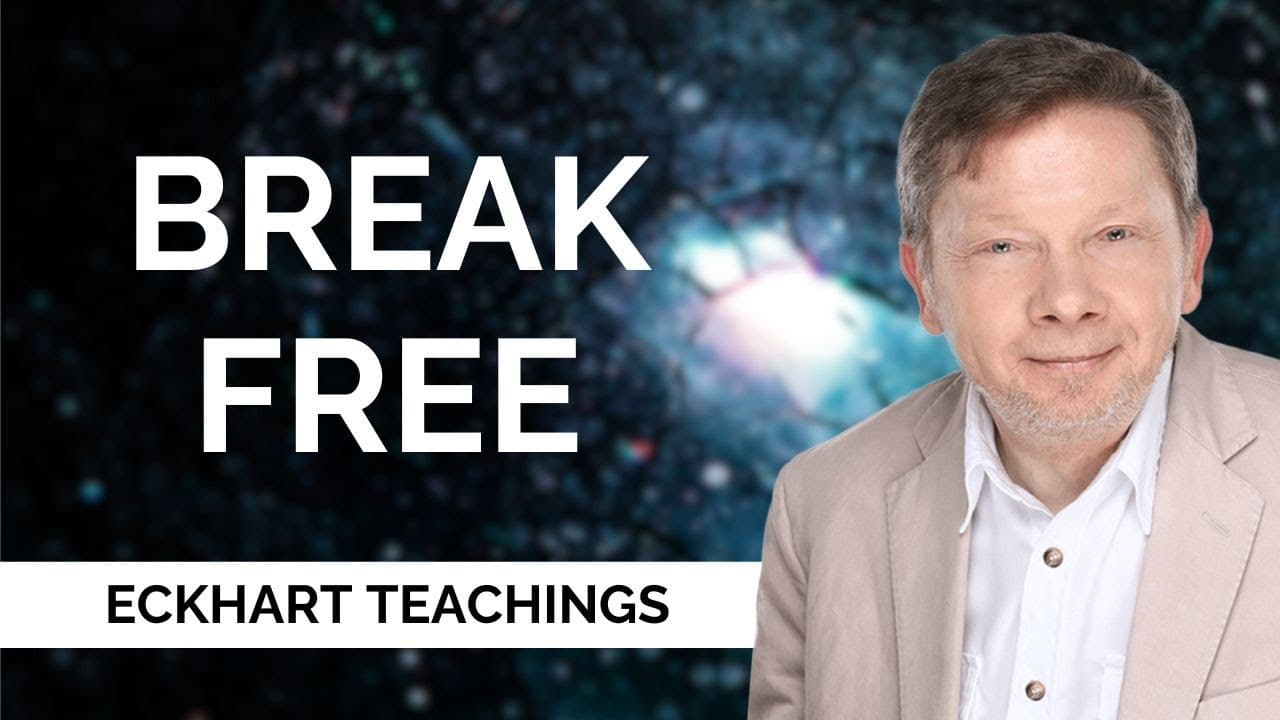
You break identification with thought by noticing the alert presence in which thoughts, emotions, memories, and concepts appear. When thinking briefly subsides without losing alertness, consciousness can recognize itself as something vaster than mental content, allowing thought to continue as a useful creative tool rather than a compulsive source of identity.
Transcript
but the Consciousness is not form and what we perceive as space can we even say that space exists well not really it makes existence possible but it doesn't exist as such because space is not anything it's a total mystery we can look into outer space at night clear sky and then you look and there's the vastness of space and what is all inspiring wh... Read More
Key Insights
- Space is not a form or object, but it makes the existence and appearance of forms possible. Its vastness and absolute stillness can inspire deeper wonder than the celestial bodies it contains because space itself cannot be grasped through ordinary conceptual thinking.
- Inner space is the formless field of consciousness that allows mental content to appear. It is compared with outer space because both make manifestation possible, although inner space has no physical extension and is described as not being subject to time.
- A room's essence is the space within its physical boundaries, not merely its furniture, walls, floor, or ceiling. This analogy shows how attention to visible contents can obscure the less obvious dimension that makes the entire arrangement possible.
- Personal identity is commonly constructed from memories, concepts, thoughts, emotions, past experiences, and personality. Identifying exclusively with these contents leaves a person unaware of the conscious presence in which all such mental material is experienced.
- Awareness becomes recognizable when thinking subsides briefly while alertness remains. This gap is not the dullness of falling asleep, but an immediate experience of presence that cannot be understood merely as another concept or object of thought.
- Transcending thinking means recognizing what lies beyond thought while still including it. It does not require eliminating thought, because thinking retains an important function once it is no longer treated as the foundation of personal identity.
- Thought becomes a powerful creative tool when it is no longer compulsive, addictive, or self-serving. From awareness, thinking can help give form to things and participate consciously in creation without controlling the person's entire sense of self.
- Unaware thinking is an involuntary and conditioned process shaped by personal background, culture, upbringing, and environment. When awareness is absent, thoughts simply appear, and the mindmade identity mistakenly treats those conditioned processes as an independently choosing self.
Install to Summarize YouTube Videos and Get Transcripts
Explore YouTube Video Summarizer or Get YouTube Transcript Extractor
Questions & Answers
Q: What is the inner space of consciousness?
The inner space of consciousness is the formless presence that makes thoughts, emotions, memories, concepts, and perceptions possible. It resembles outer space in the teaching because it holds content without being one more item of content. Unlike physical space, it has no extension in the visible dimension and is described as not being subject to time.
Q: How can I stop identifying with my thoughts?
Begin by noticing that thoughts are contents appearing within awareness, alongside emotions, memories, concepts, and perceptions. A brief gap in thinking, while alertness remains, reveals that conscious presence does not disappear when thought pauses. This recognition loosens the assumption that your personality and mental stream are the complete essence of who you are.
Q: Does transcending thought mean that thinking stops?
Transcending thought does not mean that you no longer think. It means recognizing a dimension beyond thinking that remains inseparable from who you are and still includes thought. Thinking continues to perform an important function, but it no longer supplies the entire foundation of identity or operates only as a compulsive, addictive, self-serving process.
Q: Why does Eckhart Tolle compare consciousness to space?
Consciousness is compared to space because both allow contents to appear without being identical to those contents. Outer space enables celestial bodies and other forms to exist, while inner consciousness enables thoughts, emotions, memories, and perceptions to arise. The comparison directs attention away from visible or mental objects and toward the presence that makes experience possible.
Q: How does the room analogy explain awakening?
A room might describe itself through its furniture, lamps, walls, ceiling, and floor while overlooking the space that makes it a room. People similarly describe themselves through personality, history, thoughts, emotions, memories, and concepts. Awakening occurs when the overlooked essence, the conscious presence holding all those contents, becomes immediately recognizable rather than merely conceptualized.
Q: Why is ordinary thinking described as conditioned?
Ordinary thinking is described as conditioned because the thoughts appearing in the mind depend on personal history, culture, upbringing, environment, and the part of the planet where a person developed. Without awareness, this process is involuntary. Thoughts arise according to prior conditioning, even though the resulting mindmade identity assumes that it independently creates and controls them.
Q: What happens when thinking subsides but alertness remains?
When thinking briefly subsides while alertness remains, consciousness can recognize itself without using another thought or concept. The pause differs from falling asleep because awareness stays present. It offers an immediate realization of the presence that makes mental activity possible and reveals something vaster than the continuous stream of conditioned thinking.
Q: How does awareness change the function of thought?
Awareness changes thought from a compulsive basis of identity into a practical and creative tool. Thinking can still help manifest ideas, create forms, and serve necessary functions, but it is no longer wholly self-serving or addictive. The person is less at the mercy of conditioned mental activity because thought is included within a wider conscious presence.
Summary & Key Takeaways
-
Space makes the existence of forms possible without itself appearing as a form. The vast, still space visible around stars serves as an analogy for consciousness, which allows thoughts, emotions, memories, and perceptions to arise while remaining beyond the contents it holds and outside the ordinary experience of time.
-
A room is defined not only by its furniture, walls, floor, and ceiling, but fundamentally by the space they surround. In the same way, a person commonly describes themselves through personality and mental content while overlooking the conscious presence that makes every thought, emotion, memory, and concept perceptible.
-
Transcending thought does not mean permanently ceasing to think. It means recognizing a dimension of consciousness beyond thought that includes thinking without depending on it for identity. Thought can then serve creation and practical activity instead of operating compulsively according to personal, cultural, and environmental conditioning.
Read in Other Languages (beta)
Share This Summary 📚
Summarize YouTube Videos and Get Video Transcripts with 1-Click
Try YouTube Summary with ChatGPT & Claude or YouTube Transcript Generator
Explore More Summaries from Eckhart Tolle 📚




Summarize YouTube Videos and Get Video Transcripts with 1-Click
Try YouTube Summary with ChatGPT & Claude or YouTube Transcript Generator