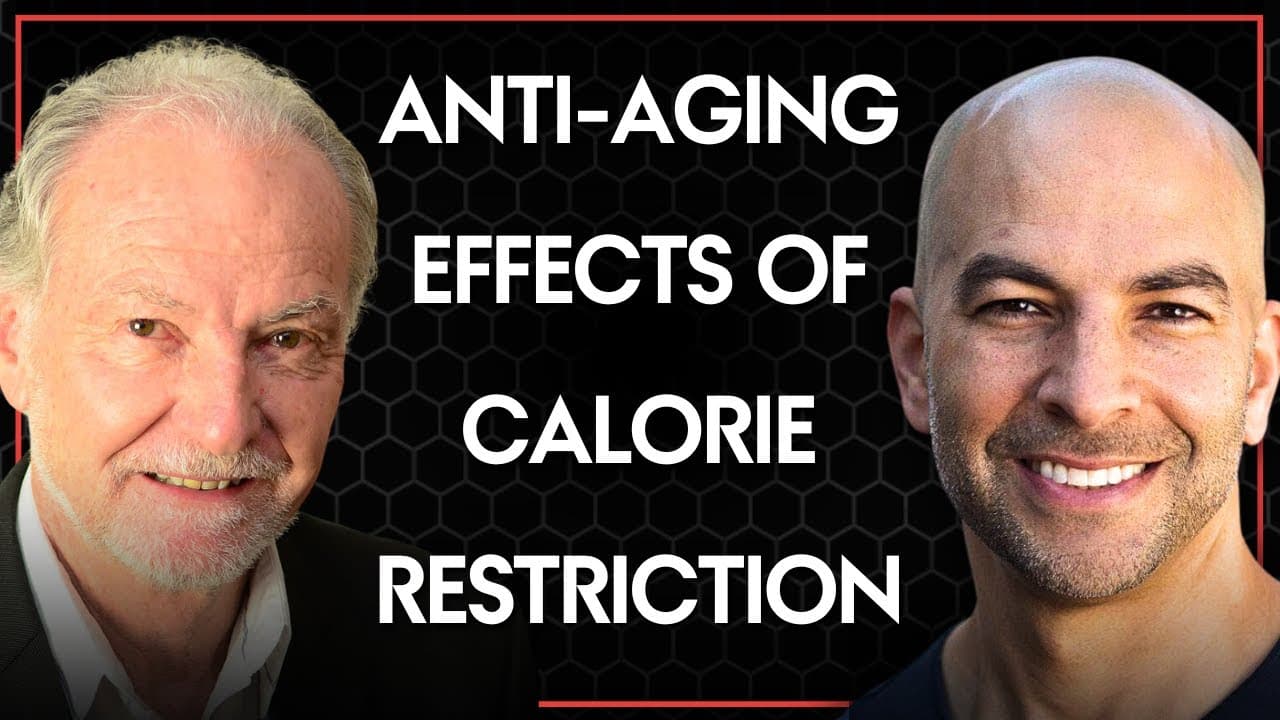
How Does Calorie Restriction Affect Aging?
TL;DR
Calorie restriction improved cardiometabolic risk factors, inflammatory markers, and skeletal muscle mitochondrial turnover in healthy participants. Its anti-aging effects may reflect both lower energy requirements and the creation of newer, more efficient mitochondria that produce fewer reactive oxygen species, although primary aging mechanisms such as autophagy and cellular membrane changes were harder to measure directly.
Transcript
so what do you think from a from an anti-aging perspective were the most important uh biomarkers that changed like for example did you do ogtts or ug glycemic clamps I mean how much did you uh scrutinize glucose disposal and insulin sensitivity in these people yeah we we didn't do clamps uh let me tell you there are two kind of Aging there's primar... Read More
Key Insights
- Aging can be divided into primary aging and secondary aging. Primary aging includes processes such as senescence, mitochondrial dysfunction, and leaky cellular membranes, while secondary aging reflects the effects of environment and lifestyle through factors such as insulin sensitivity and cardiovascular health.
- Cardiometabolic risk factors improved substantially with calorie restriction despite participants being healthy at baseline. The study population had BMIs ranging from 22 to 27.9, making the broad improvements in markers associated with secondary aging particularly notable to the researchers.
- Mitochondrial biogenesis increased in skeletal muscle during calorie restriction. Researchers determined this by examining the relationship between nuclear markers and mitochondrial DNA, finding greater mitochondrial turnover even though participants used less energy and became more metabolically efficient.
- Reduced reactive oxygen species may result from two complementary effects of calorie restriction. Lower energy requirements reduce substrate utilization, while increased mitochondrial biogenesis provides newer and more efficient mitochondria that generate fewer reactive oxygen species than older mitochondrial machinery.
- Primary aging is more difficult to evaluate directly in humans than secondary aging. The researchers lacked as much information as they wanted because processes such as autophagy, mitochondrial function, and cellular membrane leakiness are challenging to measure comprehensively in study participants.
- Inflammatory markers improved during calorie restriction even though baseline inflammation was not abnormal. Measurements at 6, 12, and 24 months included high-sensitivity CRP, interleukins, and TNF alpha, with the discussed panel showing broad improvement.
- Thymus imaging showed a reduction in fat involution during calorie restriction. This finding generated interest in investigating immune responses more deeply through transcriptomic analysis across different tissues, linking the intervention to potentially meaningful changes in immune function.
- Framingham cardiometabolic risk estimates improved markedly as the underlying biomarkers changed. The result was characterized as participants gaining approximately 10 years in two years, supporting calorie restriction as strong experimental evidence for people who can sustain it.
Install to Summarize YouTube Videos and Get Transcripts
Explore YouTube Video Summarizer or Get YouTube Transcript Extractor
Questions & Answers
Q: How does calorie restriction affect biomarkers of aging?
Calorie restriction substantially improved cardiometabolic risk factors associated with secondary aging, including measures connected with cardiovascular and metabolic health. It also improved the assessed inflammatory panel and increased mitochondrial biogenesis and turnover in skeletal muscle. These changes occurred even though participants were healthy at baseline, with BMIs ranging from 22 to 27.9.
Q: What is the difference between primary and secondary aging?
Primary aging refers to underlying biological processes such as senescence, mitochondrial dysfunction, autophagy, and leakiness of cellular membranes. Secondary aging describes the effects of environment and lifestyle, including changes in insulin sensitivity and cardiovascular risk factors. The study measured secondary aging extensively, while several mechanisms of primary aging were more difficult to assess directly in humans.
Q: Why might calorie restriction reduce reactive oxygen species?
Calorie restriction may reduce reactive oxygen species through two mechanisms working together. First, lower energy requirements can reduce substrate utilization and the associated production of reactive oxygen species. Second, increased mitochondrial biogenesis and turnover can replace older mitochondria with newer, more efficient mitochondria that produce fewer reactive oxygen species while processing substrates.
Q: Does calorie restriction increase mitochondrial turnover?
Calorie restriction increased mitochondrial turnover and biogenesis in skeletal muscle in the discussed human study. Researchers assessed this effect by examining the relationship between nuclear markers and mitochondrial DNA. The result was notable because mitochondrial biogenesis increased even as participants used less energy and became more efficient, suggesting renewal of the cellular machinery involved in energy processing.
Q: How does calorie restriction affect inflammation?
Calorie restriction improved the inflammatory markers assessed at 6, 12, and 24 months. The panel included high-sensitivity CRP, interleukins, and TNF alpha. These improvements were striking because participants did not have abnormal inflammation at baseline, indicating that calorie restriction changed inflammatory measurements even within an initially healthy study population.
Q: What did thymus imaging show during calorie restriction?
Imaging of the thymus showed reduced fat involution during calorie restriction. The result was considered particularly interesting for immune function and encouraged further investigation of immune responses using transcriptomics in different tissues. The transcript does not provide a complete clinical interpretation, but it presents the imaging change as a notable biological response to the intervention.
Q: Did the study directly measure autophagy during calorie restriction?
The study did not directly measure the discussed autophagy markers, including LC-related measures. Instead, researchers evaluated mitochondrial turnover using the relationship between nuclear markers and mitochondrial DNA. They found increased turnover with calorie restriction, but direct conclusions about human autophagy were limited because that process is difficult to measure comprehensively in study participants.
Q: How much did calorie restriction change calculated cardiometabolic risk?
The cardiometabolic biomarkers improved enough to produce a striking change when evaluated with the Framingham risk calculator. The effect was described as approximately gaining 10 years in two years. This estimate reflected improvements in the calculator's underlying biomarkers, and the discussion presented it as strong experimental support for calorie restriction among people capable of maintaining it.
Summary & Key Takeaways
-
Calorie restriction produced substantial improvements across cardiometabolic markers associated with secondary aging, even though participants were healthy at baseline and had BMIs from 22 to 27.9. The researchers distinguished these lifestyle-related outcomes from primary aging processes, including senescence, mitochondrial dysfunction, autophagy, and changes in cellular membranes, which are considerably harder to measure.
-
Researchers found increased mitochondrial biogenesis and turnover in skeletal muscle during calorie restriction. This suggests that reduced reactive oxygen species may result from two complementary mechanisms: participants required less energy, and their newer mitochondria processed substrates more efficiently while producing fewer reactive oxygen species than older mitochondria. Direct autophagy measurements were not performed.
-
Inflammatory measurements taken at 6, 12, and 24 months improved across the assessed panel, including high-sensitivity CRP, interleukins, and TNF alpha. Thymus imaging also showed reduced fat involution. Changes in cardiometabolic biomarkers produced a striking improvement in calculated Framingham risk, described as approximately gaining 10 years over two years.
Read in Other Languages (beta)
Share This Summary 📚
Summarize YouTube Videos and Get Video Transcripts with 1-Click
Try YouTube Summary with ChatGPT & Claude or YouTube Transcript Generator
Explore More Summaries from Peter Attia MD 📚


Summarize YouTube Videos and Get Video Transcripts with 1-Click
Try YouTube Summary with ChatGPT & Claude or YouTube Transcript Generator