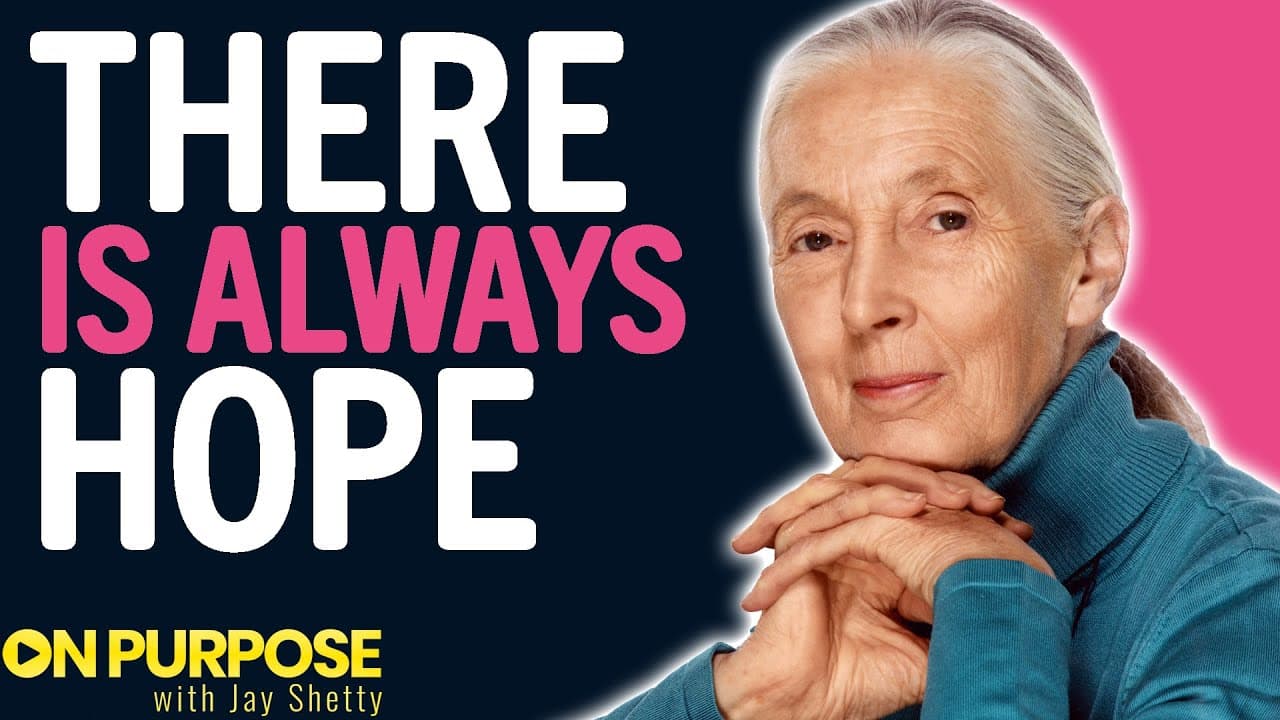
Jane Goodall ON: Winning the War on Nature & How Simple Actions Make Big Changes
TL;DR
People can make a difference in nature by pairing hope with conscious action and recognizing that individual choices contribute to wider change. Jane Goodall explains how Roots & Shoots empowers young people, why compassion must guide human intellect, and how her mother’s encouragement helped her pursue a childhood dream of living with wild animals in Africa. Read on for practical lessons about resilience, purpose, storytelling, and environmental responsibility.
Transcript
we don't deserve the title of homo sapiens the wise ape because we've been destroying our only home because there's been a disconnect i think between this clever brain and the human heart i love the way we poetically put love and compassion into the human heart and then finally this indomitable human spirit that won't give in and so often succeeds ... Read More
Key Insights
- Jane Goodall believes every individual can make a significant impact on the planet through conscious actions.
- The war against nature is ongoing, and awareness of our interconnectedness with the natural world is crucial.
- Goodall's Roots & Shoots program empowers young people to take action on environmental and humanitarian issues.
- Hope is not passive; it requires taking action to make a difference.
- The resilience of nature is evident, as seen in stories like the Survivor Tree from 9/11.
- Human intellect, when combined with compassion, can lead to positive environmental change.
- Parental support and encouragement played a vital role in shaping Goodall's determination and success.
- Storytelling is a powerful tool for inspiring hope and motivating others to take action.
Install to Summarize YouTube Videos and Get Transcripts
Explore YouTube Video Summarizer or Get YouTube Transcript Extractor
Questions & Answers
Q: How can individuals make a difference in nature?
Individuals can consider how their daily actions affect the environment and make more conscious choices about what they buy and waste. Jane Goodall emphasizes that even small actions matter because they contribute to a broader movement for environmental change.
Q: What is Jane Goodall’s Roots & Shoots program?
Roots & Shoots is a program founded by Jane Goodall that empowers young people to act on environmental, conservation, and humanitarian issues. Participants choose projects that reflect their interests and work together to improve their communities.
Q: Why does Jane Goodall believe hope requires action?
Goodall presents hope as an active force rather than a passive feeling. It helps people resist apathy, believe change is possible, and take meaningful steps to improve the world.
Q: Why does Jane Goodall say humans do not deserve the title Homo sapiens?
Goodall says humans have been destroying their only home, so they do not deserve a name meaning “the wise ape.” She attributes this behavior to a disconnect between the clever human brain and the love and compassion associated with the human heart.
Q: How did Jane Goodall’s mother help her pursue her dream?
When others laughed at Goodall’s ambition to go to Africa, live with wild animals, and write books about them, her mother encouraged her. She advised Goodall to work very hard, take every opportunity, and refuse to give up, and Goodall attributes much of her life and work to that support.
Q: What did Jane Goodall learn from growing up during World War II?
Growing up during World War II taught Goodall to take nothing for granted. Food, clothing, and petrol were rationed, waste was avoided, and the deaths of family friends meant that even life itself could not be assumed.
Q: What does the Survivor Tree story represent?
The Survivor Tree represents nature’s resilience and the possibility of restoration. After being nearly destroyed in the 9/11 attacks, it was nurtured back to health and replanted at the Twin Towers site, becoming a symbol of hope and renewal.
Q: How does storytelling inspire environmental action?
Goodall sees storytelling as a way to connect with people emotionally and spread hope. Stories of resilience and positive change can motivate people to believe improvement is possible and take action themselves.
Summary
In this video, Jay Shetty interviews Jane Goodall, a renowned scientist and conservationist, about hope, resilience, and the importance of taking action to protect the environment and create a better world. Goodall shares personal stories and insights from her own life, including her childhood dream of living with wild animals, the influence of her mother in supporting her dreams, and the powerful connection she experienced with a chimpanzee named David Greybeard. She also discusses the role of hope in difficult times, the need for a new definition of success, and the unique capabilities of human intellect.
Questions & Answers
Q: What inspired Jane Goodall to pursue her dream of living with wild animals in Africa?
When Jane was 10 years old, she read the book "Tarzan of the Apes," which inspired her to go to Africa and live with wild animals in the forest. Although she no longer enjoys the book due to its violent content, it ignited her passion for studying and writing about wild animals.
Q: How did Jane's mother support her dreams of becoming a scientist?
Jane's mother had progressive parents who nurtured her curiosity about nature from an early age. They took her and her siblings into the woods, taught them about wildlife, and instilled a love for the natural world. Jane's mother, in turn, supported her dreams by encouraging her to work hard, seize opportunities, and never give up.
Q: How did Jane deal with discouragement from others who doubted her dreams?
Jane's supportive family shielded her from external negativity during her early years. Living through World War II also taught her not to take anything for granted and to persevere in the face of challenges. Jane shares her mother's advice that if she worked hard and didn't give up, she might find a way to achieve her dreams.
Q: What role did hope and resilience play in Jane's journey?
Jane credits her upbringing during World War II for instilling an awareness of the fragility of life and the importance of not giving in to despair. She believes that hope is a survival trait and that the indomitable human spirit often succeeds in the face of adversity. Through her work, she aims to inspire young people to take action and make a difference in the world.
Q: How can people develop a sense of hope and gratitude in today's world?
Jane suggests that we recognize the ongoing environmental crisis as a war against nature. By understanding our interconnectedness with the natural world and not taking its resources for granted, we can develop a different relationship with the environment. She also advises focusing on stories of courage, bravery, and self-sacrifice, which can awaken a sense of hope and gratitude in us.
Q: What practical steps can individuals take to make a positive impact on the environment?
Jane emphasizes the power of consumer choices. By considering the environmental impact, animal cruelty, and unfair wages associated with the products we buy, we can choose to support ethical practices. Additionally, she encourages young people to join groups like Roots & Shoots, where they can collaborate on projects to address environmental, animal welfare, and human rights issues.
Q: Can Jane share a memorable moment of connection with nature?
Jane recalls a special moment with a chimpanzee named David Greybeard. While following him in the forest, she lost sight of him but found him waiting for her. She offered him a palm nut, which he refused, but he gently squeezed her fingers to reassure her. This nonverbal communication conveyed understanding and forged a connection between Jane and the wild chimpanzee.
Q: What can we learn from nature's interconnectedness?
Jane compares the interconnectedness of species and ecosystems to a beautiful tapestry of life. Every species has a role to play, and when one disappears, it's like pulling a thread from the tapestry. Understanding this interconnectedness helps us recognize the importance of conserving and protecting the natural world.
Q: How can we find hope when faced with the current challenges and uncertainties of the world?
Jane draws parallels between living through World War II and the current state of the world. She acknowledges the growing awareness brought about by the pandemic and highlights stories of courage, self-sacrifice, and environmental awakening. Jane believes that young people, armed with knowledge and empowered to take action, can be a source of hope and positive change.
Q: How can individuals restore hope after losing it during the pandemic?
Jane suggests that despite the challenges, the pandemic has also created an opportunity for people to reevaluate their lives and priorities. She advises shifting focus from material success to making a positive impact and helping others. By embracing humility and taking small steps, individuals can regain hope and contribute to a better world.
Takeaways
Jane Goodall's interview highlights the importance of hope, resilience, and taking action to address the challenges facing humanity and the environment. She shares personal stories of her journey, the lessons learned during World War II, and the power of the indomitable human spirit. Goodall stresses the need for a new definition of success that prioritizes making the world better and emphasizes the interconnectedness of all species and ecosystems. Through examples of grassroots activism, she inspires individuals to find hope and make a difference by following their passions and taking action.
Summary & Key Takeaways
-
Jane Goodall stresses the importance of individual actions in environmental conservation. She shares her experiences with chimpanzees and emphasizes the need for hope and resilience in the face of environmental challenges. Her Roots & Shoots program encourages young people to take action on issues they are passionate about.
-
Goodall discusses the ongoing war against nature and the need for a better relationship with the natural world. She highlights the resilience of nature, as seen in the Survivor Tree story, and the role of human intellect and compassion in creating positive change.
-
The conversation touches on the importance of storytelling in spreading hope and motivating action. Goodall also shares personal insights on success, emphasizing the need to redefine it beyond material wealth, and the importance of living for a purpose that benefits others and the environment.
Read in Other Languages (beta)
Share This Summary 📚
Summarize YouTube Videos and Get Video Transcripts with 1-Click
Try YouTube Summary with ChatGPT & Claude or YouTube Transcript Generator
Explore More Summaries from On Purpose Podcast - Full Episodes 📚




Summarize YouTube Videos and Get Video Transcripts with 1-Click
Try YouTube Summary with ChatGPT & Claude or YouTube Transcript Generator