What Is Retrieval-Augmented Generation (RAG)?
TL;DR
Retrieval-Augmented Generation (RAG) enhances large language models by allowing them to access external information, improving their responses. It combines a retrieval system to find relevant data and a generation system to form answers. RAG is foundational in AI applications, debunking myths that it is obsolete or replaceable by larger context windows.
Transcript
If you've been wondering, what is rag that everybody has been talking about everywhere, then this video is for you. We're going to be doing a complete no-fluff deep dive into rag. What it actually is, why some people are getting it wrong, and all the moving parts under the hood. And then, 10 different rag patterns that you need to know in 2026. And... Read More
Key Insights
- RAG stands for Retrieval-Augmented Generation, a method that allows AI models to access external data sources.
- RAG combines a retrieval system to find relevant information and a generation system to create informed responses.
- Misconceptions about RAG include the belief that it is obsolete or that larger context windows make it unnecessary.
- RAG is essential for enterprise AI applications, improving accuracy and efficiency in various fields like customer support and legal analysis.
- Document chunking is crucial in RAG, with semantic and hierarchical chunking offering better context preservation.
- Embedding models convert text into numerical vectors for semantic search, with specialized models recommended for different domains.
- Vector databases store embeddings, with features like query latency and metadata filtering influencing their effectiveness.
- Advanced RAG patterns, such as agentic RAG and graph RAG, address complex queries and data relationships, enhancing AI capabilities.
Install to Summarize YouTube Videos and Get Transcripts
Explore YouTube Video Summarizer or Get YouTube Transcript Extractor
Questions & Answers
Q: What is Retrieval-Augmented Generation (RAG)?
Retrieval-Augmented Generation (RAG) is a method that enhances large language models by allowing them to access and utilize external information sources. This approach combines a retrieval system that locates relevant data and a generation system that uses the retrieved information to form coherent and accurate responses. RAG is fundamental in improving the performance of AI applications by grounding answers in up-to-date and contextually relevant data.
Q: Why is RAG important in AI applications?
RAG is crucial in AI applications because it addresses the limitations of traditional language models, which rely solely on pre-trained knowledge. By integrating a retrieval system, RAG enables models to access and incorporate real-time, relevant information from external sources, leading to more accurate and contextually appropriate responses. This capability is particularly important in dynamic fields like customer support and legal analysis, where up-to-date information is essential.
Q: How does RAG differ from using larger context windows?
RAG differs from using larger context windows by focusing on retrieving and utilizing specific, relevant information rather than relying on a broader, potentially overwhelming dataset. While larger context windows can increase the amount of information a model processes, they can also introduce noise and increase computational costs. RAG, on the other hand, efficiently retrieves only the necessary information, improving accuracy and reducing processing time and costs.
Q: What are some misconceptions about RAG?
Common misconceptions about RAG include the belief that it is obsolete or that advancements in context window size render it unnecessary. These views overlook RAG's ability to efficiently retrieve and utilize relevant information, which remains crucial for accurate and cost-effective AI applications. RAG's evolving architecture and patterns, such as corrective and agentic RAG, continue to address its limitations and enhance its utility in various domains.
Q: What are the key components of RAG architecture?
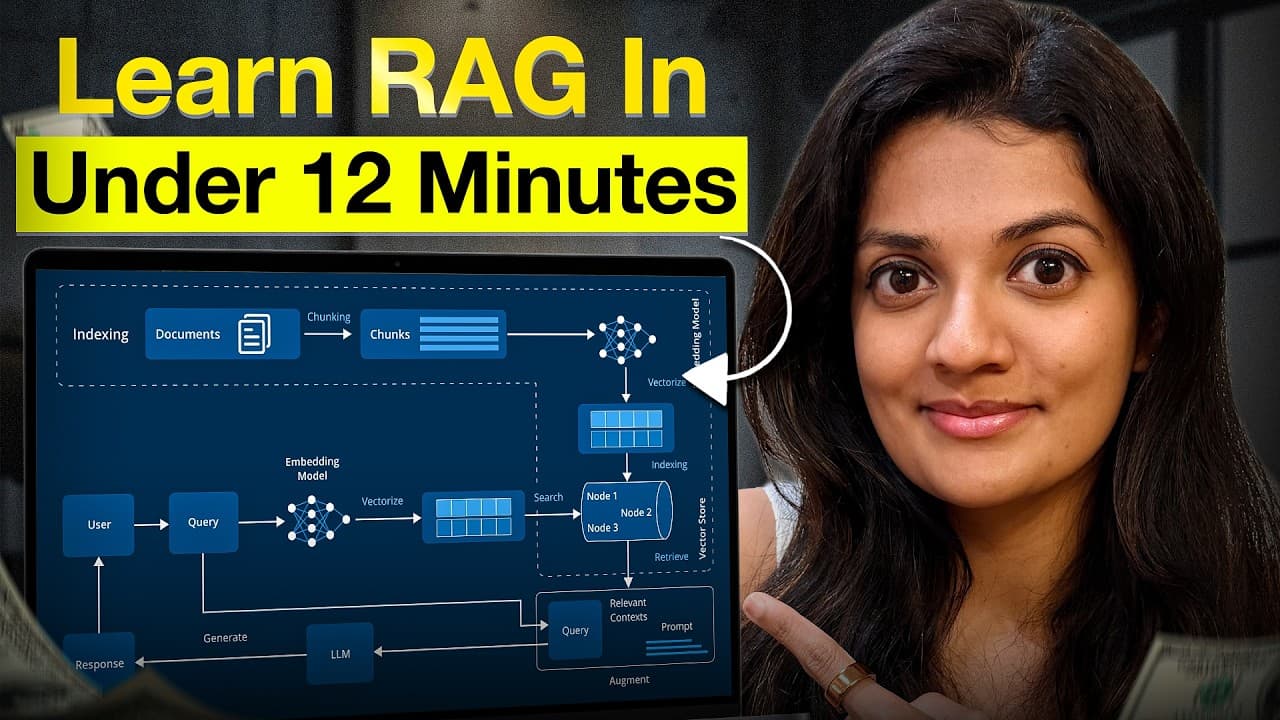
The key components of RAG architecture include document chunking, embedding models, and vector databases. Document chunking involves breaking down documents into manageable pieces, with semantic and hierarchical chunking preserving context. Embedding models convert text into numerical vectors for semantic search, while vector databases store these embeddings. These components work together to enable efficient retrieval and generation of contextually relevant responses.
Q: How do embedding models function in RAG?
In RAG, embedding models function by converting text chunks into numerical vectors that represent their semantic meaning. These vectors enable semantic search, allowing the retrieval system to find the most relevant information based on a user's query. Different embedding models may perform better in specific domains, so benchmarking them on domain-specific data is recommended to ensure optimal performance in retrieving relevant information.
Q: What role do vector databases play in RAG?
Vector databases play a critical role in RAG by storing the embeddings generated from document chunks. They facilitate efficient retrieval of relevant information by enabling fast semantic searches based on query embeddings. Key features to consider when choosing a vector database include query latency, support for metadata filtering, and the ability to perform hybrid searches, all of which contribute to the overall effectiveness of the RAG system.
Q: What are some advanced RAG patterns?
Advanced RAG patterns include agentic RAG, graph RAG, and multimodal RAG. Agentic RAG uses AI agents to orchestrate multi-step retrieval and generation processes. Graph RAG builds a knowledge graph to understand relationships between data points, improving response quality for complex queries. Multimodal RAG handles diverse data types, such as images and text, by integrating vision language models, enhancing the system's ability to process and retrieve information from various sources.
Summary & Key Takeaways
-
Retrieval-Augmented Generation (RAG) enhances AI models by allowing them to access external data, improving response accuracy and relevance. It combines a retrieval system to find relevant information and a generation system to create informed responses. RAG is foundational in various enterprise AI applications, debunking myths about its obsolescence.
-
RAG's architecture involves document chunking, embedding models, and vector databases. Semantic and hierarchical chunking help preserve context, while specialized embedding models improve semantic search. Vector databases store these embeddings, with features like query latency and metadata filtering enhancing their effectiveness.
-
Advanced RAG patterns, such as agentic RAG and graph RAG, address complex queries and data relationships. These patterns enhance AI capabilities by allowing models to orchestrate multiple steps, handle multimodal data, and understand relationships between data points, making RAG indispensable for AI development.
Read in Other Languages (beta)
Share This Summary 📚
Summarize YouTube Videos and Get Video Transcripts with 1-Click
Try YouTube Summary with ChatGPT & Claude or YouTube Transcript Generator
Explore More Summaries from Aishwarya Srinivasan 📚




Summarize YouTube Videos and Get Video Transcripts with 1-Click
Try YouTube Summary with ChatGPT & Claude or YouTube Transcript Generator