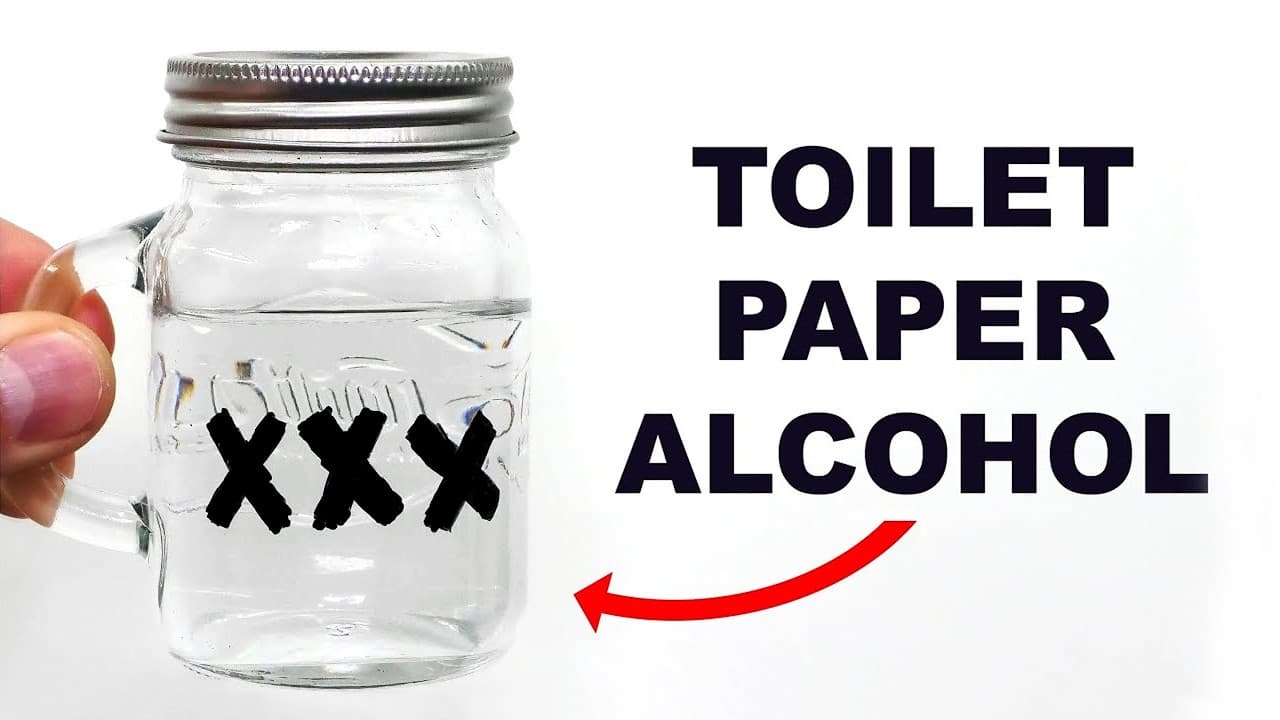
How to Make Alcohol from Toilet Paper: An Experiment
TL;DR
You can make alcohol from toilet paper by breaking down its cellulose into glucose using an enzyme called cellulase, then fermenting the glucose with yeast. The process involves treating the toilet paper in a dilute base, cooking it, adding the enzyme, and finally distilling the resulting mixture to purify the alcohol. The experiment yielded a surprising concentration of 64% ethanol.
Transcript
So for this video, I'm gonna be doing exactly what the title says, and I'm gonna be turning toilet paper, into drinkable alcohol. I don't know exactly where this idea came from, but about six months ago, I became convinced that this conversion was possible. This is because toilet paper, and well pretty much all paper, is made almost entir... Read More
Key Insights
- 🏮 Toilet paper, as well as most paper and wood, is primarily composed of cellulose, a chain of glucose sugar molecules.
- 🍳 Cellulose can be broken down into glucose through enzymatic or chemical methods.
- ❓ Yeast can ferment glucose into alcohol, which can then be purified through distillation.
- 🍳 The enzymatic method chosen in this experiment was effective in breaking down the cellulose and producing a solution of glucose for fermentation.
- ✋ The final yield of alcohol exceeded expectations, with a relatively high concentration of ethanol achieved.
- 👅 The taste and quality of the resulting alcohol were comparable to generic alcohol products.
- 🧻 The experiment highlights the potential for using unconventional sources, such as toilet paper, to produce drinkable alcohol.
Install to Summarize YouTube Videos and Get Transcripts
Explore YouTube Video Summarizer or Get YouTube Transcript Extractor
Questions & Answers
Q: What is cellulose, and why does it need to be broken down into glucose?
Cellulose is a complex carbohydrate found in plant cell walls, and breaking it down into glucose is necessary because yeast can only ferment glucose into alcohol.
Q: Why did the creator choose the enzymatic method over the chemical method for breaking down cellulose?
The creator chose the enzymatic method because it was cleaner and easier to set up, despite being less efficient and taking longer than the chemical method.
Q: What were the challenges faced during the distillation process?
The distillation process caused foaming and splattering, leading to some loss of the alcohol solution. Additionally, the heads and tails sections contained other volatile compounds that affected the taste.
Q: What was the overall yield and efficiency of the experiment?
The experiment yielded approximately 50 mL of pure ethanol from 100 g of toilet paper, resulting in an efficiency of around 75-83%.
Summary & Key Takeaways
-
The creator sets out to turn toilet paper, composed mostly of cellulose, into a solution of glucose that can be fermented into alcohol.
-
Achieving this requires treating the cellulose with a dilute base, cooking it, and adding an enzyme solution called cellulase to break down the cellulose into glucose.
-
The glucose solution is then fermented with brewer's yeast to produce alcohol, followed by distillation for purification.
Read in Other Languages (beta)
Share This Summary 📚
Summarize YouTube Videos and Get Video Transcripts with 1-Click
Try YouTube Summary with ChatGPT & Claude or YouTube Transcript Generator
Explore More Summaries from NileRed 📚
Summarize YouTube Videos and Get Video Transcripts with 1-Click
Try YouTube Summary with ChatGPT & Claude or YouTube Transcript Generator