What Are Shade Balls and Why Are They Used in Reservoirs?
TL;DR
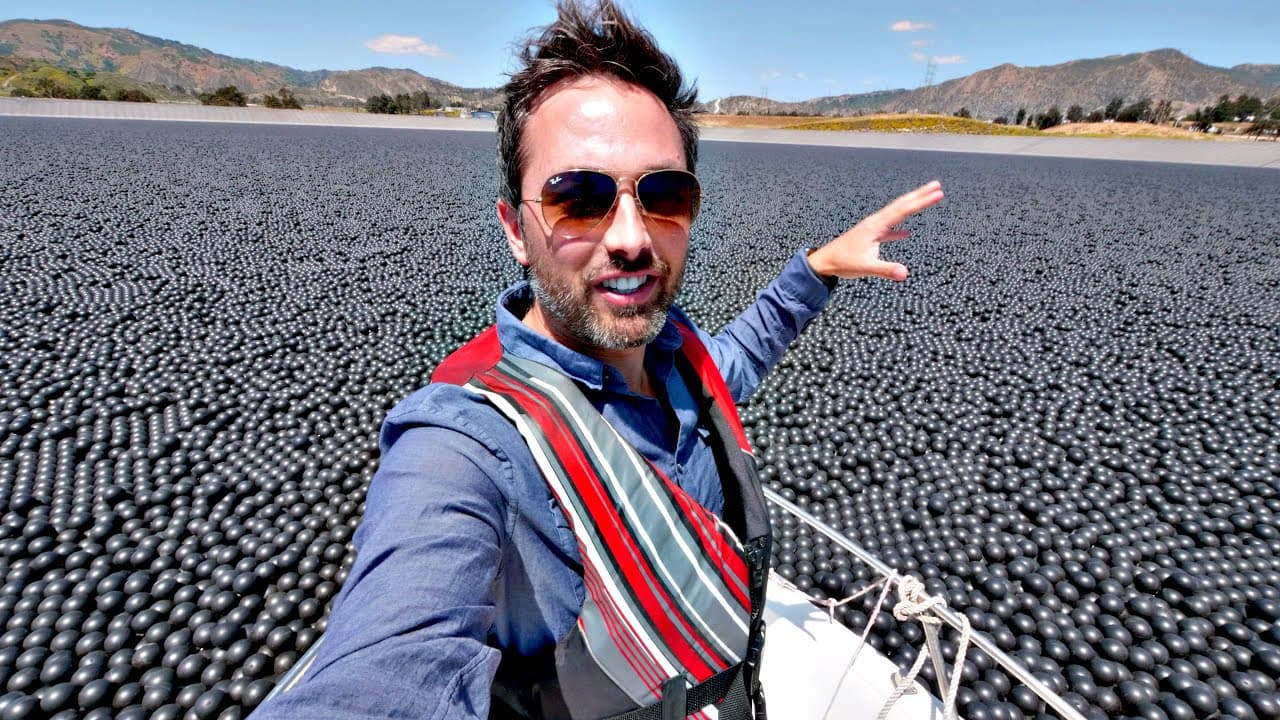
Shade balls are black plastic spheres used in water reservoirs to block sunlight and prevent the formation of Bromate, a carcinogenic substance. Made from food-grade high-density polyethylene, they also reduce evaporation by 80-90% and control algae growth, which improves water quality and results in cost savings.
Transcript
(shade balls rolling) - These are shade balls. They're being dumped into this water reservoir in Los Angeles. And contrary to what you may have heard, their main purpose is not to reduce evaporation. So what are they really for? To find out, I'm visiting the largest collection of these balls anywhere on earth, What? at LA Reservoir. (tranquil music... Read More
Key Insights
- 💦 Shade balls were initially developed to deter birds and wildlife from sitting on polluted water bodies.
- 🥺 The need to reduce Bromate formation in the water led to the discovery of shade balls' effectiveness in blocking sunlight.
- 💬 Shade balls have multiple benefits, including preventing Bromate formation, reducing evaporation, and controlling algae growth.
- 😎 Despite their black color, shade balls stay cool due to their insulating properties.
- 😒 The cost of shade balls is offset by savings in chemical use and reduced evaporation.
- 💠 The shape of the shade balls prevents them from stacking up or perching on the sides of the reservoir.
- 💬 Recyclable materials are used to manufacture shade balls, making them environmentally friendly.
Install to Summarize YouTube Videos and Get Transcripts
Explore YouTube Video Summarizer or Get YouTube Transcript Extractor
Questions & Answers
Q: How do shade balls prevent the formation of Bromate?
Shade balls are black to block all light from reaching the water, preventing the reaction of Bromide and Chlorine to form Bromate. The black color of the shade balls is achieved by adding carbon black to the high-density polyethylene material.
Q: Do shade balls affect the temperature of the water?
While shade balls absorb more energy and get hotter on top, the bottom of the balls stays cool. The air-filled balls act as thermal insulators, preventing much of the heat from transferring to the water. In fact, it has been measured that the areas under the shade balls are cooler than the areas without shade balls.
Q: How much do shade balls cost?
Shade balls cost around 3 for $1, with each ball priced at approximately 33 to 34 cents. Over their lifespan, the cost of the shade balls is significantly offset by savings in chlorination and reduced evaporation.
Q: Can shade balls be recycled?
Yes, shade balls are made from recyclable materials, so they have salvage value. When the time comes to remove them, they can be recycled.
Summary & Key Takeaways
-
Shade balls are used in water reservoirs to prevent the formation of Bromate, a carcinogenic substance that forms when Bromide and Chlorine react to sunlight.
-
The shade balls are made from high-density polyethylene and contain carbon black to block all light from reaching the water.
-
They not only prevent Bromate formation but also reduce evaporation and algae growth, resulting in cost savings and improved water quality.
Read in Other Languages (beta)
Share This Summary 📚
Summarize YouTube Videos and Get Video Transcripts with 1-Click
Try YouTube Summary with ChatGPT & Claude or YouTube Transcript Generator
Explore More Summaries from Veritasium 📚




Summarize YouTube Videos and Get Video Transcripts with 1-Click
Try YouTube Summary with ChatGPT & Claude or YouTube Transcript Generator