How to build an AI content generator in Make.com
TL;DR
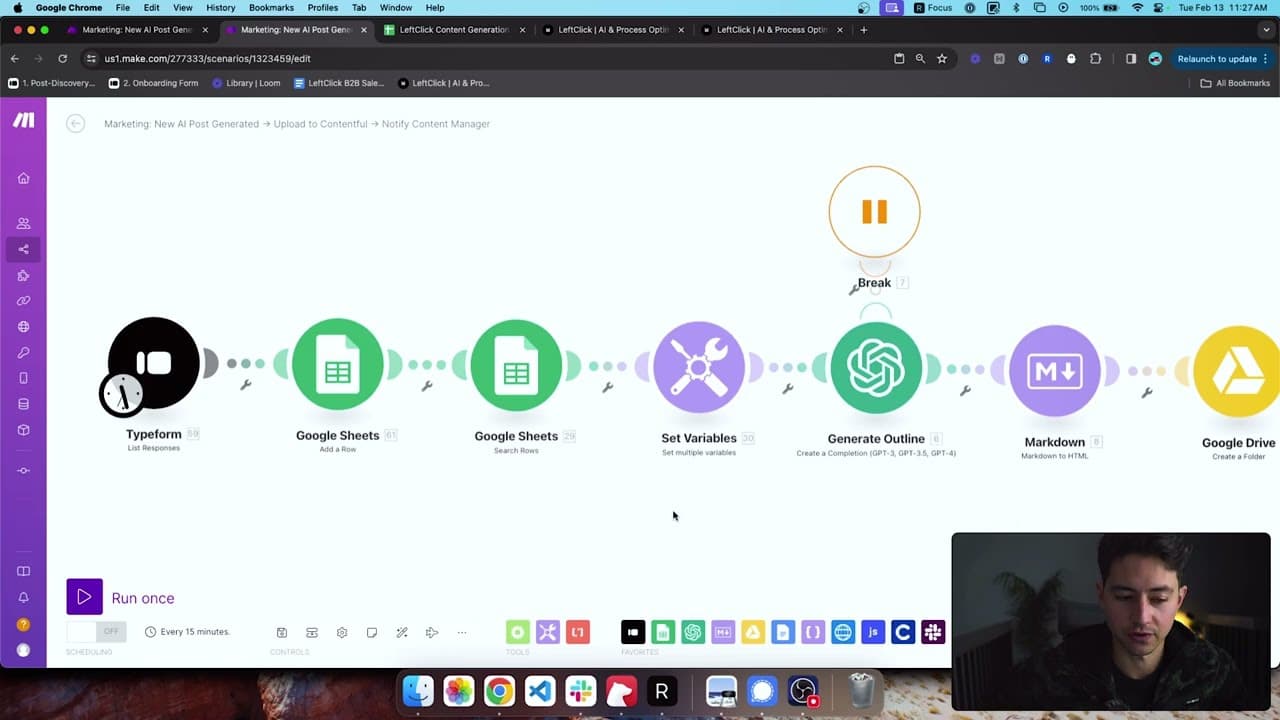
You can cut the cost of producing articles from about $50–$100 per piece to 10–20 cents by automating AI content in Make.com. The system uses Google Sheets as the data hub, a type form for input, and a GPT-4 based workflow to generate and format content, then outputs to Google Docs. This setup scales by iterating content sections and assembling the final piece automatically.
Transcript
hello everybody in this video I'm going to show you an end to-end content generation system in make.com that leverages AI using the open AI endpoint to produce super high quality articles at scale I've implemented the same system in a variety of seven and eight figure companies and it basically takes the cost of producing content down from usually ... Read More
Key Insights
- AI content generation in Make.com dramatically lowers piece-by-piece costs from 50 to 100 dollars to about 0.20 dollars per piece.
- The system uses Google Sheets as the single source of truth to manage titles, word counts, keywords, and links for SEO.
- An iterator module drives content generation section by section, enabling scalable assembly of full articles.
- A GPT-4 based prompt workflow formats output in Markdown to maintain structure for later transformation into blog-ready documents.
- Typeform and Google Sheets work together to capture inputs and populate the content pipeline efficiently.
- Internal and external links are optional but are prepared in advance to support SEO and navigation within the article.
- The design emphasizes maintainability and testability by splitting data handling into multiple modules and using a variables stage for testing.
- The final content is exported to a Google Doc, enabling easy publishing and review while preserving document structure.
- More videos from this channel:
- More from this channel: Nick Saraev
Install to Summarize YouTube Videos and Get Transcripts
Explore YouTube Video Summarizer or Get YouTube Transcript Extractor
Questions & Answers
Q: What is the main cost benefit of the Make.com AI content generator in the video?
The main cost benefit is reducing content production from typical costs of 50 to 100 dollars per piece down to about 0.20 dollars in tokens. This is achieved by automating the article creation process using an AI endpoint within Make.com, alongside a data pipeline that feeds structured inputs into a GPT-4 prompt. The system is designed to scale across many articles while maintaining quality.
Q: How does the workflow start the content generation process?
The workflow starts with a Typeform submission that captures the article title, word count, primary and secondary keywords, and optional internal and external links. This data is then pushed into a Google Sheet, which serves as the single source of truth. The Make.com automation reads from this sheet to drive the rest of the pipeline and prepare JSON for the AI model.
Q: What role does the Google Sheet play in the system?
The Google Sheet acts as the single source of truth for all article data. It stores fields like title, word count, primary keyword, secondary keywords, internal links, external links, and additional instructions. The sheet's data is parsed into JSON and fed into the OpenAI GPT-4 prompt, enabling structured and repeatable content generation.
Q: What is the ‘iterator module’ used for in the Make.com flow?
The iterator module in the Make.com flow is used to generate content in sections, processing the article piece by piece rather than all at once. This modular approach allows the system to assemble a complete article incrementally, improving manageability and enabling fine-grained control over content generation, before the final output is published to Google Docs.
Q: How is the content formatted for AI generation and later use?
Content is formatted using a JSON structure derived from the Google Sheet data, including fields like title, word count, keywords, and links. The GPT-4 system prompt then instructs the model to output in Markdown format with clear headings and sections, making it easy to convert into a Google Doc later for publishing.
Q: What output format is used for the final article before publishing?
The final article is produced in a Google Doc format, created after the GPT-4 content generation. The Markdown-structured output is designed to be consumed by the AI to create a well-formatted document, which is then exported to Google Docs for easy publishing and review by the content team.
Q: Why is the system designed with multiple modules and testing variables?
Multiple modules and testing variables make the system more maintainable and testable. Splitting data handling into separate steps allows for flexible testing, easy swapping of inputs, and clearer debugging. This design choice supports frequent updates and experimentation while keeping the workflow robust for daily use.
Q: What is described as the secret sauce of the pipeline?
The secret sauce is the combination of iterating content in sections and using a GPT-4 prompt to structure the output as Markdown. This approach preserves document structure, enhances readability, and facilitates downstream editing and publishing, enabling scalable, high-quality content production at a fraction of traditional costs.
Summary & Key Takeaways
-
This summary describes a fully automated AI content generator built in Make.com that converts input data into high quality articles. It uses a Google Sheet as the single source of truth, combined with typeform data and an OpenAI endpoint to produce content. The output is formatted in a Google Doc for blog publication.
-
The system reduces costs by replacing expensive manual content creation with an AI-driven pipeline. It iterates content sections, constructs a complete article, and stores metadata like word count and keywords for SEO. The architecture emphasizes maintainability and testability for scalable content production.
-
The video walks through the flow from form entry to Google Sheet updates, then to AI generation and final document creation. It highlights the secret sauce: iterating content piece by piece and exporting to a document. This enables high-volume production at a fraction of traditional costs.
Read in Other Languages (beta)
Share This Summary 📚
Summarize YouTube Videos and Get Video Transcripts with 1-Click
Try YouTube Summary with ChatGPT & Claude or YouTube Transcript Generator
Explore More Summaries from Nick Saraev 📚






Summarize YouTube Videos and Get Video Transcripts with 1-Click
Try YouTube Summary with ChatGPT & Claude or YouTube Transcript Generator