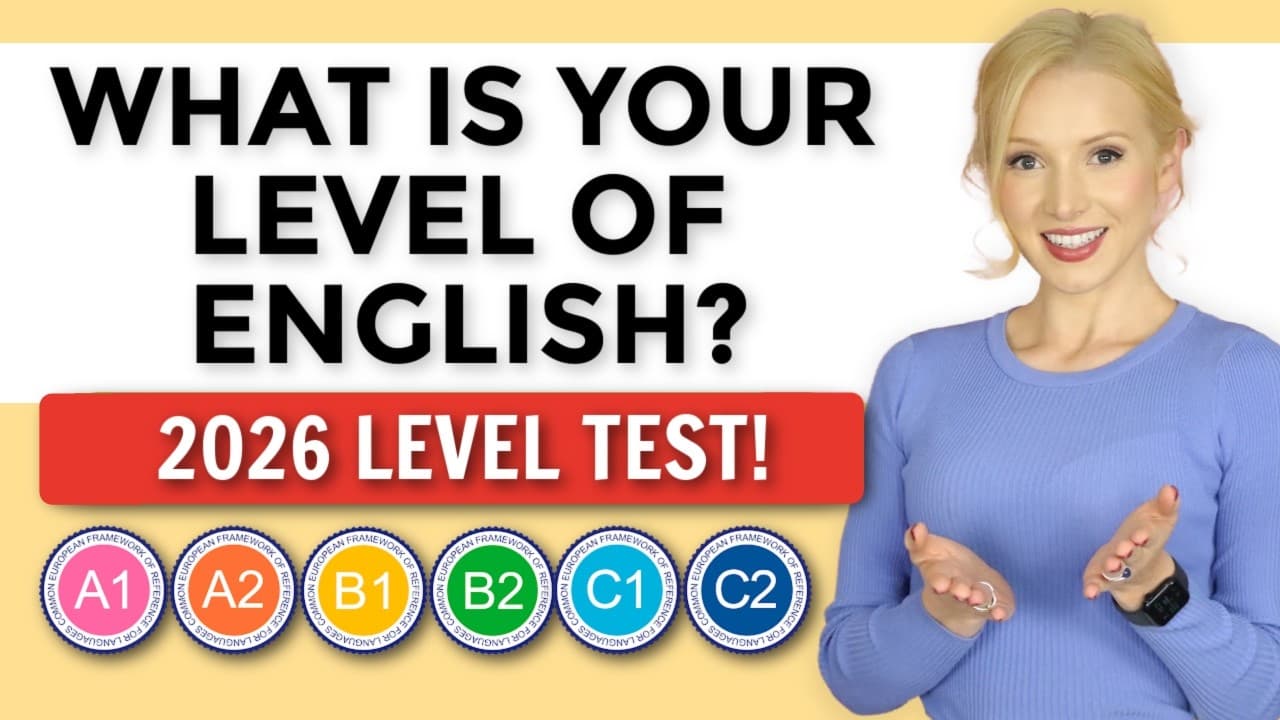
How to Test Your English Level from A1 to C2
TL;DR
Answer 30 multiple-choice questions, record each correct response, and use the section totals to estimate your English level from A1 to C2. The test focuses mainly on grammar and vocabulary, progressing from basic question forms and present-simple rules to perfect tenses, conditionals, passive constructions, phrasal verbs, precise word choice, and gerund patterns.
Transcript
Today we are going to finally find out what your level of English is in 2026. A1, A2, B1, B2, or even C1 or C2, the maximum level of English. Here is how it's going to work. I will ask you 30 questions starting at A1 and moving all the way up to English proficiency at C2. Just keep track of your score as we go and by the end of this lesson you will... Read More
Key Insights
- A1 grammar requires accurate subject and verb agreement. “She has two cats” is correct because third-person singular subjects take “has,” while possession is normally expressed with a simple tense rather than the continuous form “she’s having.”
- Question words have distinct grammatical roles. “What is your name?” asks for information, while “who” refers to a person and “whom” is a formal object form that does not fit the sentence used in the test.
- Adverbs of frequency usually appear before the main verb. “I often go to the gym” is the most natural option, although placing “often” at the beginning can be grammatically possible while sounding less common in everyday speech.
- Present perfect constructions distinguish starting points from durations. “Since” identifies when an action began, as in “since January,” while “for” introduces a period of time, such as “for three years.”
- Prohibition is expressed with “mustn’t,” not “don’t have to” or “don’t need to.” The latter expressions indicate that something is unnecessary, while “mustn’t” states that an action is not allowed.
- The passive voice focuses attention on an action or affected object. “Gerald’s phone was stolen” is appropriate because the phone matters more than the thief, and the person who committed the theft is unknown.
- The third conditional describes an unreal past situation and its imagined result. Its structure uses “if” plus the past perfect, followed by “would have” plus a past participle, as in “If I had known, I would have translated.”
- B2 vocabulary depends on precise meaning and natural combinations. “Conduct a survey,” “economical choice,” and “held us up” respectively describe carrying out research, saving money, and causing a delay in ordinary communication.
Install to Summarize YouTube Videos and Get Transcripts
Explore YouTube Video Summarizer or Get YouTube Transcript Extractor
Questions & Answers
Q: How can I estimate my English level from A1 to C2?
Complete the 30 multiple-choice questions in order, beginning with A1 and progressing toward C2, and keep a record of every correct answer. The assessment mainly measures grammar and vocabulary, so the total provides a clearer idea of your current level rather than a complete measurement of every language skill. Pause when necessary and review each explanation after answering.
Q: What grammar knowledge is tested at the A1 level?
The A1 section tests basic question words, third-person singular verb forms, “there is” with a singular noun, the normal position of frequency adverbs, and present-simple negatives. Examples include “What is your name?”, “She has two cats,” “There is a park,” “I often go,” and “She doesn’t like pizza.”
Q: What score indicates a solid A2 English level?
A total of around eight or more correct answers across the five A1 questions and five A2 questions suggests a solid A2 level. That result indicates comfort with the basics and readiness to continue progressing. The lesson still recommends taking the free full online assessment because it covers all levels and can provide a clearer overall picture.
Q: When should I use “for” instead of “since” in English?
Use “for” with a period of time or duration, such as “for three years” or “for two months.” Use “since” with the starting point of an action or state, such as “since January.” Both commonly appear with perfect tenses when something began in the past and remains true or continues in the present.
Q: What is the difference between “mustn’t” and “don’t have to”?
“Mustn’t” means that an action is prohibited or not allowed, as in “You mustn’t park here.” “Don’t have to” and “don’t need to” express a lack of necessity instead. They do not communicate a ban. Choosing the correct form therefore depends on whether the sentence describes prohibition or merely says an action is optional.
Q: How does the third conditional work in English?
The third conditional describes an imaginary past situation that did not occur and an imagined consequence. Its structure is “if” plus the past perfect, followed by “would have” plus a past participle. For example, “If I had known you needed help, I would have translated the document” means the person did not know and therefore did not translate it.
Q: What is the difference between “economic” and “economical”?
“Economical” describes something cost-effective or efficient with money, so buying in bulk can be more economical than buying individual items. “Economic” relates to the economy or to economics as a field, as in economic policy. The distinction matters because an economical decision saves money, while an economic issue concerns the wider economy.
Q: Why does “suggest” take a gerund in the B2 question?
“Suggest” is followed by an “-ing” form rather than an infinitive in the tested construction. The correct sentence is “She suggested extending the deadline rather than cancelling the project entirely.” Both verbs use gerunds because “rather than” creates a parallel structure, so the grammatical form after it should match the form used before it.
Summary & Key Takeaways
-
The assessment begins at A1 with foundational grammar and word order. Questions cover choosing “what” for names, using “has” with third-person singular subjects, matching “there is” with a singular noun, positioning frequency adverbs before main verbs, and forming present-simple negatives with “doesn’t” for he, she, or it.
-
The A2 and B1 sections introduce duration with “for,” comparative adjectives, result clauses with “so,” prohibition with “mustn’t,” and feeling adjectives ending in “-ed.” They then test the present perfect continuous, practical vocabulary, passive voice, restaurant reservations, and the third conditional for unreal past situations.
-
The B2 section emphasizes natural and precise English. It tests “hold up” for delays, the distinction between “economic” and “economical,” the collocation “conduct a survey,” the subtle difference between “during” and “throughout,” and parallel gerund forms after “suggest” and “rather than.” Scores provide an approximate level indication.
Read in Other Languages (beta)
Share This Summary 📚
Summarize YouTube Videos and Get Video Transcripts with 1-Click
Try YouTube Summary with ChatGPT & Claude or YouTube Transcript Generator
Explore More Summaries from English with Lucy 📚


Summarize YouTube Videos and Get Video Transcripts with 1-Click
Try YouTube Summary with ChatGPT & Claude or YouTube Transcript Generator